
Speaker profile
Max Gosney
Max’s aviation journey began in 2016 when he put on a hi-vis jacket and safety boots and went out on the ramp as part of his induction as Chairman of...
The aviation industry has always demanded resilience.
From early starts and overnight operations to complex airport environments and safety-critical decision making, aviation professionals operate under constant pressure.
Today, however, those pressures have intensified.
Following the pandemic, organisations across the aviation ecosystem are rebuilding workforces, introducing new technologies and managing increasingly complex operations with less experienced teams. Against that backdrop, mental wellbeing has become far more than an employee benefit—it has become an operational priority.
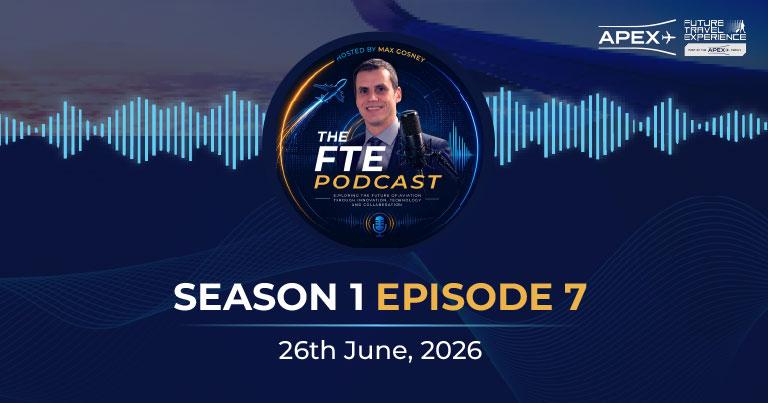
In this episode of the Future Travel Experience (FTE) Podcast, proudly part of the APEX family, host Max Gosney is joined by Andy & Kirsty Dobson, founders of Clarity&, to explore why supporting people is becoming one of the aviation industry’s greatest competitive advantages.
Drawing on professional expertise and personal experience, they explain how psychological safety, human factors and kindness directly influence safety, employee retention, innovation and business performance.
Although aviation has always been a demanding industry, today’s operational environment presents new challenges.
Andy explains how many organisations are now operating with:
Ground handling organisations, airlines and airports are all balancing increasing operational demands while rebuilding teams that often have significantly less collective experience than before COVID.
The discussion highlights how these changing workforce dynamics make investment in people more important than ever.
One of the key themes throughout the conversation is that human factors and mental wellbeing should never be viewed in isolation.
When people operate under prolonged pressure, fatigue and stress begin affecting how the brain processes information.
This can reduce:
Rather than focusing solely on individual mistakes, Andy and Kirsty explain why organisations should examine the wider operational systems that influence human behaviour.
That systems-thinking approach is fundamental to building stronger safety cultures.
The conversation explores why psychological safety has become one of the strongest indicators of organisational performance.
When employees feel safe to speak openly they are far more likely to:
By contrast, environments where employees fear criticism or blame often experience hidden operational risks, lower engagement and reduced innovation.
Psychological safety, therefore, isn’t simply a wellbeing initiative—it directly impacts operational excellence.
Kirsty introduces the concept of operating in either the Red Zone or the Blue Zone.
During periods of high stress, the body’s natural threat response narrows attention, increases cortisol and adrenaline, and reduces cognitive performance.
This can lead to:
Conversely, operating in the Blue Zone enables people to remain calmer, think more clearly and make better decisions even during high-pressure situations.
Importantly, the episode shares practical techniques that aviation professionals can use immediately, including breathing exercises, widening visual awareness and taking short cognitive recovery breaks throughout the day.
One of the strongest messages from the episode is that rest should never be mistaken for laziness.
Andy and Kirsty explain that genuine cognitive recovery allows the brain to recharge, improve problem solving and perform more effectively.
Whether it’s taking a short walk, stepping away from a screen, listening to music or simply taking a few minutes to reset, these small moments can significantly improve performance throughout the working day.
For organisations operating around the clock, recognising the value of cognitive recovery may become an increasingly important part of workforce management.
Artificial Intelligence is transforming aviation at an unprecedented pace.
While Andy and Kirsty strongly support technological innovation, they also discuss the importance of ensuring technology complements people rather than replacing them.
The conversation explores how increasing reliance on AI may affect:
Rather than viewing AI as a replacement for employees, they encourage organisations to involve their workforce in technology adoption so automation becomes a tool that supports human performance.
Perhaps the most thought-provoking section of the discussion focuses on kindness.
Often dismissed as a “soft skill”, kindness is increasingly supported by research as an important driver of organisational performance.
Andy and Kirsty explain how empathetic leadership and supportive workplace cultures contribute to:
Far from reducing accountability, kindness helps create environments where people perform at their very best.
Throughout the episode, Andy and Kirsty encourage leaders to demonstrate openness and vulnerability.
By sharing their own challenges, admitting mistakes and creating environments where employees feel comfortable speaking up, leaders can build trust throughout their organisations.
That trust becomes the foundation for stronger safety cultures, greater innovation and healthier teams.
Supporting people is no longer simply a wellbeing initiative.
It is a business strategy.
As aviation embraces AI, automation and increasingly complex operations, organisations that invest in human performance will be better positioned to improve safety, retain talent, strengthen innovation and deliver better passenger experiences.
This episode provides valuable insights for leaders across airlines, airports, ground handling companies, technology providers and the wider aviation ecosystem.
Whether your focus is operational excellence, workforce resilience or future innovation, Andy and Kirsty offer practical advice that every aviation executive should hear.
Subscribe to the Future Travel Experience Podcast for more conversations with the innovators, leaders and technology pioneers shaping the future of aviation.
Discover more episodes featuring airlines, airports, technology providers and industry experts exploring the trends transforming passenger experience, airport operations and the future of air transport.
Max’s aviation journey began in 2016 when he put on a hi-vis jacket and safety boots and went out on the ramp as part of his induction as Chairman of...


Discover related episodes connected by topic or season.
How do you transform baggage handling at one of the world’s busiest and most space-constrained airports? Heathrow’s Jamie Ratcliffe joins the APEX FTE Podcast to explore “relentless productivity”,...
United Airlines’ Dominic Green joins the APEX FTE Podcast to reveal how seatback entertainment, Starlink connectivity, streaming and personalisation are coming together to create a new generation of...
Unit Load Devices are among aviation’s most important yet overlooked assets. In this episode, Unilode COO Janis Balkens explores how live tracking, IoT sensors, lightweight materials, automation, robotics...
Get Future Travel Experience news & updates sent to your inbox