




Summary:
- Munich Airport prepares for the 13 April 2026 opening of its new Terminal 1 Pier, a major infrastructure milestone adding capacity for up to six million passengers annually and strengthening non-Schengen operations.
- The 95,000sqm pier sets new standards in passenger experience and efficiency, featuring centralised security with CT technology, premium retail and dining, relaxation zones, energy-efficient systems, and the ability to handle wide-body aircraft.
- Extensive trial operations validate readiness for live operations, including testing of future passenger processes, the EU Entry Exit System, and end-to-end handling under realistic conditions to ensure stable, high-quality performance from day one.
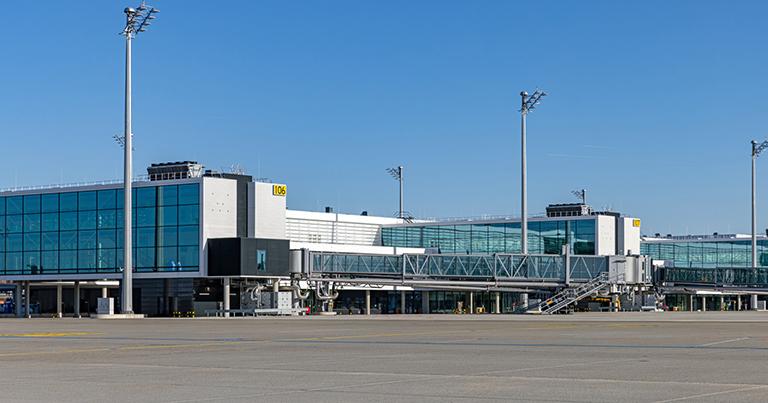
Munich Airport is preparing for the opening of its new Terminal 1 Pier on 13 April 2026, setting another milestone in the further development of its infrastructure.
“With our new pier, we are making a targeted investment in the future viability of our airport,” said Munich Airport CEO Jost Lammers. “The pier not only strengthens our capacities, but also sets new standards in quality, efficiency, and passenger comfort – especially for non-Schengen traffic. The pier is a central element of our long-term infrastructure strategy.”
The Terminal 1 Pier provides additional capacity for up to six million passengers per year. The new building is currently one of Bavaria’s largest infrastructure projects. It extends over a length of around 360m into the west apron and covers a total area of around 95,000sqm, including an area in the current Arrivals Module B of Terminal 1. The new pier can handle up to 12 short- and medium-haul aircraft or, alternatively, six wide-body aircraft at the same time. Advanced handling areas are available on a total of six levels, three of which are dedicated to passenger processes. These include centralised security checks with state-of-the-art CT technology, comfortable waiting areas, attractive commercial spaces for retail and dining, and specially designed relaxation and recreation zones. The use of energy-efficient facility and system technology underscores the airport’s high standards of sustainability and future viability.
The new T1 Pier will also feature two exclusive lounges. One of these is the new Airport Lounge World, which offers spectacular views of the apron and even the Alpine mountains thanks to its location in the southwest of the building. The approximately 1,200sqm lounge is operated by Munich Airport. It extends over two floors and provides a wide range of culinary options, a gallery level with a bar, a children’s play area, workspaces, and resting areas. The second lounge is operated by Emirates, where guests can shorten their waiting time until departure in an area of approximately 900sqm.
“The new Terminal 1 Pier at Munich Airport stands for a premium expansion of our five-star airport and for Bavaria as an attractive, future-oriented business region,” said Albert Füracker, Bavarian Minister of Finance and Chairman of the Supervisory Board of Munich Airport. “Financed entirely from our own resources, the upcoming opening crowns the completion of a huge location project. With state-of-the-art technology and generous spaces, the new pier offers mobility, comfort, and sustainability at the highest level.”
Since October, an extensive trial operation phase has been running along with the final construction work and preparations for full operation. This trial operation phase has provided important insights for the start of operations. The trial operation took place under realistic conditions and involved over 1,500 test passengers over the course of several months. Future processes were thoroughly tested, and the operational organisation was prepared for regular operations. The interim conclusion is overall positive: the infrastructure and processes ensure stable, high-quality passenger handling, while specific areas for optimisation were also identified.
Further test runs are planned before the opening, particularly to prepare for the arrival process. The Entry Exit System for non-Schengen passengers, which the EU introduced at the end of last year, also plays a key role in testing procedures under realistic conditions at an early stage.
You may also be interested in
12 technology and CX trends that can enhance airline and airport operations in 2026