





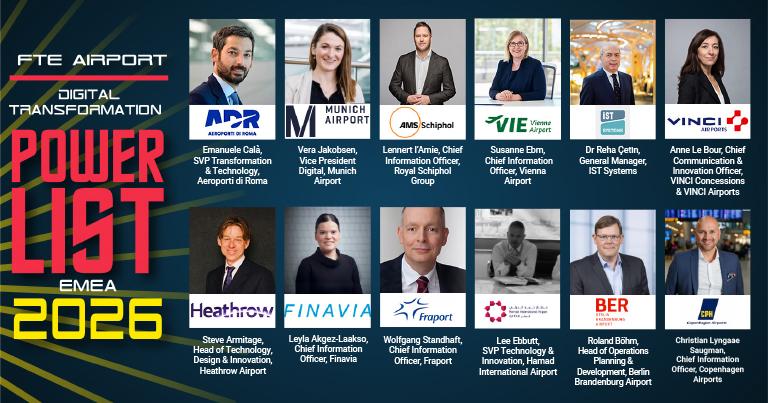

Future Travel Experience is excited to unveil the FTE Airport Digital Transformation Power List EMEA 2026. Here we shine a light on those who are pioneering new approaches that have the potential to improve travel for passengers and make the industry safer, more efficient and commercially successful. The EMEA edition champions the most transformative change enablers within the airport industry in Europe, the Middle East and Africa for their outstanding efforts to lead how their organisation has embraced digital innovation. In 2026, FTE is more committed than ever to supporting digital transformation efforts in the industry through the FTE Digital, Innovation & Startup Hub, which is a truly unique community designed specifically for the individuals and organisations who are at the forefront of digital transformation and innovation in aviation. The FTE Hub is focusing on three key themes this year – Artificial Intelligence (AI), Robotics, and Internet of Things (IoT) – and in alignment with that, the Power List recognises those that are leading key digital transformation efforts. In recognition of their leadership and achievements, each member of the Power List will receive a complimentary “Golden Ticket” to the co-located APEX FTE EMEA and APEX FTE Ancillary & Retailing events, taking place in Dublin on 9-11 June 2026. After extensive research into each candidate, we believe the following 12 executives have been at the forefront of innovation, driving transformational change for their organisations and the wider industry. You can view the FTE Airline Digital Transformation Power List EMEA 2026 by clicking here.
Register for the co-located APEX FTE EMEA and APEX FTE Ancillary & Retailing events – free for airlines, low-cost for airports >>
Emanuele Calà, SVP Transformation & Technology, Aeroporti di Roma
Emanuele Calà is the driving force behind Aeroporti di Roma’s (ADR) innovation journey – a Corporate Partner of the FTE Digital, Innovation & Startup Hub – shaping Fiumicino Airport as a global testbed for transformative technologies. As SVP Transformation & Technology and Managing Director of ADR Ventures, Calà leads the company’s Innovation Hub, where a multidisciplinary team of 30 ‘Innovation Cabin Crew’ mentors startups and drives internal innovation across the airport ecosystem.
Under Calà’s leadership, ADR has launched the ‘Runway to the Future’ acceleration programme, attracting over 1,000 startups globally. ADR Ventures complements this by providing both financing and know-how, enabling startups to scale solutions that improve airport operations, passenger experience, and sustainability. Collaboration is a key pillar: ADR co-founded the ‘Airports for Innovation’ network, connecting 10 leading airports worldwide to test and implement cutting-edge solutions in parallel, while also partnering with the Lufthansa Innovation Hub to share best practices and insights.
Artificial intelligence (AI), robotics, automation, and the Internet of Things (IoT) are central to ADR’s strategy. AI-powered platforms now provide real-time monitoring of aircraft movements, passenger flows, and airside operations, shifting processes from reactive to predictive. Innovative initiatives include AI copilots supporting Procurement and HR, AI-driven baggage handling with Azalea Robotics, and autonomous cleaning robots trained via Virtual Reality. Passenger-facing AI solutions, including chatbots and integrated service platforms, enable personalised, seamless interactions throughout the journey.
Safety and operational resilience remain priorities. ADR has tested optical systems for Foreign Object Debris detection, real-time construction monitoring, and predictive weather analytics, all powered by AI, improving efficiency and risk management. Across the airport, AI integrates fragmented operations into a unified, continuously learning ecosystem, supporting faster, smarter decision-making while amplifying human expertise.
With the launch of the fourth edition of the Call4Startups programme, over 400 startups will co-develop solutions in areas from AI and automation to robotics and active noise reduction, working alongside ADR’s Innovation Cabin Crew within real operational environments. This programme confirms ADR’s commitment to transform Fiumicino into a true smart city, where innovation, experimentation, and collaboration enhance operations, sustainability, and passenger experience.
For his role in positioning ADR at the forefront of airport digital transformation, fostering open innovation, and embedding AI and emerging technologies across operations and passenger services, Emanuele Calà is recognised on the FTE Airport Digital Transformation Power List EMEA 2026.
Hear more from Aeroporti di Roma at the co-located APEX FTE EMEA and APEX FTE Ancillary & Retailing events, taking place in Dublin on 9-11 June 2026. Emanuele Calà, SVP Transformation & Technology, Aeroporti di Roma, is participating in a session focused on ‘When technology becomes a teammate: Embracing human/tech collaboration to optimise operational efficiency across the organisation’.
Vera Jakobsen, Vice President Digital, Munich Airport

Vera Jakobsen, Vice President Digital at Munich Airport – a Corporate Partner of the FTE Digital, Innovation & Startup Hub – plays a central role in driving the airport’s digital transformation. Jakobsen leads a team of experts across digital/AI strategy; digital ecosystem management; digital product and channel management; innovation management; data, processes and process mining; and data-driven marketing. She is responsible for establishing cross-functional digital projects and collaborations, as well as for steering Munich Airport’s digital community.
Munich Airport is focused on leveraging innovation, robotics, automation, and autonomous vehicles to improve operational efficiency, enhance passenger experience, and solidify its position as a premium innovation hub.
Munich Airport has deployed service robotics such as JEEVES, a self-driving robot providing snacks and beverages, and Ottobot, an autonomous assistant supporting passengers with information, rebooking, and refunds. In partnership with Fraunhofer IML – a Corporate Partner of the FTE Digital, Innovation & Startup Hub and Partner of the FTE Baggage Innovation Working Group – the airport is pioneering projects like BagBOT and evoBOT, advanced robots designed for aircraft loading/unloading, handling hazardous goods, and supporting heavy lifting operations. Munich Airport is also exploring artificial intelligence (AI) and generative AI applications in travel retail, passenger engagement, and process optimisation.
Munich Airport champions collaborative innovation, exemplified by its participation in both the Airports for Innovation network and the FTE Smart Ramp initiative. Smart Ramp explores how robotics, automation, and autonomous vehicles can transform aircraft turnaround processes. Similarly, the Next Best Process project integrates process mining, AI, and strategic airport development to improve operational speed and efficiency at Munich’s hub. The MUC2030 joint innovation roadmap and Loyalty Hub partnership with Lufthansa and Miles & More illustrate Munich Airport’s dedication to coordinated innovation, combining data sharing, AI, and digital services to deliver timely, personalised offers and smarter passenger services.
Munich Airport also operates LabCampus, a cross-industry innovation centre bringing startups, research institutions, and established companies together. LabCampus serves as a real-world testbed for developing and scaling digital services, smart infrastructure solutions, and mobility concepts. Through its active engagement in the Airports for Innovation network, Munich Airport fosters global collaboration, enabling startups and technology partners to pilot solutions that enhance operations and passenger experience across multiple hubs.
By integrating advanced robotics, AI-driven automation, and collaborative innovation programmes, Jakobsen ensures Munich Airport remains at the forefront of technological progress. Her leadership demonstrates how combining strategic partnerships, startup engagement, and operational excellence can deliver real-world impact for passengers and the broader aviation ecosystem. As a result, Vera Jakobsen is recognised on the FTE Airport Digital Transformation Power List EMEA 2026 for her pivotal role in driving Munich Airport’s innovation-led digital transformation.
Hear more from Munich Airport at the co-located APEX FTE EMEA and APEX FTE Ancillary & Retailing events, taking place in Dublin on 9-11 June 2026. Dr Jan-Henrik Andersson, Chief Commercial Officer, Munich Airport, is participating in a session focused on ‘Commercial collaboration: embracing innovation and collaboration to create new revenue streams for airlines, airports and their partners’ with the ‘Exclusive launch of the Commercial Collaboration Playbook, delivered by FTE in partnership with Munich Airport and partners’. Meanwhile, Vera Jakobsen, Vice President Digital, Munich Airport, is speaking in a session focused on ‘Making the autonomous ramp a reality: lessons learned, opportunities and challenges’.
Lennert l’Amie, Chief Information Officer, Royal Schiphol Group

Lennert l’Amie is driving Royal Schiphol Group’s digital transformation and innovation agenda, helping realise the airport’s Vision 2050 – a strategy that categorises innovations into Earth (incremental), Moon (transformational), and Mars (disruptive) projects. As Chief Information Officer, l’Amie is spearheading efforts to “aim for the Moon and Mars,” with a long-term plan for fully autonomous airside operations by 2050.
Schiphol – a Corporate Partner of the FTE Digital, Innovation & Startup Hub and a Partner of the FTE Baggage Innovation Working Group – is embracing collaboration across the aviation ecosystem. The airport brings proven solutions developed at Amsterdam Airport Schiphol to market via its Aviation Solutions division and partners with airlines and innovation consortia such as the FTE Smart Ramp programme and BOOST to advance robotics, automation, and autonomous ground operations. A notable example is the deployment of a new electric, self-driving baggage vehicle developed with KLM and Aurrigo International, optimising baggage handling while reducing emissions and improving working conditions for ground crews.
Artificial intelligence (AI), machine learning, robotics, automation, and the Internet of Things (IoT) form the backbone of Schiphol’s operational innovation. AI-powered tools such as Dynamic Time Slots, Real-time Passenger Flow Balancing, and Gate Planning Insights have reduced waiting times, optimised gate assignments, and improved operational predictability and safety. Schiphol’s approach blends real-time data, predictive analytics, and human expertise to create a seamless, scalable airport ecosystem.
Schiphol believes the next frontier is an orchestrated, data-driven airport. Through digital twins, augmented decision-making tools, and AI-enhanced operations, Schiphol aims to integrate people, systems, and processes across the airport to improve efficiency, capacity, and passenger experience. Schiphol has also deployed a private 5G network, enabling real-time, secure operations and providing the infrastructure for autonomous airside logistics.
By combining AI-driven operational tools with collaborative innovation programmes, autonomous systems, and sustainable practices, Schiphol is establishing a benchmark for Europe’s next-generation airports. For his role in shaping this vision and embedding technology across Schiphol’s operations, Lennert l’Amie is recognised on the FTE Airport Digital Transformation Power List EMEA 2026.
Susanne Ebm, Chief Information Officer, Vienna Airport

As Chief Information Officer at Vienna Airport – a Corporate Partner of the FTE Digital, Innovation & Startup Hub – Susanne Ebm is focused on harnessing digitalisation and innovation to enhance both passenger experience and operational efficiency. She continuously explores emerging technologies and solutions that can create meaningful improvements across airport operations.
Vienna Airport is positioning itself as an “innovation hotspot for the digital travel world of the future,” implementing initiatives that combine sustainability, efficiency, and passenger comfort. Current projects include autonomous wheelchairs, artificial intelligence (AI)-based photovoltaic inspection, autonomous cleaning robots, and baggage check-in from home. In partnership with Plug and Play, Vienna Airport is enhancing its digitalisation and innovation capabilities, enabling the identification and development of future-focused digital projects.
The Internet of Things (IoT) underpins Vienna Airport’s digital transformation, providing real-time operational data across the airport. This comprehensive digital visibility supports better resource management, process optimisation, and the effective deployment of AI-driven initiatives include digital twin technology for facility management, automated passenger services, AI-powered baggage and security tools, and autonomous transport robots. These projects not only improve efficiency and passenger experience but also contribute to sustainability goals.
Vienna Airport is also undertaking a €420 million terminal expansion, scheduled for completion in 2027, with a strong emphasis on digital innovation. Digital twin technology is being applied throughout the project to enhance planning, operations, and long-term management of the terminal.
Through her leadership, Susanne Ebm is central to Vienna Airport’s digital transformation strategy, integrating robotics, AI, automation, and smart technologies to drive operational excellence, sustainability, and customer-centric innovation. For her work in leveraging technology to enhance efficiency, passenger experience, and long-term operational performance, Ebm is recognised on the FTE Airport Digital Transformation Power List EMEA 2026.
Dr Reha Çeti̇n, General Manager, IST Systems
Dr Reha Çeti̇n is General Manager of IST Systems, Istanbul Airport’s dedicated IT company, effectively serving as its Chief Information Officer. IST Systems was established as the master systems integrator for the new Istanbul Airport, operating smart building systems and utilising next-generation technologies to drive digital transformation. Under Dr Çeti̇n’s leadership, Istanbul Airport aims to be a pioneer of digital innovation and the world’s most guest-centred hub airport.
Digitalisation and optimisation processes are central to Istanbul Airport’s strategy, enhancing operational efficiency, supporting strategic decision-making, and strengthening partnerships with airlines. Robotic Process Automation (RPA) automates defined tasks, freeing employees for higher-value work, while an extensive Internet of Things (IoT) infrastructure enables real-time monitoring of environmental conditions across technical areas, improving operational control and efficiency.
The Istanbul Airport mobile app delivers services in seven languages, offering real-time flight updates, personalised travel profiles, interactive maps, wayfinding tools, and easy access to retail, dining, and parking. An artificial intelligence (AI)-powered chatbot and corporate WhatsApp line provide immediate assistance, while the AI-driven CiGAWise platform ensures accessible knowledge sharing for airport stakeholders.
Istanbul Airport has also deployed AI-powered digital assistants called ‘Digital Companions’ and an ‘Accessible Companion’ for enhanced accessibility, enabling independent travel for all passengers via mobile app and WhatsApp. Cutting-edge technologies such as machine learning, virtual reality, augmented reality, big data, biometrics, and the Internet of Things are leveraged across operations and retail, providing interactive, personalised, and seamless experiences for travellers.
Through his leadership in integrating digitalisation, AI, automation, and IoT into operational and passenger-focused solutions, Dr Reha Çeti̇n is recognised on the FTE Airport Digital Transformation Power List EMEA 2026 for driving innovation that enhances efficiency, accessibility, and customer experience at Istanbul Airport.
Anne Le Bour, Chief Communication & Innovation Officer, VINCI Concessions & VINCI Airports

Anne Le Bour leads innovation at VINCI Airports – a Corporate Partner of the FTE Digital, Innovation & Startup Hub – shaping the company’s strategy to modernise airport infrastructure and operations across its network of more than 70 airports in 14 countries across Europe, Asia, and the Americas.
Under her leadership, VINCI Airports is driving a comprehensive digital transformation aimed at improving operational efficiency, enhancing passenger experience, and supporting environmental goals. The company’s ‘global integrator’ approach combines airport development, financing, and operation with the implementation of advanced technologies such as artificial intelligence (AI), the Internet of Things (IoT), and biometrics to create a connected, sustainable, and resilient airport ecosystem.
Innovation at VINCI Airports is structured around three Centres of Excellence: London Gatwick focuses on airfield operations and sustainability; Lyon-Saint Exupéry specialises in customer engagement and experience; and Lisbon Airport is dedicated to smart terminal operations and technology. These hubs serve as platforms for experimentation, testing, and scaling solutions across VINCI’s international network.
AI is central to VINCI Airports’ transformation. Generative AI and emerging agentic AI technologies are being deployed to personalise services, streamline interactions, and enhance operational efficiency. In Lyon, a virtual agent powered by agentic AI is improving customer engagement through multilingual, personalised, and seamless interactions. Across the network, AI enables predictive analytics, real-time monitoring, and process automation, optimising passenger flows while reducing environmental impact.
Le Bour’s leadership ensures that VINCI Airports remains at the forefront of innovation, balancing operational excellence with passenger-centric digital services. While many teams contribute to the company’s initiatives, Anne Le Bour is recognised on the FTE Airport Digital Transformation Power List EMEA 2026 for her role in driving technology-focused transformation across one of the world’s most extensive airport networks.

The co-located APEX FTE EMEA and APEX FTE Ancillary & Retailing, taking place at the RDS in Dublin on 9-11 June 2026, will be a mega-event where the worlds of digital, commercial and CX will collide. One registration provides access to both events, where attendees will hear inspirational presentations from a number of the leading airports listed here and many more speakers from inside and outside the industry.Find out more and register to attend >>
Steve Armitage, Head of Technology, Design & Innovation, Heathrow Airport

As the UK’s biggest front door and only hub airport, Heathrow – a Corporate Partner of the FTE Digital, Innovation & Startup Hub – continues to adopt cutting-edge technologies and comprehensive digital transformation initiatives to enhance operational efficiency and customer experience.
Heathrow is focused on digitalisation, intelligent automation (both physical and virtual), and smart connected devices, transforming the experience of every airport stakeholder. The airport is using robotics and autonomous vehicles for customer service, cleaning, baggage handling, and more. Artificial intelligence (AI), generative AI, machine learning, the Internet of Things (IoT), and data analytics are deployed across operations to optimise efficiency, improve safety, and enhance passenger experience. IoT enables real-time monitoring, connected digital displays, smart baggage tracking, and precise passenger movement insights, forming a foundation for Heathrow’s digital ecosystem.
A £1.3 billion infrastructure investment in 2026 will see significant improvements across the airport, including innovations such as AI-enabled camera networks being installed across the airside to speed up turnaround times and improve operational resilience.
Heathrow – a Partner of the FTE Baggage Innovation Working Group – is actively piloting innovative solutions, including Proof of Concept initiatives in collaboration with strategic partners such as Vanderlande to improve baggage alignment and system efficiency. The airport is upgrading Terminal 2’s baggage handling system with semi-automated processes and exploring advanced robotics to further enhance operational performance.
The AIRHART platform has been selected as Heathrow’s new digital backbone, enabling AI-driven orchestration and optimised operations, joining a trend among leading airports to leverage orchestration platforms for data-driven transformation. Heathrow takes a pragmatic approach to innovation, starting small with minimum viable products, engaging stakeholders early, testing in live conditions, and building organisational resilience to sustain long-term change.
Through leadership in leveraging advanced technologies to enhance passenger experience, improve efficiency, reduce operational costs, and maintain high safety standards. Steve Armitage, Head of Technology, Design & Innovation, Heathrow Airport, is recognised on the FTE Airport Digital Transformation Power List EMEA 2026 for driving Heathrow’s pioneering digital transformation efforts.
Hear more from Heathrow at the co-located APEX FTE EMEA and APEX FTE Ancillary & Retailing events, taking place in Dublin on 9-11 June 2026. Jamie Ratcliffe, Senior Baggage Product Development Manager, Heathrow, is participating in a session focused on ‘How can airports and airlines successfully scale baggage handling innovations to make a real difference across the industry? Is the time now?’
Leyla Akgez-Laakso, Chief Information Officer, Finavia

As Chief Information Officer at Finavia, Leyla Akgez-Laakso leads the technology unit overseeing IT, data, cybersecurity, and corporate development, driving the digital transformation across Finland’s 20 airports, including its major hub at Helsinki. Reporting directly into the executive leadership, Akgez-Laakso plays a pivotal role in integrating technology into Finavia’s strategic vision and operational priorities.
Under her leadership, Finavia has embraced advanced digital technologies to enhance operational efficiency and passenger experience. Initiatives include the implementation of a cloud-based Airport Operational Database (AODB), which provides a scalable and flexible platform for real-time data sharing, optimised scheduling, and improved on-time performance. The move to an open cloud platform has enabled rapid deployment of innovations, from contactless payments to new passenger handling solutions, without lengthy IT project cycles or certification hurdles.
Artificial intelligence (AI), machine learning, robotics, automation, and the Internet of Things (IoT) are being actively explored and integrated across Finavia’s operations. Recent pilots include AI-powered security solutions and predictive analytics tools designed to enhance situational awareness, operational decision-making, and the passenger journey. Automation and robotics are improving both operational efficiency and customer convenience, while IoT-enabled devices provide real-time monitoring across airport systems, enhancing both safety and sustainability.
Finavia’s approach balances innovation with practicality, ensuring that new technologies not only streamline operations but also improve the end-to-end experience for passengers. Akgez-Laakso has built a team that combines diverse skill sets, fostering a culture of experimentation, collaboration, and continuous learning to keep Finavia at the forefront of digital transformation in aviation.
Through her vision and leadership, Leyla Akgez-Laakso is shaping the future of airport operations in Finland, driving innovation across the network, and cementing her influence as a technology leader in aviation, earning her a well-deserved place on the FTE Airport Digital Transformation Power List EMEA 2026.
Wolfgang Standhaft, Chief Information Officer, Fraport

Wolfgang Standhaft is spearheading Fraport’s integration of IT, digitalisation, and transformation, positioning the airport operator as a global leader in technology-driven operations. Fraport – a Corporate Partner of the FTE Digital, Innovation & Startup Hub – is running over 100 digital projects simultaneously, ranging from cloud technologies, private 5G, digital twins, the Internet of Things (IoT), robotics and automation, to artificial intelligence (AI) and biometrics.
Digital transformation forms a central pillar of Fraport.2030, the company’s long-term corporate strategy. The approach focuses on increasing digital maturity holistically, with measurable outcomes, while leveraging global ecosystems to adapt to highly dynamic markets. Fraport is actively integrating cutting-edge solutions, including AI, to optimise services for passengers and employees, automate processes, and shape the future of airports. The four core objectives of its digitalisation efforts are to reduce costs, seize additional revenue opportunities, enhance customer experiences, and establish innovative ways of working.
The AI@Fraport initiative explores generative AI (GenAI), large language models (LLMs), computer vision, reinforcement learning, and cyber-autonomous systems to drive operational efficiency, improve passenger experience, and support employees. Fraport’s biometric deployment – the largest in the world – enables passengers to pass seamlessly through enrolment kiosks, automated gates, and self-boarding, paving the way for broader adoption across Star Alliance airports.
The Digital Factory is central to Fraport’s innovation efforts, identifying market innovations and facilitating rapid Proof of Concept development. Since its launch, 83 projects have been initiated, 64 MVPs developed, and 44 solutions successfully rolled out. Pilot projects include autonomous wheelchairs for PRMs, FOD-detection robots on the apron, and other robotics technologies aimed at operational optimisation. Fraport focuses on four core processes – passenger, flight, cargo, and infrastructure – targeting specific action areas to adopt a customer-centric perspective, optimise the value chain, and make operations more adaptable and efficient.
Fraport is also leading the AeroAS Autonomous Airport Operations Program, a collaboration of over 120 airports worldwide. This initiative seeks to integrate autonomous technologies at scale, from crew transport to logistics, while pooling resources and expertise to overcome technical and financial barriers. Through shared development and standardisation, the programme aims to make autonomous airport operations feasible, scalable, and cost-efficient across the industry.
In addition, Fraport is pioneering AI applications for airport security through the deployment of APIDS (Automatic Prohibited Item Detection Systems) at Frankfurt Airport, helping security teams automatically detect prohibited items in X-ray images while keeping humans in control.
Through his leadership in merging IT, AI, robotics, and digital transformation into scalable operational solutions, Wolfgang Standhaft is recognised on the FTE Airport Digital Transformation Power List EMEA 2026 for driving innovation that enhances efficiency, passenger experience, and safety across Fraport’s airports. By combining state-of-the-art technology, process optimisation, and a digital mindset, he is helping Fraport become more competitive, digitally mature, and future-ready.
Hear more from Fraport at the co-located APEX FTE EMEA and APEX FTE Ancillary & Retailing events, taking place in Dublin on 9-11 June 2026. Marina Lützenberger, Program Director, Corporate Strategy & Digitalization, Fraport, is participating in a session focused on ‘AI, Innovation and Digital Transformation Excellence’ with a presentation titled ‘How Fraport has successfully scaled 80+ digitalisation projects in five years – from AI and robotics to workflow optimisation’.
Lee Ebbutt, SVP Technology & Innovation, Hamad International Airport
Lee Ebbutt, SVP Technology & Innovation at Hamad International Airport – a Corporate Partner of the FTE Digital, Innovation & Startup Hub – is spearheading the airport’s ambitious transformation into a fully integrated smart airport. Appointed in September 2025, Ebbutt brings a strong customer-centric mindset and a clear focus on leveraging technology and data as strategic enablers to enhance both operational performance and passenger experience.
Under his leadership, Hamad International Airport is advancing a comprehensive digital transformation strategy centred on artificial intelligence (AI), biometrics, and a pioneering 3D Digital Twin platform. This ecosystem enables real-time, data-driven decision-making by integrating inputs across airport stakeholders, including airlines and ground handlers – a significant step forward in collaborative airport operations. By transforming complex data into actionable insights, the Digital Twin is helping shift the airport from reactive processes to predictive, optimised performance.
AI is embedded across multiple facets of the operation. From the ‘EMMA’ system, which enhances aircraft movement efficiency, to AI-powered smart screening and generative AI-driven customer service chatbots, Hamad International Airport is streamlining processes while improving safety, security, and passenger engagement. Autonomous Passenger Digital Assistance Kiosks and intelligent wayfinding solutions further support a seamless, increasingly document-free journey.
Innovation extends to airside operations, where Hamad International Airport – in collaboration with Qatar Aviation Services – has trialled autonomous buses and unmanned logistics tractors. Equipped with advanced sensors including LiDAR, cameras, and GPS, these vehicles operate continuously with automated charging, demonstrating the airport’s commitment to next-generation mobility and operational efficiency.
Strategic partnerships are also a key pillar of Hamad International Airport’s transformation roadmap. A collaboration with Cisco is exploring advanced networking, cybersecurity, and digital infrastructure capabilities, supporting the development of a future-ready technology ecosystem that enhances connectivity, safety, and customer interactions across the airport.
The airport’s expansion, including the opening of Concourses D and E, further showcases the integration of smart technologies, with self-boarding systems enabling faster, more efficient passenger processing and reduced wait times.
For his leadership in driving a data-led, AI-enabled transformation at Hamad International Airport, fostering cross-industry collaboration, and delivering innovative solutions that elevate both operations and passenger experience, Lee Ebbutt is recognised on the FTE Airport Digital Transformation Power List EMEA 2026.
Roland Böhm, Head of Operations Planning & Development, Berlin Brandenburg Airport

Roland Böhm, Head of Operations Planning & Development at Berlin Brandenburg Airport (BER) – a Corporate Partner of the FTE Digital, Innovation & Startup Hub – is driving the airport’s ambitious digital transformation agenda, focused on artificial intelligence (AI)-driven operations, biometrics, and next-generation passenger services.
BER is deploying advanced technologies to enhance both operational efficiency and passenger experience. Key initiatives include Digital Turnaround, an AI-based aircraft handling system that uses live cameras and self-learning software to optimise apron operations in real time; BER Biometrics, which enables contactless movement through Terminal 1; and BER Runway, designed to manage virtual security queues efficiently. Robotics, the Internet of Things (IoT), machine learning, and AI are deployed across multiple operational areas to create smoother, faster, and safer airport processes.
A major innovation is the implementation of generative AI (GenAI) through BER’s fully automated call centre and digital assistant, ‘Melli’, which won Most Innovative Airport Initiative at last year’s FTE EMEA Innovate Awards. Following a successful live trial, BER plans to expand Melli to internal services such as IT helpdesk operations. GenAI is being explored for high-volume, repetitive, non-safety-critical tasks, ensuring consistent, reliable, and round-the-clock support. Future applications include AI-driven information points throughout the airport, enhancing accessibility and passenger engagement. Strategic partnerships with local startups KiNOVA and Parloa have been critical to the rapid development and deployment of these AI solutions.
Beyond operational improvements, BER is focused on creating a seamless, passenger-centric experience. The AI-driven Melli platform has already demonstrated improved response times, cost savings, and enhanced customer satisfaction, laying the groundwork for further AI applications across the airport’s operations. This innovation complements BER’s previous success with the Digital Turnaround system, establishing the airport as a leader in technology-driven operational excellence.
Through his leadership in integrating AI, robotics, biometrics, and digital transformation into scalable, passenger-focused solutions, Roland Böhm is recognised on the FTE Airport Digital Transformation Power List EMEA 2026 for driving innovation that enhances operational efficiency, customer experience, and the overall smart airport ecosystem at Berlin Brandenburg Airport.
Christian Lyngaae Saugman, Chief Information Officer, Copenhagen Airports
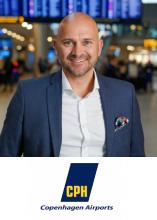
As Chief Information Officer, Christian Lyngaae Saugman leads Copenhagen Airports’ digital and technology strategy, reporting directly to the CEO and serving on the Corporate Leadership Team. He is responsible for the full spectrum of digitally driven business transformation, managing a team of eight senior leaders, over 200 employees, and numerous outsourced resources. His role spans financial oversight of the IT budget, strategic digital planning, and driving innovation across the airport ecosystem.
Under Saugman’s leadership, Copenhagen Airport has established itself as one of the world’s most digitally advanced airports, embracing artificial intelligence (AI), robotics, automation, and the Internet of Things (IoT) to enhance passenger experience, operational efficiency, and sustainability. Central to this transformation is the AIRHART platform by Smarter Airports, a real-time data ecosystem that integrates over 100 airport systems into a single operational hub. AIRHART powers Total Airport Management, enabling predictive passenger flow modelling, optimised gate allocation, reduced ground emissions, and more efficient aircraft turnarounds.
AI is also embedded in Copenhagen Airport’s culture through the AI Café, a dedicated space for employees to experiment, learn, and build confidence with AI tools. Saugman emphasises the human dimension of technology: fostering psychological safety, encouraging questions, and promoting collaboration to ensure AI is a natural part of daily operations.
Robotics and automation are transforming passenger engagement and operational processes. Self-driving service robots provide interactive entertainment, deliver information, and enhance commercial opportunities, while machine learning and video analytics optimise baggage handling by predicting arrival times on conveyors in real time. IoT sensors monitor critical infrastructure – from baggage systems to climate controls – enabling actionable insights that improve both sustainability and operational productivity.
Through his leadership, Copenhagen Airports continues to set new benchmarks for airport digitisation and operational excellence. Christian Lyngaae Saugman is recognised on the FTE Airport Digital Transformation Power List EMEA 2026 for his commitment to innovation, technology integration, and a collaborative digital culture has made him a driving force in shaping the airport of the future.

You may also be interested in
12 technology and CX trends that can enhance airline and airport operations in 2026
12 innovations that have the potential to enhance CX and future-proof airport operations