




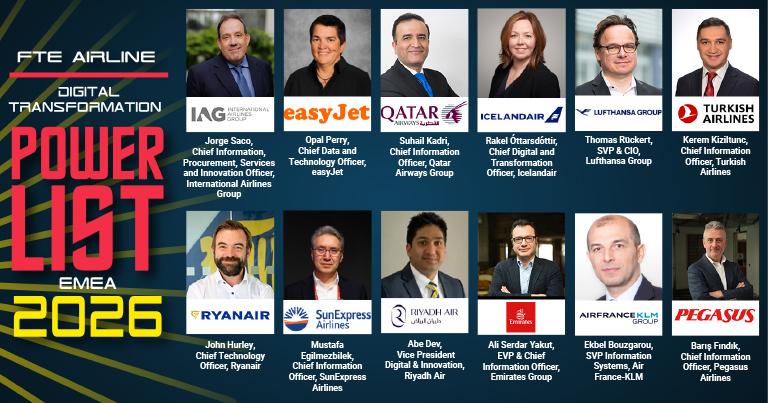

Future Travel Experience is excited to unveil the FTE Airline Digital Transformation Power List EMEA 2026. Here we shine a light on those who are pioneering new approaches that have the potential to improve travel for passengers and make the industry safer, more efficient and commercially successful. The EMEA edition champions the most transformative change enablers within the airline industry in Europe, the Middle East and Africa for their outstanding efforts to lead how their organisation has embraced digital innovation. In 2026, FTE is more committed than ever to supporting digital transformation efforts in the industry through the FTE Digital, Innovation & Startup Hub, which is a truly unique community designed specifically for the individuals and organisations who are at the forefront of digital transformation and innovation in aviation. The FTE Hub is focusing on three key themes this year – Artificial Intelligence (AI), Robotics, and Internet of Things (IoT) – and in alignment with that, the Power List recognises those that are leading key digital transformation efforts. In recognition of their leadership and achievements, each member of the Power List will receive a complimentary “Golden Ticket” to the co-located APEX FTE EMEA and APEX FTE Ancillary & Retailing events, taking place in Dublin on 9-11 June 2026. After extensive research into each candidate, we believe the following 12 executives have been at the forefront of innovation, driving transformational change for their organisations and the wider industry. You can view the FTE Airport Digital Transformation Power List EMEA 2026 by clicking here.
Register for the co-located APEX FTE EMEA and APEX FTE Ancillary & Retailing events – free for airlines, low-cost for airports >>
Jorge Saco, Chief Information, Procurement, Services and Innovation Officer, International Airlines Group (IAG)

Jorge Saco was appointed Chief Information, Procurement, Services and Innovation Officer at International Airlines Group (IAG) – a Corporate Partner of the FTE Digital, Innovation & Startup Hub – in 2023. IAG, whose member airlines include British Airways, Iberia, Aer Lingus, Vueling and LEVEL, is on an impressive transformation journey – not only of its own operations, but also how our industry operates.
From testing cutting-edge technology like generative AI and Mixed Reality, to technologies with the potential to reduce the carbon intensity from flight and investing in startups, IAG focuses on finding solutions for its customers, people, operations, and the environment. It fosters a culture of creativity and experimentation, creating an environment that encourages and supports innovation.
Robotics and automation are key focus areas for IAG and the overarching technology underpinning IAG’s innovation efforts is AI. Its efforts in this space are undoubtedly among the most impressive FTE has seen. IAG is focused on building and scaling AI products that enhance the customer experience, optimise operations and drive sustainable efficiencies. Indeed, it is mobilising at pace and the Group has opened IAG.ai labs in London and Barcelona as spaces to foster collaboration and innovation.
Applications for the IAGi Accelerator’s 2026 programme recently opened. The multi-track innovation programme supports early-stage startups with technology solutions at different stages of development, across six focus areas: AI, automation and robotics, sustainability and mobility, experiential platforms, connectivity and next-generation computing and cybersecurity. The Accelerator acts as a bridge between innovators and operators.
It is clear that IAG is on a very exciting journey and has AI, startups and collaboration right at the top of its agenda. While a number of members of the IAG innovation teams are contributing to digital transformation efforts, as Chief Information, Procurement, Services and Innovation Officer, Jorge Saco is recognised on the FTE Airline Digital Transformation Power List EMEA 2026 for his technology-focused leadership.
Hear more from International Airlines Group at the co-located APEX FTE EMEA and APEX FTE Ancillary & Retailing events, taking place in Dublin on 9-11 June 2026. Keith Walters, Group Transformation Lead, International Airlines Group, is participating in the ‘FTE Data Sharing Think Tank Live: Breaking the data sharing deadlock: How airlines, airports and their partners can finally achieve meaningful data collaboration’.
Opal Perry, Chief Data and Technology Officer, easyJet

Opal Perry joined easyJet as Chief Data and Technology Officer in February 2025, bringing a strong track record of transforming digital customer experiences while modernising legacy systems. Previously, she served as Chief Strategy and Digital Transformation Officer at PODS Enterprises and Chief Information Officer at Hertz, where she led cloud-based systems transformations across global operations.
At easyJet, Perry is driving a bold digital transformation agenda, leveraging data, artificial intelligence (AI), the Internet of Things (IoT), and robotics to enhance operational efficiency, reduce maintenance delays, and improve the passenger experience. Key initiatives include predictive maintenance, AI-driven operations, robotics-assisted inspections, and digital onboard solutions – all designed to make flying smoother for customers and crew alike.
In October 2025, easyJet launched a new app for its ground crew, enabling real-time support anywhere in the airport. From check-in to updating customer details or making booking changes, staff can now provide services previously only available at a fixed desk, significantly enhancing customer service at the point of need.
easyJet has opened a state-of-the-art Integrated Control Centre (ICC), managing the airline’s daily programme of around 2,000 flights. AI tools within the ICC assist with crew planning, standby requirements, and operational decision-making, helping flights depart safely and on time while improving the customer experience. Robotic Process Automation (RPA) tools streamline repetitive operational workflows, allowing specialists to focus on critical decisions. The centre, staffed by over 250 experts working 24/7, was carefully designed to foster focus and wellbeing, with calming spaces, natural light, and bespoke workstations.
easyJet has also introduced Jetstream, a generative AI tool giving ICC teams instant access to operational policies and manuals, streamlining decision-making in real time. AI is increasingly deployed across the airline, from optimising seat allocation to predictive maintenance, real-time aircraft positioning, and even reducing emissions through smarter flight management.
Beyond operational innovation, Perry is championing diversity and inclusion through a partnership with Women in Data, promoting career development, mentorship, and pathways into data-driven roles at easyJet. The airline is also expanding its digital footprint internationally, with a new digital centre in Barcelona to develop products and enhance internal processes.
Through these initiatives, Opal Perry is spearheading easyJet’s transformation into a truly data and technology-driven airline, placing operational excellence, innovation, and the passenger experience at the heart of every decision. She is recognised on the FTE Airline Digital Transformation Power List EMEA 2026 for her visionary leadership and tangible impact on the airline’s digital evolution.
Suhail Kadri, Chief Information Officer, Qatar Airways Group
Suhail Kadri was appointed Chief Information Officer of Qatar Airways Group in September 2024, having previously been Senior Vice President – Technology & Innovation at Hamad International Airport.
As the Chief Information Officer, Kadri oversees Qatar Airways Group’s technology, data, and digital initiatives. This encompasses leading critical technology strategies for Qatar Airways, Hamad International Airport, and the Group’s subsidiaries, including ground handling, retail, hospitality, and airline catering. Kadri’s work is rooted in leveraging technology and fostering innovation to deliver seamless passenger experiences and operational excellence. By collaborating with stakeholders and building strategic partnerships, the aim is to drive transformative change and create sustainable business value.
Qatar Airways’ vision is to blend human connection with technological innovation. It is integrating cutting-edge technology to enhance its digital brand experience, including redefining the pre-travel experience with Sama 2.0, the world’s first Artificial Intelligence (AI) flight attendant, and QVerse – its virtual travel experience platform. The deployment of Sama 2.0 and QVerse has initiated a new era of digital engagement at Qatar Airways. The combination of both technologies has proven instrumental in identifying previously unrecognised customer pain-points within the pre-travel phase.
The airline’s suite of intuitive, user-led airline products designed to enhance and personalise passenger experience and advance industry innovation includes Q Search – a first-of-its-kind solution designed to deliver instant answers across Qatar Airways products and services. Q Search acts as an abstract yet intelligent layer, allowing users to ask questions in natural language and receive intuitive, conversational responses. The experience is part of the airline’s ongoing enhancement of its digital ecosystem and loyalty offerings. Meanwhile, the Qatar Airways app is a powerhouse of smart technology and innovation. The app focuses on speed, personalisation, intuitive navigation, and exclusive world-first experiences that aim to redefine what passengers can expect from a digital airline platform, including AI-powered features.
The airline’s foundational work with AI and Virtual Reality is setting the stage for further innovations in Augmented Reality and the Internet of Things (IoT). It plans to use Augmented Reality to enhance passenger interactions by overlaying personalised, context-aware information directly into their field of view, making every step of their journey more engaging. Similarly, IoT will interconnect various elements of the travel experience, from airport facilities to inflight services, ensuring seamless communication and enhanced service delivery.
Rakel Óttarsdóttir, Chief Digital & Transformation Officer, Icelandair

Rakel Óttarsdóttir has served as Chief Digital & Transformation Officer at Icelandair since March 2022, bringing a wealth of technology leadership experience from her previous role as Chief Information Officer at Alvotech. Since joining the airline, she has played a pivotal role in driving a comprehensive digital transformation strategy designed to modernise operations and elevate the end-to-end passenger experience.
Icelandair is on an ambitious journey to deliver seamless, personalised travel powered by advanced data and digital capabilities. Under Óttarsdóttir’s leadership, the airline is accelerating initiatives across artificial intelligence (AI)-driven marketing, automation, innovative baggage solutions, and enhanced inflight connectivity. These efforts are focused on creating a more intuitive, efficient and customer-centric travel experience, while also delivering measurable operational improvements.
A key pillar of Icelandair’s transformation is its commitment to modern retailing and distribution. The airline’s multi-year content agreement with Travelport ensures broad access to its full range of fares and content, including New Distribution Capability (NDC), reinforcing its ambition to make its products easily accessible to the global travel agency community. This is complemented by an expanded partnership with Amadeus, enabling Icelandair to further develop its retailing capabilities and better meet evolving traveller expectations.
Through the adoption of NDC and advanced offer management, Icelandair is building the foundations for more dynamic, personalised offerings. This allows the airline to tailor experiences to individual customer needs, enhancing satisfaction and loyalty while unlocking new revenue opportunities. At the same time, these developments support the simplification of underlying business processes, improving agility and efficiency across the organisation.
Beyond distribution, Icelandair is actively leveraging AI and machine learning, robotics and automation, and the Internet of Things to optimise operations and enhance decision-making. From predictive insights to smarter resource allocation, these technologies are helping the airline operate more efficiently while maintaining a strong focus on delivering high-quality passenger experiences.
Icelandair’s digital transformation is clearly gaining momentum, with innovation, personalisation and operational excellence at its core. As Chief Digital Officer, Rakel Óttarsdóttir is leading this evolution with a clear vision and strong execution. She is therefore recognised on the FTE Airline Digital Transformation Power List EMEA 2026 for her leadership in harnessing digital innovation to reshape both the customer experience and operational performance at Icelandair.
Thomas Rückert, SVP & CIO, Lufthansa Group
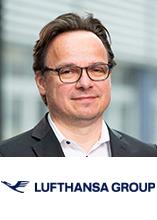
Thomas Rückert, SVP & CIO, is central to the transformation journey to becoming “One Tech Community” across Lufthansa Group, bringing together all colleagues who are driving digitalisation for member airlines and their customers. The key is leveraging synergies in the sense of “do-IT-once” and offering customers irresistible digital offers faster.
Lufthansa Group is harnessing artificial intelligence (AI)-driven insights to anticipate and respond dynamically to changes, ensuring efficiency and customer satisfaction remain at the heart of operations. It is working intensively on enhancing and digitalising its customer services with AI and machine learning technologies, with the aim of offering hyper-personalised passenger services. Digital Hangar – the airline’s digital-focused business unit – aims to accelerate digital transformation, “creating the world’s best connected travel experience”.
At Lufthansa Group, AI is not just yet another technology – it is a key enabler for improving customer experience, optimising operations and driving efficiency. From personalised customer interactions and smart disruption management, to predictive maintenance, Lufthansa Group is leveraging AI to make travel smoother, more efficient, and more sustainable.
A strategic, long-term collaboration with Infosys is also accelerating digital transformation and driving innovation. Infosys’ expertise in digitalisation and innovation using AI and data-driven solutions will be instrumental in optimising Lufthansa’s operations, enhancing passenger experiences and increasing the productivity and stability of operational processes.
Immersive technologies are also a key element of Lufthansa’s strategy. The airline has collaborated with Meta, the parent company of Facebook, to offer Meta Quest 3 Mixed Reality headsets to passengers flying in its new Allegris Business Class. Lufthansa Group has been using Extended Reality in training and marketing for some time – and is now a first-mover for this innovative entertainment offering.
Meanwhile, autonomous vehicles and automation on the ramp is another key focus area.
The FTE Airline Digital Transformation Power List EMEA 2026 recognises Thomas Rückert as a key figure in Lufthansa’s digital transformation, as the group continues to safeguard its leading market position and economic success as an agile and flexible organisation.
Hear more from Lufthansa at the co-located APEX FTE EMEA and APEX FTE Ancillary & Retailing events, taking place in Dublin on 9-11 June 2026. Stefan Patermann, Head of Commercial Development & Commercial Airport Partnerships, Lufthansa, is participating in the ‘Commercial Collaboration Playbook’ panel. Also, Anja Schuhmacher, Senior Manager Airport Experience & Partnerships, Lufthansa, is speaking in a session focused on ‘How can airports and airlines successfully scale baggage handling innovations to make a real difference across the industry? Is the time now?’
Kerem Kiziltunc, Chief Information Officer, Turkish Airlines
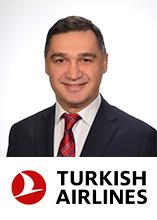
Turkish Airlines is charting a course to rank among the top 3 global airlines for digital passenger experience. Leading this ambitious digital transformation is Kerem Kızıltunç, the Chief Information Officer, who also oversees Turkish Technology, the airline’s innovation hub. The airline has a thorough strategy that includes fintech, Artificial Intelligence (AI), biometrics, and an all-encompassing digital experience for passengers.
As a recognised ‘2026 APEX World Class Airline’, Turkish Airlines is committed to continuous innovation. The airline turns 100 in 2033 and its centennial vision includes delivering a personalised digital experience at every touchpoint. A key focus on this journey for Turkish Airlines is building resilience into its 24/7 operation to support the growth and transformation of the airline, as well as its low-cost carrier AJet, with a different tech approach being taken for the new airline brand. Turkish Airlines’ digital strategy is focused on building operational resilience and enhancing customer experience. This is exemplified by the launch of TK Wallet, a feature within the airline’s app and website that simplifies payment and refund processes for Miles&Smiles loyalty members. Turkish Airlines also recently collaborated with Google as a launch partner for the Find Hub feature, as well as with Samsung Electronics for its SmartThings Find feature, making it easier for travellers to track their baggage.
Turkish Technology, the airline’s IT subsidiary, is crucial in this transformation. With more than 1,500 employees, this company focuses on providing advanced IT services, leading research and development in AI, analytics, fintech, and cybersecurity.
The airline also acknowledges the potential of robotics and automation in tasks such as baggage handling and aircraft turnarounds, highlighting the importance of automation working alongside, rather than replacing, human interaction.
In addition to his position as Chief Information Officer at Turkish Airlines, Kerem Kiziltunc is Chair of IATA’s Digital Transformation Advisory Council. Alongside delivering the vision to be one of the top 3 digital airlines in the world, he is therefore also recognised on the FTE Airline Digital Transformation Power List EMEA 2026 for his strong leadership role within the industry.
Hear more from Turkish Airlines at the co-located APEX FTE EMEA and APEX FTE Ancillary & Retailing events, taking place in Dublin on 9-11 June 2026. Yılmaz Goralı, Vice President, Airline Retailing – Product Development, Turkish Technology, is participating in a Fireside Chat on ‘How Turkish Airlines is creating a new era of commercial opportunity’. Meanwhile, Ozan Peneklioglu,VP of Business Development (IT Solutions), Turkish Technology, is participating in a session on ‘Making the autonomous ramp a reality: lessons learned, opportunities and challenges’.
The co-located APEX FTE EMEA and APEX FTE Ancillary & Retailing, taking place at the RDS in Dublin on 9-11 June 2026, will be a mega-event where the worlds of digital, commercial and CX will collide. One registration provides access to both events, where attendees will hear inspirational presentations from a number of the leading airlines listed here and many more speakers from inside and outside the industry.Find out more and register to attend >>
John Hurley, Chief Technology Officer, Ryanair
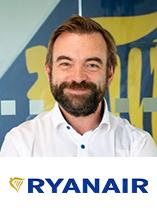
As Chief Technology Officer, John Hurley continues to drive digital transformation strategy for Ryanair – a Corporate Partner of the FTE Digital, Innovation & Startup Hub. Ryanair has evolved into a tech-first business, with Ryanair Labs – its in-house development engine – at the heart of the transformation. Spread across Ireland, Spain, Poland and Portugal, Ryanair Labs builds custom tools to support profitability, speed, and control. Innovations include Brainer, a machine learning pricing engine, and Ryanair Connect, an internal crew app inspired by Amazon’s A to Z system. The airline’s philosophy is to not buy off-the-shelf unless it’s the smartest option – building lets Ryanair move faster and tailor everything to its needs. As Ryanair continues to scale, there is a cultural shift underway – it is no longer just a low-cost carrier, it is a digital organisation competing for tech talent, innovating constantly, and still doing it all with lean budgets.
As part of its digital innovation efforts, Ryanair has partnered with Amazon Web Services (AWS), rebuilding its legacy systems into cloud-based, innovative services and leveraging machine learning to transform the digital experience of its customers. As part of efforts to further explore the potential of artificial intelligence (AI) and Machine Learning, Ryanair – a Corporate Partner of the FTE Digital, Innovation & Startup Hub – is engaging with the AWS Generative AI Innovation Center to explore developing and deploying GenAI solutions.
Digital initiatives include the Day of Travel Assistant within the Ryanair app, Digital Self-Service Hub and myRyanair Wallet. Using the Day of Travel app, customers are able to get live updates and notifications about the airport, including terminal and gate information. Passengers receive live videos and webcasts from Ryanair’s operations centre during major disruptions. The app also provides easy access to boarding passes and other travel documents.
Customers can use the Digital Self-Service Hub to change flights, update passenger information, and add bags, seats and other services. Meanwhile, myRyanair Wallet gives customers quick access to book flights using their wallet balance and provides real-time status updates on refunds.
As Chief Technology Officer, John Hurley also leads the team of developers working at Ryanair Labs, the airline’s digital innovation hubs based in Dublin, Wroclaw, Madrid and Portugal, which continue to deliver the core digital facets of the airline’s “Always Getting Better” programme.
Hear more from Ryanair at the co-located APEX FTE EMEA and APEX FTE Ancillary & Retailing events, taking place in Dublin on 9-11 June 2026. John Hurley, Chief Technology Officer, Ryanair, is participating in a session titled ‘When technology becomes a teammate: Embracing human/tech collaboration to optimise operational efficiency across the organisation’. Meanwhile, Tom Kelly, Director, Ground Operations, Ryanair, is speaking in a session focused on ‘Making the autonomous ramp a reality: lessons learned, opportunities and challenges’.
Mustafa Egilmezbilek, Chief Information Officer, SunExpress Airlines

Mustafa Egilmezbilek has served as Chief Information Officer at SunExpress Airlines since March 2021, where he leads the airline’s digital and operational transformation agenda. With a clear vision for innovation and agility, he is responsible for shaping SunExpress’ digital strategy and embedding a data-driven culture across the organisation.
SunExpress is on a significant transformation journey, focused on building modern digital foundations that enable greater flexibility, scalability and responsiveness to evolving passenger and operational needs. Under Egilmezbilek’s leadership, the airline has developed a comprehensive information systems strategy aligned with its long-term digital ambitions, ensuring technology investments are closely tied to business value and growth.
A key priority has been the development of new digital capabilities driven by business demand. This includes the adoption of a product-centric operating model, transitioning from traditional project delivery to digital product management. By organising around products rather than projects, SunExpress is enhancing speed-to-market, fostering continuous improvement and ensuring a more customer-centric approach to innovation.
Collaboration is also central to the airline’s transformation efforts. Egilmezbilek has championed the creation of ‘fusion teams’ – cross-functional groups that bring together business and technology expertise – helping to break down silos and increase engagement across the organisation. This approach is enabling faster decision-making and more effective deployment of digital solutions.
Data is at the core of SunExpress’ strategy, with a strong emphasis on building a truly data-driven enterprise. By promoting the use of data at all levels of decision-making, the airline is improving operational insight, forecasting accuracy and customer understanding. This is complemented by the growing adoption of artificial intelligence (AI), machine learning and advanced analytics to drive smarter, more efficient operations.
In parallel, SunExpress is embracing hyper-automation to boost productivity and streamline internal processes. Through the use of robotic process automation and other emerging technologies, the airline is reducing manual workloads, improving accuracy and enabling employees to focus on higher-value activities.
Egilmezbilek is also actively fostering innovation beyond the organisation by engaging with startup communities and integrating external solutions into SunExpress’ ecosystem. This open approach to innovation allows the airline to rapidly explore and scale new technologies, keeping it at the forefront of industry developments.
SunExpress’ focus on innovation saw it receive the Most Innovative Airline Initiative award at last year’s FTE EMEA Innovate Awards. The airline was recognised for its pioneering use of machine learning to enhance flight planning accuracy, reduce fuel consumption, and lower carbon emissions.
SunExpress’ digital transformation is characterised by a strong strategic foundation, a collaborative culture and a forward-looking approach to technology adoption. As Chief Information Officer, Mustafa Egilmezbilek is playing a central role in driving this evolution. He is therefore recognised on the FTE Airline Digital Transformation Power List EMEA 2026 for his leadership in advancing a modern, data-driven and innovation-focused airline.
Hear more from SunExpress Airlines at the co-located APEX FTE EMEA and APEX FTE Ancillary & Retailing events, taking place in Dublin on 9-11 June 2026. Mustafa Egilmezbilek, Chief Information Officer, SunExpress Airlines, is participating in a session focused on ‘AI, Innovation and Digital Transformation Excellence’ with a presentation titled ‘How SunExpress is embracing AI, ML and emerging tech to optimise operations across the airline’.
Abe Dev, Vice President Digital & Innovation, Riyadh Air

Riyadh Air is the world’s first truly digitally native airline. It aims to change the way people interact with airlines through personalised experiences designed to make travelling much easier, with a strong emphasis on digital innovation. The vision is to provide intuitive travel enhanced by cutting-edge Artificial Intelligence (AI), allowing Riyadh Air to curate a unique experience for every customer.
A key goal is to create the world’s best travel app in collaboration with partners, with which Riyadh Air is paving the way to providing an exceptional passenger experience from booking to arrival. Its seamless digital offering will enable numerous travellers to book their whole trip in one place, combining multiple itineraries under one order and adding optional extras with the airline being able to respond to any context and any customer. AI will offer personalised options that are tailored to the needs of individuals, for example, should a traveller be running late, they could opt for a last-minute fast-track. Passengers will also be able to book hotels, lounges, taxis, or even concerts or football tickets at the same time as booking flights, ensuring everything needed for a full travel itinerary is completed instantaneously and solely on the Riyadh Air shopping cart. The Riyadh Air app will act as a true digital travel assistant, with a passenger’s own device becoming their remote to their onboard experience – be that for ordering, seating, lighting, or any other aspect of travel.
As part of its digital innovation efforts, Riyadh Air has signed a Memorandum of Understanding with Huawei to support the airline’s ambition to become one of the world’s most digitally advanced carriers, leveraging expertise in cloud, AI, mobility services, and integrated digital ecosystems.
As Vice President Digital & Innovation, Abe Dev is leading Riyadh Air’s efforts to be at the cutting-edge of technology, enabling digital innovation at every passenger touchpoint, and being “a true disruptor in terms of guest experience”. He joined Riyadh Air in May 2022, bringing a wealth of experience from previous roles including Head of Technology at Qantas Regional Airlines, and Director of Technology at Etihad Airways.
Ali Serdar Yakut, EVP & Chief Information Officer, Emirates Group
Ali Serdar Yakut joined Emirates Group as EVP & Chief Information Officer in May 2023, having previously been CEO of Turkish Technology – Turkish Airlines’ innovation hub.
Emirates Group has embarked on a futuristic, immersive digital journey to transform its employee experiences by collaborating with Amazon Web Services (AWS) on a first for the industry. Together, they have developed an immersive Extended Reality (iXR) platform for Emirates Group’s cabin crew, new joiners, and the wider industry partner community. This includes 3D virtual hubs, virtual training, gamified environments, and simulated experiences, powered by spatial computing and artificial intelligence (AI).
Key technologies Emirates is currently focusing on include robotics, AI, Extended Reality and Web 3.0. The Innovation Majlis at Emirates Group’s Dubai HQ is the platform used to foster deeper research and development, and greater exchange of cutting-edge ideas – it showcases the latest in robotics, hyper-reality, holograms, sensor tech and other advanced technologies.
Emirates sees enormous potential for AI technology to support its business requirements, helping tackle complex commercial challenges, strengthening operations, and enhancing the customer experience. As part of these efforts, Emirates has entered into a strategic collaboration with OpenAI to advance AI adoption and innovation across the airline. As part of their work together, Emirates and OpenAI are exploring opportunities to introduce practical use cases, develop an internal AI champion network, and establish an AI Centre of Excellence. This collaboration will identify key areas for enhancing and expanding AI capabilities across the organisation, covering the critical skills, processes and technology needed to power Emirates into the next era.
Ali Serdar Yakut is recognised on the FTE Airline Digital Transformation Power List EMEA 2026 as a central figure in delivering Emirates’ commitment to using technology and innovation to create practical and scalable solutions that benefit travellers, communities, the wider industry, and all its brands and businesses.
Ekbel Bouzgarou, SVP Information Systems, Air France-KLM
Ekbel Bouzgarou was appointed Senior Vice President – Information Systems at Air France-KLM in October 2025. He has previously held a number of senior positions at Air France-KLM, including SVP Information Technology Development, and Chief Technology Officer.
As Air France-KLM accelerates its transformation, it continues to invest and innovate in high-performance information systems. Data, artificial intelligence (AI) and cyber risk prevention are all areas in which the Air France-KLM Group is further developing its expertise, and Bandet is playing a key role in strengthening the group’s leadership in its IT activities.
For some years Air France and KLM have combined their digital development resources and expertise to create a joint digital ecosystem for the Air France and KLM brands. Based on agile methods of working, a continuous effort is directed at providing customers with a state-of-the-art digital experience. The foundation of this ecosystem is a joint API framework, covering the entire journey.
Air France-KLM continues to invest in further empowering staff through the use of digital tools, with the aim of enabling them to surpass customers’ expectations. The group wants to ensure an unrivalled end-to-end customer experience, which exceeds expectations at all touchpoints. It is also targeting improving the customer experience through personalised and digitalised offers and best-in-class operational performance.
Air France-KLM is a Partner of the FTE Baggage Innovation Working Group and KLM is pioneering automation on the ramp in collaboration with Schiphol. As part of these efforts, KLM and Schiphol are partnering in the pioneering FTE Smart Ramp programme, which has the ultimate goal that aircraft turnaround can be achieved autonomously and more efficiently. Their Smart Ramp projects aim to develop and integrate automation and autonomy into ramp operations to realise a seamless inbound flow. The objective is to reduce avoidable emissions and create better working circumstances for the groundcrew. These initiatives build on a strong platform of collaboration between KLM and Schiphol, including the recent deployment of a new electric, self-driving baggage vehicle as part of the collective vision for a smarter, more sustainable future in ground operations.
Barış Fındık, Chief Information Officer, Pegasus Airlines

Pegasus Airlines – a Corporate Partner of the FTE Digital, Innovation & Startup Hub – is determined to become one of the world’s most technologically-advanced airlines. In pursuit of this, it is taking significant strides to evaluate collaboration opportunities with startups, universities, and other players in the field of technology and aviation.
Significantly, Pegasus has established a Technology Innovation Lab in Silicon Valley to secure the sustainable development of its digitalisation journey. The airline aims to monitor and assess onsite the latest technological advancements worldwide. This move is designed to further strengthen the company’s global competitiveness and its firm commitment to technological innovation. It follows the launch of Pegasus’ digital transformation programme in 2018 under the motto ‘Your Digital Airline’.
The airline’s focus is on artificial intelligence, mobile capabilities, self-service, and other cutting-edge technologies it believes will directly enhance both operational efficiency and customer experience.
Central to these efforts is Pegasus’ collaboration with Microsoft, leveraging Azure AI Services. The airline’s AI transformation is a prime example of how technology drives strategic value. The integration of AI-powered solutions has doubled customer satisfaction with Pegasus’ FlyBot virtual assistant, as well as boosting employee satisfaction by 20% for the human resources virtual assistant. This success includes enhancements like real-time customer support through FlyBot and personalised travel recommendations via ChatGPT, along with AI-powered solutions improving employee workflows.
Additionally, as part of its commitment to enhancing the travel experience through innovative solutions, Pegasus has elevated the baggage tracking process. It has enabled support for Apple’s Share Item Location feature to allow customers to securely and privately share the location of their AirTag and other Find My network accessories with the airline’s customer service team to more quickly locate lost or delayed bags and reunite them with customers. This step reflects its dedication to leveraging technology for a smoother and more seamless passenger journey.
As Chief Information Officer, the FTE Airline Digital Transformation Power List EMEA 2026 recognises Barış Fındık as a key figure in Pegasus’ digital transformation.

You may also be interested in
12 technology and CX trends that can enhance airline and airport operations in 2026
12 innovations that have the potential to enhance CX and future-proof airport operations
The FTE Commercial Collaboration Playbook – delivered in partnership with Munich Airport