





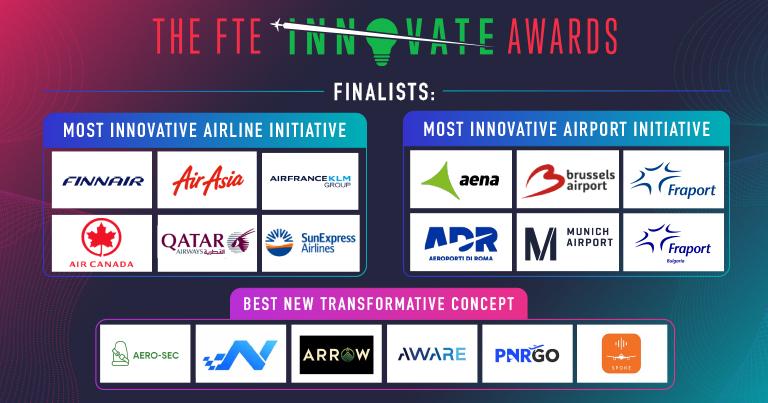
Future Travel Experience is delighted to unveil the finalists for the highly anticipated FTE Innovate Awards – the industry’s most respected platform for recognising innovation with real-world impact – taking place at the co-located APEX FTE EMEA and APEX FTE Ancillary & Retailing events (Dublin, 9-11 June 2026). Airlines, airports and vendors from around the world will compete head-to-head, as they pitch their trailblazing initiatives live on stage, with the winners decided by our expert judges and audience votes. There are three awards categories: Finnair, AirAsia, Air France-KLM, Air Canada, Qatar Airways and SunExpress are shortlisted for Most Innovative Airline Initiative; Aena, Brussels Airport, Fraport, Aeroporti di Roma, Munich Airport and Fraport Twin Star Airport Management are shortlisted for Most Innovative Airport Initiative; and Aero-Sec, NewSense Engineering, Arrow Analytics, Aware, PnrGo and Metcove are shortlisted for Best New Transformative Concept. Find out more about why they made the shortlist and what they will present in the pitch sessions.
Register for the co-located APEX FTE EMEA and APEX FTE Ancillary & Retailing events – free for airlines, low-cost for airports >>Most Innovative Airline Initiative shortlist
Finnair’s inflight Order to Seat innovation: Enhancing customer experience, ancillary revenue and efficiency
 Finnair is shortlisted for its Order to Seat innovation, enhancing operational efficiency, customer experience, and commercial performance. The initiative will be pitched live on stage by Salla Rinta-Kanto, Head of Products & Retailing, and Taneli Lukkarinen, Business Manager, Products & Retailing.
Launched in December 2025, Finnair’s narrow-body Order to Seat extends a digital retail service already offered on long-haul flights. Passengers can browse, order, and pay for food and beverages through their personal devices via onboard WiFi. On long-haul aircraft, the same functionality is available via the inflight entertainment system, ensuring a seamless, network-wide experience.
The system streamlines cabin operations by allowing passengers to place and pay for orders independently, freeing crew to focus on delivery rather than payment handling. Spreading orders across the flight reduces peak-time pressure, while unified features on both short- and long-haul aircraft simplify routines and ensure predictable, smoother service flow.
Finnair’s service embodies Finnish design principles – efficient, straightforward, and respectful. Passengers enjoy autonomy, convenience, and clarity, ordering whenever they wish without interrupting crew. Enhanced product information, dietary filters, and personalised recommendations improve selection, while integrated payment options – including Apple Pay, Alipay, credit cards and Avios – make transactions fast and intuitive.
By lowering barriers to purchase, Order to Seat drives additional sales beyond standard trolley rounds. Recommendations boost average spend, and integrated payment supports higher conversion rates. Early results are promising: flights to the Canary Islands now see around 10% of all onboard sales via the system, generating double-digit incremental revenue per passenger on some routes.
Finnair’s Order to Seat initiative demonstrates measurable improvements across operations, passenger experience, and ancillary revenue, making it one of the only airlines to offer fully integrated digital ordering across both short- and long-haul flights.
AirAsia’s Flight Disruption Management System
 AirAsia is shortlisted for its Flight Disruption Management System (FDMS), which will be pitched live on stage by Alexia Leong Gan Hung, Head of Customer Happiness & Transformation.
The FDMS is a strategic digital platform designed to automate and humanise irregular operations (IROPS), replacing fragmented, manual recovery processes with a unified, high-precision ecosystem. Its goal is to turn one of the most stressful moments in air travel – flight disruptions – into an opportunity for operational efficiency, passenger satisfaction, and commercial value.
At the heart of the FDMS is the ‘Magic Button’, which reduces hours of manual coordination to minutes. A unified dashboard consolidates flight data, enabling a single operator to manage thousands of passengers. Real-time detection of disruptions triggers recovery options even before passengers reach the help desk, while up to 80% of support traffic related to disruptions is now automated. This dramatically reduces workload for customer support and ground staff, while minimising human error.
FDMS provides passengers with personalised, mobile-friendly recovery options, empowering self-service rebooking and instant digital credits or vouchers. By eliminating the information vacuum typical during delays, it maintains and improves Net Promoter Scores during stressful travel events.
Automating re-accommodation reduces labour costs, protects revenue through loyalty retention, and supports a lean, scalable operation. Monthly adoption of self-service recovery has increased by 20%, while manual handling has dropped by 41%, translating to estimated savings of US$1.5 million annually. By issuing instant credits instead of traditional refunds, FDMS retains passengers within AirAsia’s ecosystem, turning a cost centre into a revenue-generating, loyalty-enhancing tool.
FDMS exemplifies AirAsia’s commitment to operational excellence, innovation, and human-centred travel experiences. By merging automation with empathy, it delivers faster, more accurate solutions while enhancing staff satisfaction and passenger trust – transforming flight disruptions from a source of frustration into a competitive advantage.
Air France-KLM’s SPARC: Internal merchandising and bundling tool
 Air France-KLM is shortlisted for SPARC – an internal merchandising and bundling tool, which will be pitched live on-stage by Alexis Montcel, Head of Tech.
Launched in Q1 2026, SPARC is designed to centralise and optimise all ancillary products across Air France-KLM’s network. By internalising a system previously managed by an external vendor, the airline has significantly reduced costs while gaining full control over its merchandising strategy, enabling faster time-to-market for offers and more agile experimentation.
SPARC streamlines airline operations by reducing dependency on third-party vendors, lowering run and maintenance costs, and accelerating deployment of new merchandising initiatives. Its internal architecture allows teams to respond quickly to market demands, implement business rules, and leverage artificial intelligence (AI)-driven optimisation to ensure offers are timely, relevant, and consistent.
The tool lays the foundation for a more personalised passenger journey. Customers will benefit from smarter, more relevant offers, tailored bundles, and dynamic pricing adjustments that better match individual travel preferences. SPARC’s experimentation-friendly setup allows the airline to continuously refine its merchandising logic, improving the relevance and attractiveness of ancillary products across the network.
SPARC has already delivered measurable revenue uplift, with additional potential growth anticipated through dynamic pricing readiness. By reducing total cost of ownership compared with external solutions, the tool not only enhances profitability but also supports the airline’s strategic objective of modernising retail capabilities.
Through SPARC, Air France-KLM is taking meaningful steps toward the next generation of airline retailing, internalising key capabilities while maintaining flexibility for innovation. The initiative demonstrates how technology-driven control over merchandising can enhance operational efficiency, elevate the passenger experience, and drive sustainable commercial performance, positioning the airline at the forefront of modern airline retailing.
Air Canada’s baggage endeavour: Redefining the customer and employee experience
 Air Canada is shortlisted for its groundbreaking baggage transformation initiative, which is redefining the customer and employee experience and will be pitched live on stage by Jason Odey, Director, Baggage & Airside Innovation.
The initiative follows a six-phase maturity journey that systematically redefines baggage operations – from reactive handling to autonomous, intelligence-driven systems:
- Phase 1 – Identify: Comprehensive 5-point baggage scanning tracks every bag from check-in to carousel and, in rare delays, through to final delivery at passengers’ doorsteps.
- Phase 2 – Connect: Scan data is integrated with airport operations, linking each bag to real-time flight schedules, gate assignments, and connections.
- Phase 3 – Understand: Advanced analytics reveal operational patterns, bottlenecks, and station-specific vulnerabilities invisible to manual observation.
- Phase 4 – Predict: Machine learning models forecast mishandling risk, simulate staffing scenarios, and flag at-risk bags before errors occur.
- Phase 5 – Deliver: Passenger-facing innovations include an industry-first feature displaying the name of the team member handling their bag, enhancing trust and reducing anxiety.
- Phase 6 – Automate (In Progress): Autonomous baggage vehicles, robotic handling systems, and artificial intelligence (AI)-powered connection runners are being deployed on a foundation validated through prior phases.
The transformation has delivered measurable operational, customer, and financial improvements: mishandled bags have decreased by 36%, recovery speed has improved by 57%, and delayed bags are rerouted 43% faster. Customer satisfaction has increased, and the reduction in mishandling costs allows reinvestment in further innovation.
Air Canada’s phased, intelligence-first approach ensures that automation operates on validated operational insights rather than guesswork. By combining data, AI, and customer-centric design, the airline has redefined both the passenger and employee experience in baggage handling. The initiative exemplifies leadership in operational efficiency, technological innovation, and service excellence – setting a new benchmark for the industry.
Qatar Airways: Transforming aircraft loading operations through real-time digital load reconciliation
 Qatar Airways is shortlisted for its Aircraft Loading Reconciliation Tool (ALERT), which will be pitched live on stage by Naveen Thomas, Project Manager, Qatar Airways, and Maciej Jukowski, Head of Load Control & CLC Operations, Qatar Aviation Services.
Launched in October 2025, ALERT is a digital solution that transforms aircraft loading from a manual, experience-dependent process into a structured, system-guided workflow. Traditional ramp operations relied on paper load instructions and verbal updates, which could lead to last-minute discrepancies, reopens, and safety risks. ALERT replaces these legacy practices by connecting directly to the Weight & Balance system, sharing the latest electronic load plan with ground teams in real time.
The tool employs a three-stage verification process – Ramp, Lower Deck Loader, and Aircraft Hold – using barcode scanning at each step. If a mismatch or safety concern is detected, ALERT halts progression and highlights the issue for immediate correction, preventing errors before they escalate. This approach ensures units match the live load plan, locks are verified, and image evidence confirms secure placement.
ALERT eliminates rework, hold reopens, and last-minute offloads, improving predictability and on-time performance. More than 1,000 frontline users now operate daily with the tool, benefiting from familiar devices and a simple scan-and-confirm workflow that minimises training requirements.
Passengers experience greater reliability as baggage and cargo are correctly loaded, reducing downstream disruption. For the airline, ALERT lowers operational costs, fuel burn, and emissions while enhancing safety assurance through real-time weight, piece count, and sequence validation.
Deployment at hub operations has eliminated over-carried ULDs and common loading discrepancies, contributing to stable turnarounds and improved punctuality. The solution demonstrates that practical, frontline-focused digital innovation can enhance safety, operational control, and customer experience.
ALERT represents a scalable model for transforming ramp operations, delivering measurable impact and establishing a new standard for safe, efficient, and digitally assured aircraft loading.
SunExpress’ SmartTail: Fuel efficiency through optimal tail assignment
 SunExpress is shortlisted for SmartTail, its in-house tail assignment optimisation system, which will be pitched live on stage by Selçuk Kalafat, Data & AI Solutions Manager.
SmartTail automates the complex process of assigning aircraft to flights across SunExpress’ fleet of 85+ aircraft and 450+ daily flights at peak season – a task that previously required experienced planners hours of manual coordination. Using advanced mathematical optimisation and live operational data, the system generates a 45-day plan that balances fuel efficiency, maintenance schedules, noise restrictions, fleet rotation, and schedule stability.
The system replaces routine manual work, producing ready-to-use assignments that integrate directly into the operations platform. Planners can now focus on strategy and exception management rather than juggling dozens of interdependent rules. The optimiser continuously adapts to changing conditions, re-optimising schedules within minutes during disruptions.
SmartTail assigns the most fuel-efficient aircraft to the longest routes and routes quieter aircraft to noise-sensitive European airports, reducing both fuel consumption and noise footprint. Early validation runs show fleet-wide fuel savings of 1-2%, with additional potential in off-peak seasons.
By keeping aircraft on schedule and aligned with maintenance rotations, the system reduces the risk of technical delays or cancellations. High-frequency domestic routes maintain consistent aircraft assignments, enhancing reliability and passenger predictability.
Optimised tail assignments deliver direct fuel and CO₂ savings, preserve noise compliance discounts, and eliminate uncovered flights, all while reducing reliance on expensive external vendors. The solution demonstrates that in-house innovation can deliver measurable operational, environmental, and commercial benefits.
SmartTail exemplifies how data-driven, automated decision-making can modernise airline operations. By combining domain expertise with advanced optimisation, SunExpress has achieved operational excellence, improved sustainability, and freed planners to focus on strategic priorities – proving that transformative innovation is possible without massive budgets or external dependency.
Register for the co-located APEX FTE EMEA and APEX FTE Ancillary & Retailing events – free for airlines, low-cost for airports >>Most Innovative Airport Initiative shortlist
Aena’s LiDAR Passenger Flow Analytics
 Aena is shortlisted for its LiDAR Passenger Flow Analytics, which will be pitched live on stage by Vanesa Calvo, Head of Funding and Emerging Innovation Trends.
Launched in September 2025 at Malaga Airport, this initiative deploys advanced LiDAR sensors combined with artificial intelligence (AI) and a 3D digital twin to track and analyse passenger movement in real time, with particular focus on the EU Entry-Exit System (EES). The system delivers precise KPIs, including queue length, actual and predicted waiting times, service counter utilisation, and individual passenger journey tracking – all while preserving privacy.
The platform reconstructs individual trajectories with 20cm spatial accuracy, enabling staff to anticipate congestion, dynamically adjust staffing, and optimise resource allocation. Automated alerts notify teams when KPIs exceed thresholds, allowing pre-emptive action that reduces bottlenecks. This predictive approach supports more consistent service levels and streamlines airport operations.
Passengers benefit from reduced waiting times, more evenly distributed queues, and the ability to anticipate delays. Real-time insights into crowding and predictive waiting times improve comfort, safety, and satisfaction. The system’s ability to track over 90% of passengers end-to-end ensures a smoother, less stressful journey.
By understanding passenger dwell patterns and trajectories, airports can optimise retail and F&B operations, increase airside engagement, and boost commercial revenue. Efficient processing also allows for smarter deployment of staff and energy resources, reducing overstaffing and unnecessary counter operation.
The system has already been integrated with Aena’s IT environment, meeting cybersecurity and operational requirements, and is capable of replication across the network. Early tests demonstrate 95% accuracy for passenger counts, 90% for real waiting times, and 85% for predicted waiting times.
LiDAR Passenger Flow Analytics represents a decisive step forward in predictive, real-time, and passenger-centric airport operations. It establishes a new benchmark for efficiency, transparency, and operational intelligence, transforming how airports manage critical processes such as the EES.
Brussels Airport’s BRUce: The assistant that knows your luggage better than you do
 Brussels Airport is shortlisted for BRUce, its digital travel assistant, which will be pitched live on stage by Bernd Bries, Chatbot & Conversation Designer.
Launched in July 2025, BRUce addresses one of the most common passenger concerns: “Can I bring this onboard?” From lithium batteries to unusual objects, these questions create stress for travellers and extra workload for airport teams. BRUce combines conversational artificial intelligence (AI), a continuously updated knowledge base, and photo recognition to provide instant, reliable answers. Passengers simply snap a picture of an item, and BRUce confirms whether it is allowed in hand luggage or checked baggage, delivering responses in Dutch, French, or English across the website, app, WhatsApp, and Messenger – 24/7.
BRUce reduces anxiety at security checkpoints by providing clear, immediate guidance for unusual items that are often absent from traditional FAQs. This has translated into strong passenger satisfaction, with an NPS of 45, demonstrating high trust and usability.
The upgraded system significantly reduces repetitive contacts to Customer Care. In 2024, security-related questions generated over 1,500 manual inquiries; post-upgrade, BRUce handled nearly 25,000, and in the first four months alone supported over 200,000 conversations with more than 3.5 million messages exchanged. The photo feature was used 15,000+ times, resolving questions across 250+ categories and improving successful resolution rates by 17.3%.
BRUce’s photo recognition is rare in airport operations, offering intuitive assistance without requiring passengers to describe items accurately. Behind the scenes, advanced AI and a custom airport database ensure accurate, rule-based responses where precision is critical, avoiding the risks of purely generative systems.
BRUce demonstrates how smart digital tools can reduce passenger stress, streamline operations, and operate at scale while keeping safety and accuracy at the forefront. It sets a new benchmark for AI-driven self-service in airports, improving both the travel experience and operational efficiency.
Fraport: From regulation to ROI – autonomous snow clearance in ILS zones
 Fraport – a Corporate Partner of the FTE Digital, Innovation & Startup Hub – is shortlisted for its ‘Autonomous Snow Clearance of ILS Protection Zones’ project, which will be pitched live on stage by Marina Lützenberger, Program Manager Corporate Strategy and Digitalization.
Launched in August 2025, the initiative applies autonomous robotics to one of the most safety-critical areas of airport operations: Instrument Landing System (ILS) glide path protection zones. Traditionally, snow clearance in these restricted areas requires multiple tractors and specially licensed drivers, making the process resource-intensive, risky, and difficult to scale. Fraport’s solution pilots an electrically powered robotic vehicle capable of independently executing snow clearance routes, dynamically adapting to surface conditions, and returning to its charging station, all under remote supervision from the winter service operations centre.
The autonomous system reduces reliance on qualified airside drivers, minimises standby times, and enables predictable, repeatable clearance cycles synchronised with runway operations. During testing, the robot cleared a 720sqm reference area in 18 minutes – well below the 30-minute target – while maintaining navigation accuracy within 5cm and achieving 99% system availability. Safety features, including emergency stop, collision avoidance, and warning systems, operated reliably, ensuring safe operation in restricted, high-risk areas.
The electric robotic solution reduces emissions and optimises resource deployment. It also delivers significant cost savings, with a projected €3 million over five years through reduced staffing and equipment needs. The platform is scalable for other airside tasks such as mowing or additional restricted area operations.
By maintaining ILS zones free of snow, the system enhances runway availability, operational resilience, and punctuality during winter weather disruptions, indirectly improving the customer experience.
Fraport’s initiative demonstrates that autonomous robotics can be safely integrated into core airport operations, delivering measurable safety, efficiency, sustainability, and economic benefits. It establishes a blueprint for future autonomous airside applications, proving that innovation can move beyond experimentation into practical, high-impact deployment.
Aeroporti di Roma’s Buildots digital twin construction initiative
 Aeroporti di Roma (ADR) – a Corporate Partner of the FTE Digital, Innovation & Startup Hub – is shortlisted for its Buildots digital twin construction initiative, which will be pitched live on stage by Letizia Petrarca Head of Innovation Hub & Intrapreneurship.
Launched in December 2025, Buildots is part of ADR’s broader innovation model that embeds startups directly into operational processes through programmes like Call4Startups and ADR Ventures. This approach enables rapid validation and integration of high-impact solutions in areas such as robotics, passenger experience, infrastructure intelligence, and sustainability.
Buildots leverages artificial intelligence (AI)-powered construction analytics to create a dynamic digital twin of airport infrastructure under development. Using 360° site imagery, the platform continuously compares actual progress with BIM models and planned schedules, automatically identifying deviations, potential rework, and performance gaps. This real-time visibility allows engineers and project managers to react quickly to design changes, operational constraints, or emerging issues.
By integrating Buildots into its digital ecosystem, ADR reduces reliance on manual inspections, accelerates monitoring, and enhances decision-making during complex construction projects. The solution supports more accurate progress tracking, earlier detection of deviations, and faster response to operational constraints, helping ensure projects stay on schedule.
Buildots is co-designed with engineering, operations, and IT teams, ensuring practical alignment with real-world airport challenges. The initiative exemplifies ADR’s innovation philosophy: embedding advanced technologies into operational workflows rather than deploying isolated tools, accelerating solution maturity and impact.
By modernising infrastructure management, Buildots strengthens the airport’s operational resilience and long-term asset lifecycle management. It also reinforces Fiumicino’s position as a global benchmark for intelligent, data-driven airport development, enhancing efficiency, transparency, and control in large-scale construction programmes.
Through this initiative, ADR demonstrates how AI, digital twins, and a collaborative innovation model can transform airport infrastructure delivery, creating measurable operational, strategic, and long-term value for both passengers and the airport system.
Munich Airport’s Airside 360 – One Platform. All operations. Orchestrated.
 Munich Airport – a Corporate Partner of the FTE Digital, Innovation & Startup Hub – is shortlisted for Airside 360 – a modern, scalable and secure platform for airfield management – which will be pitched live on stage by Stefan Häberlein, Aviation Operations – Head of Traffic Supervision.
Launched in October 2025, Airside 360 represents a fundamental redesign of airfield operations, replacing fragmented tools and manual workflows with a unified, data-driven orchestration platform. Building on the Airport Orchestration Platform concept and the AIRHART framework developed by Netcompany, it consolidates operational data, workflows, and decision pathways across the airfield environment, enabling all stakeholders to work from a single, consistent situational picture.
Airside 360 integrates aircraft movements, vehicle positions, infrastructure status, weather, wildlife activity, construction works, and operational irregularities into one holistic view. Mobile-first task execution connects field personnel directly to orchestrated workflows, shortening reaction times and ensuring repeatable, accountable operations. The integrated Daily Log enhances traceability and EASA compliance, shifting documentation from retrospective effort to an embedded operational process.
The platform enables Aviation Operations, Winter Services, Wildlife Management, and Safety & Compliance teams to operate seamlessly within a single environment. Early adoption has reduced variability, supported clearer prioritisation, and improved coordination across 18+ stakeholder groups. A dedicated Power User network ensures real-world validation, workflow expertise, and rapid onboarding.
By reducing unplanned escalations and operational irregularities, Airside 360 strengthens reliability, enhances punctuality, and reinforces Munich Airport’s reputation as an innovative hub. Its modular, scalable design supports ongoing evolution without structural redesign, enabling more efficient resource usage and environmental management over time.
Airside 360 fundamentally transforms airfield operations, shifting from traditional monitoring to orchestrated, data-driven decision-making. With measurable improvements in compliance, operational consistency, and cross-team coordination, the initiative sets a new benchmark for airport airfield orchestration and future-proof digital operations.
Fraport Twin Star Airport Management’s Gate Garden open-air departure concept
 Fraport Twin Star Airport Management is shortlisted for its pioneering Gate Garden open-air departure concept at Varna (VAR) and Burgas (BOJ) airports, which will be pitched live on stage by Svetlana Simeonova, Director Commercial Activities & Customer Experience.
Launched in July 2025, Gate Garden reimagines airport boarding environments by combining operational efficiency, passenger experience, and commercial engagement within secure outdoor spaces. Designed for high-volume seasonal leisure traffic, the concept provides multifunctional open-air gate areas with natural surroundings, greenery, and direct aircraft views, allowing passengers to wait comfortably while maintaining clear access to boarding gates.
Gate Garden effectively increases gate capacity without major terminal expansions, adding more than 2,000sqm of operational space and boosting departing passenger capacity by around 40%. At Burgas, new gates support concentrated charter traffic, while Varna offers flexible configurations for Schengen and non-Schengen operations. The design redistributes passenger dwell between indoor and outdoor zones, easing congestion during peak departures and improving flow management.
Passengers enjoy a fresh-air, visually engaging environment reflecting the coastal character of Bulgaria, enhancing terminal comfort and overall satisfaction. Commercial areas integrated into the open-air spaces drive revenue growth: Burgas doubled revenue per non-Schengen passenger during peak season, and Varna transformed a low-performing terrace into a high-engagement retail environment, increasing revenue over fortyfold.
By reducing reliance on energy-intensive indoor expansions, Gate Garden supports a more sustainable infrastructure approach. Its flexible design offers a scalable blueprint for other airports facing similar seasonal traffic peaks.
Gate Garden demonstrates how behavioural design, spatial innovation, and integrated commercial concepts can simultaneously improve operational efficiency, passenger satisfaction, and financial performance. The initiative sets a new standard for departure environments, offering a forward-looking, adaptable model for next-generation airport design.
Register for the co-located APEX FTE EMEA and APEX FTE Ancillary & Retailing events – free for airlines, low-cost for airports >>Best New Transformative Concept shortlist
Aero-Sec’s Integrated Seat Belt Detection System
 Aero-Sec is shortlisted for its Integrated Seat Belt Detection System, which will be pitched live on stage by Salvador Di Cio Arias, COO.
Launched in September 2025, the system provides real-time monitoring of seat belt fastening on commercial aircraft, enhancing safety for both passengers and crew. Using a fully integrated application compatible with all devices, the solution allows cabin crew to remotely verify which seat belts are fastened during critical phases of flight, including taxi, take-off, landing, turbulence, and emergency manoeuvres.
By reducing the need for physical cabin inspections, the system enables faster, safer monitoring of passenger compliance. Cabin crew can remain seated during unexpected turbulence or emergency situations while maintaining oversight of seat belt usage. This creates a safer and less stressful working environment, allowing staff to focus on other operational priorities.
The system encourages passengers to follow crew instructions more consistently, enhancing overall compliance with safety regulations. Recorded seat belt data also provides airlines with a verifiable record that can support legal protection in the rare event of passenger injuries during turbulence, strengthening operational accountability and risk management.
Aero-Sec has engaged with Civil Aviation Authorities, airlines, manufacturers, and cabin crew worldwide to validate functionality across various aircraft types, from small to large single-aisle planes. The initiative integrates technical, aviation, and legal expertise to deliver a practical, scalable solution with global relevance.
By combining technological innovation with operational practicality, the system enhances passenger safety, reinforces crew protection, and establishes a replicable model for the aviation industry worldwide.
NewSense Engineering’s 3D intelligence transforming airport safety and operations
 NewSense Engineering is shortlisted for its 3D intelligence system, co-created with Munich Airport, which is transforming airport safety and operations and will be pitched by Dr Yang Ji, Founder CEO, NewSense Engineering, and Robert Götze, Corporate Security, Munich Airport.
Launched in October 2025, this intelligent 3D security cockpit transforms airport safety, operational efficiency, and predictive maintenance. Drawing on technology from autonomous driving, the system leverages high-intelligence perception, decision-making, and control to deliver comprehensive situational awareness. Two advanced sensors provide full 3D coverage of 4,000m³, eliminating blind spots and reducing false alarms caused by weather, lighting, or optical interference.
By providing complete spatial coverage, the system reduces the need for additional camera installations and minimises costly false-positive alarms. It collects 24/7 operational data, such as gate opening cycles and vehicle activity, enabling predictive maintenance of critical infrastructure. This has the potential to save Munich Airport millions of euros annually in operational costs.
The system offers live waiting time information for suppliers and airport staff via the Airport Community App, preventing delays at service gates and ensuring timely deliveries of catering and operational services. This directly supports on-time departures and enhances efficiency across the airport ecosystem.
By optimising gate access and vehicle routing, the system reduces idle time, lowers CO₂ emissions, and minimises construction requirements. Predictive maintenance further decreases operational disruptions and resource consumption.
Successfully deployed at Munich Airport service gates, the system has immediately demonstrated measurable benefits in safety, efficiency, and operational cost savings. Future plans include expanding coverage to all service gates and piloting applications in terminal areas for crowd analytics and automatic alarm detection.
NewSense’s 3D intelligence system exemplifies how autonomous-driving technology can be adapted to aviation, providing scalable, ready-to-use solutions that enhance airport safety, service quality, and operational resilience.
Arrow Analytics’ real-time carry-on baggage data
 Arrow Analytics is shortlisted for its artificial intelligence (AI)-powered carry-on baggage detection and monitoring system, which will be pitched live on stage by Akku Kumar, CEO.
Launched in February 2026, the system brings real-time visibility to one of the most manual and variable aspects of airport operations: boarding gate carry-on baggage management. Using existing camera infrastructure, the fully non-intrusive solution detects, tracks, and sizes baggage in real time, providing objective data to gate agents and operations teams without altering airline workflows or gate systems.
Manual baggage estimation at boarding often leads to inconsistent enforcement, last-minute interventions, and delays. Arrow Analytics enables gate agents to proactively manage boarding flow by understanding carry-on volume and overhead bin usage in real time. Early deployment has tracked over 5,000 bags across 30 full boarding processes, demonstrating reliable performance under real-world conditions, including varying passenger flows, occlusions, and lighting. Even minor reductions in boarding time per flight can translate into substantial cost savings and improved on-time performance.
Passengers benefit from more consistent enforcement of carry-on policies, reduced gate conflicts, and a more predictable boarding experience. The system’s advisory-only nature ensures that operational improvements are seamless and unnoticed by travellers, enhancing satisfaction without disruption.
Detailed baggage data supports smarter operational planning, boarding strategies, and potential monetisation opportunities. Faster boarding reduces aircraft ground time, lowering fuel burn and CO₂ emissions, delivering both environmental and financial benefits.
The system installs in 1-2 hours per gate using off-the-shelf hardware and edge computing, making it highly scalable across airports worldwide. Current live pilots include Southwest Airlines at Gerald R. Ford International Airport and London Heathrow.
Arrow Analytics addresses a persistent operational blind spot with a practical, data-driven solution, delivering measurable improvements in efficiency, passenger experience, commercial outcomes, and sustainability.
Aware Inc’s biometric exit pilot
 Aware Inc is shortlisted for its biometric exit pilot, developed in collaboration with Greater Orlando Aviation Authority (GOAA) and U.S. Customs and Border Protection (CBP), which will be pitched live by Sami Elhini, Senior Director, Programs, Solutions, Aware Inc, and Tim Gavaghan, Solutions Manager, Aware Inc.
Launched in December 2025, the initiative represents a transformative approach to international departures, addressing operational bottlenecks while enhancing passenger experience.
The 90-day pilot introduces contactless, ‘in-motion’ identity verification at the gate, using facial recognition linked to passport and boarding data. Unlike traditional boarding, passengers are processed seamlessly without stopping, minimising congestion and enabling simultaneous verification of multiple travellers. This is particularly valuable for Orlando International Airport’s high-volume, family-oriented passenger mix.
By consolidating identity verification, boarding validation, and passenger matching into a single workflow, the system reduces gate congestion, accelerates aircraft turnaround, and provides airlines with real-time visibility – all without additional staffing. Commercial off-the-shelf hardware combined with cloud-based biometric processing enables rapid deployment, flexible gate placement, and scalable expansion across terminals without major infrastructure changes.
Travellers benefit from a faster, intuitive, and accessible process. The contactless design minimises document handling, supports families and travellers with mobility challenges, and reduces stress at one of the most operationally sensitive points in the airport journey. Early feedback from passengers and staff has been strongly positive.
Privacy safeguards, including opt-out options and secure data handling, ensure responsible use. Minimising hardware and leveraging existing infrastructure reduces environmental impact.
Aware Inc’s biometric exit pilot sets a new standard for airport departures, delivering measurable improvements in efficiency, passenger experience, and operational flexibility. By combining scalability, cost-effectiveness, and privacy-conscious design, it provides a blueprint for modern, future-ready departure processes, demonstrating that security and convenience can coexist seamlessly.
PnrGo: EES (eu-LISA) automation for NDC
 PnrGo is shortlisted for its eu-LISA automation for NDC-based systems, which will be pitched live by Aleksander Goszczycki, CEO.
Launched in January 2026, this solution addresses a critical challenge in aviation: enabling airlines to adopt modern retailing architectures based on NDC (New Distribution Capability) while remaining compliant with evolving EU digital border management systems, including EES and ETIAS.
As airlines increasingly move outside legacy Passenger Service Systems, integrating regulatory compliance becomes complex. PnrGo acts as a universal connector, allowing automated validation of passenger and crew data against EU and global government systems without requiring EDIFACT messaging, in-house development, or lengthy certification. Today, PnrGo covers 70+ country regulations, projected to exceed 80 by year-end 2026.
The solution converts complex regulatory requirements into fully automated workflows, eliminating the need for airlines to build and maintain connectivity to EU systems. Operations teams can focus on core activities rather than manual compliance, improving efficiency, scalability, and reducing risk of operational disruptions.
By integrating seamlessly with NDC platforms, PnrGo enables airlines to serve global destinations without regulatory risk. Passengers experience fewer denied boardings and smoother travel, while technology providers can leverage the integration rather than develop compliance capabilities from scratch.
Ensuring compliance with EU passenger validation prevents penalties, lost revenue, and operational disruption. PnrGo removes a key barrier to modern retailing, allowing airlines to confidently adopt NDC-based architectures while maintaining regulatory readiness.
By bridging next-generation airline IT systems with EU border management, PnrGo enables compliance and innovation to coexist. Supporting over 300 carriers globally, the solution removes technical and regulatory friction, accelerates NDC adoption, and provides a scalable framework for seamless, compliant international travel.
Metcove’s Spoke: AI-powered audio-to-data for accessible airports
 Metcove is shortlisted for Spoke, which transforms airport audio announcements into real-time, structured digital data, advancing both accessibility and operational efficiency, and will be pitched live on stage by Sara Rykov, CTO of Metcove.
Launched at Ottawa International Airport (YOW) in Q4 2025, Spoke ensures all travellers – including deaf, hard-of-hearing, blind, low-vision, and international passengers – receive critical information simultaneously through artificial intelligence (AI)-driven speech-to-text, multilingual translation, and synchronised digital sign language.
Airport audio announcements represent roughly 40% of operational information but have historically remained untapped. Spoke converts these ephemeral broadcasts into a permanent, actionable data layer, optimising the airport ecosystem. Travellers receive timely updates; airlines reduce gate delays, saving $75-$100 per minute (potentially ~$1.9 million annually per major hub airline); airports achieve accessibility compliance at a fraction of infrastructure costs; and retail/F&B partners convert passenger dwell time into up to ~$4.5 million additional revenue per terminal.
During the YOW production reference phase, Spoke captured and digitised 100% of 4,600 unique announcements. It identified boarding bottlenecks and ‘final calls’, allowing airports to audit and improve gate performance.
Digital sign language avatars, text, and haptic alerts ensure equity for deaf, hard-of-hearing, and low-vision passengers, while real-time translation into 50+ languages improves international traveller experience and reduces gate anxiety.
Spoke synchronises delivery across personal devices and large airport displays, ensuring broad accessibility. Haptic alerts reduce ‘gate drag’ by up to 25%, directly impacting costly departure delays.
Spoke turns passive audio into a real-time, actionable operational layer, creating a ‘digital heartbeat’ for airports. It enhances inclusivity, operational efficiency, and supply chain coordination, making travel smoother, safer, and more equitable.
Register for the co-located APEX FTE EMEA and APEX FTE Ancillary & Retailing events – free for airlines, low-cost for airports >>You may also be interested in
12 technology and CX trends that can enhance airline and airport operations in 2026
ADR, MUC, AMS, IST, LHR, DOH & more among FTE Airport Digital Transformation Power List EMEA 2026
12 innovations that have the potential to enhance CX and future-proof airport operations