




Digital transformation is a central pillar of the Fraport.2030 corporate strategy, with company culture a core enabler and a strong focus on innovative solutions and technologies. Fraport – a Corporate Partner of the FTE Digital, Innovation & Startup Hub – takes a collaborative approach to innovation and is actively leveraging cutting-edge solutions to shape the future of airports.
Marina Lützenberger, Program Director, Corporate Strategy & Digitalization, Fraport, is participating at the co-located APEX FTE EMEA and Ancillary & Retailing events, taking place in Dublin on 9 to 11 June 2026, in a session focused on ‘AI, Innovation and Digital Transformation Excellence’. In this interview, Lützenberger discusses how Fraport has successfully scaled 50+ digitalisation projects in five years – from artificial intelligence (AI) and robotics to workflow optimisation.
“One of the key messages I will share is that even large, highly regulated organisations can deliver tangible digital transformation impact quickly – if the right structures are in place,” Lützenberger begins. “At Fraport, we have deliberately created formats that enable speed and experimentation. Digital transformation does not happen by deploying technology alone. It requires clear governance, a modular project setup, and hands-on support for business units. By providing structured processes, cross-functional expertise and a central execution platform, we enable teams to focus on solving real operational problems while accelerating time to value.”
Register for the co-located APEX FTE EMEA and APEX FTE Ancillary & Retailing events – free for airlines, low-cost for airports >>Clear processes, strong business ownership, and scalable solutions: The key drivers of Fraport’s digitalisation success
Successfully developing 65+ Minimum Viable Products (MVPs) and scaling more than 50 digitalisation projects is a significant achievement. Several factors have been critical to this success.

“First, we established clear and lean processes that enable fast and efficient testing of solutions,” Lützenberger explains. “From the very beginning, all relevant stakeholders were involved in shaping these processes – and they are continuously refined based on real project experience. Equally important is strong business ownership from day one. Full buy-in from the respective business unit at the start of an initiative is essential. Digital solutions can only be scaled successfully if the respective departments fully support the use case, actively contribute to its development, and are committed to adopting it in day-to-day operations.”
In addition, Fraport created transparency and clear agreements around traditionally complex topics such as procurement, data protection and IT rollout responsibilities. By clarifying these interfaces early, teams can focus on value creation instead of organisational friction – creating a strong foundation for sustainable scaling.
One major challenge is that MVPs are intentionally developed in an environment with reduced complexity. “This allows us to quickly assess whether a technology can solve a problem at all,” says Lützenberger. “However, for real rollout, complexity needs to be reintroduced – operational, regulatory and organisational. We have learned that a stepwise increase in complexity is key. It allows teams to adapt solutions progressively while maintaining control over risks and dependencies. Another challenge is that pilot environments often use simplified internal processes. While these prepare implementation in principle, business units are sometimes unsure how to transition into full operations. As a central unit, we actively support this transition to ensure scalable solutions are implemented consistently – and that teams do not have to reinvent the wheel.”
AI and robotics: Horizontal enablers driving efficiency, resilience, and passenger experience
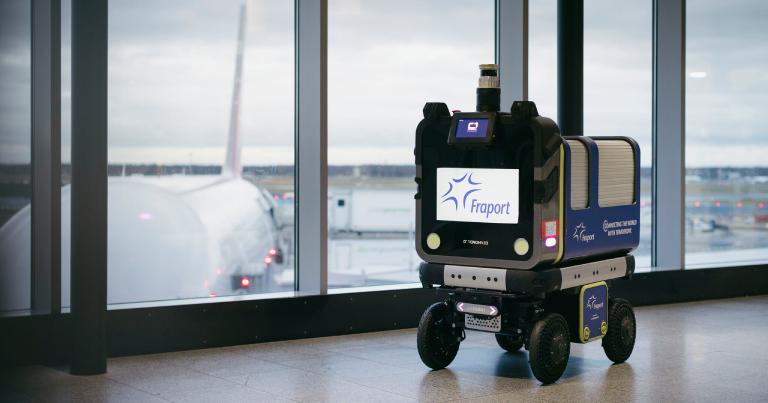
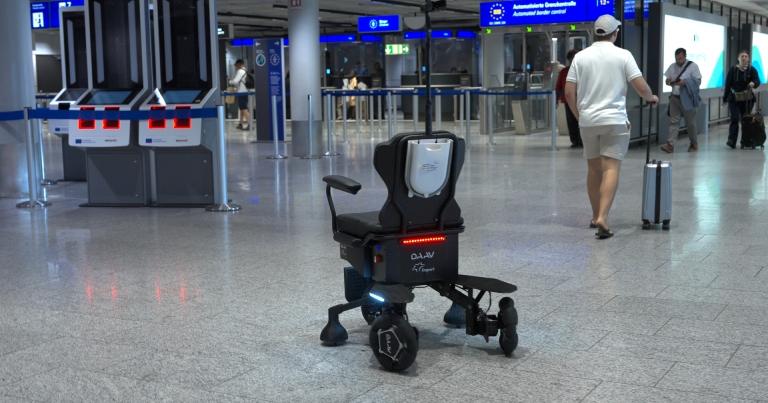
AI and robotics are central to Fraport’s innovation programme. The strongest impact comes from the direct implementation of market-ready and validated solutions. This includes transferring proven technologies from adjacent industries into airport operations, particularly in the field of robotics.
“An interesting observation is that we do not see AI impact concentrated in a single functional area,” Lützenberger shares. “Instead, value is being created in parallel across workplace solutions and operational use cases. AI has become a horizontal enabler, supporting efficiency, decision-making and resilience throughout the organisation rather than being limited to specific domains.”
Digital tools are absolutely essential to improving both operational efficiency and the passenger experience. Lützenberger highlights, however, that it is crucial to differentiate between use cases where fast implementation of market-ready solutions is appropriate, and those that require classic IT projects with potential custom development. “We are also cautious about simply digitising existing processes one-to-one. In many cases, we first challenge whether the underlying process should be redesigned – or adapted to fit a digital solution more effectively. This ensures that technology delivers real benefits rather than just replicating inefficiencies in digital form.”

Empowering people and fostering culture: Scaling digital innovation at Fraport
Scaling digital innovation isn’t just about technology, it’s also about people. Fraport has fostered a culture that supports experimentation and change across the organisation.
“Culture is the core enabler of digital transformation for us,” Lützenberger explains. “Through our central digitalisation initiatives, we aim to drive company-wide change in two ways. First, by delivering concrete, visible project results and showcasing an efficient, agile way of working. Second, through our ‘virtual employee’ concept. Employees from other departments temporarily work on our projects – even outside their core expertise. The goal is not only knowledge transfer, but to allow our fast and collaborative working methods to spread organically across the organisation. This approach has proven highly effective in building trust, ownership and openness towards change.”
One standout project delivered an ROI of over 800%, primarily driven by the elimination of 24/7 staffing requirements at more than five control points. The project implemented a technical surveillance solution to monitor vehicle exits from secured areas, ensuring that no unauthorised personnel or vehicles gain access. “As a result, manual monitoring by security personnel from the control building was fully replaced by an automated system,” says Lützenberger. “The deployed solution uses weather-resistant, tamper-proof sensors and forwards alarms directly to the central security control room, fully integrated into the incident management system. By redesigning the process and introducing a digital solution, we were able to significantly increase efficiency while maintaining safety and operational reliability.”
Ecosystem collaboration and emerging technologies: Driving predictive, resilient, and efficient airport operations
Partnerships are at the heart of Fraport’s ecosystem-driven approach. Collaboration with startups, technology providers and other airports allows Fraport to identify promising solutions early, benchmark its approaches and continuously challenge its ways of working. “Equally important is collaboration across the wider airport ecosystem,” Lützenberger shares. “Innovation scales best when stakeholders align on shared objectives and learn from each other. Digital transformation is not a solo effort – it is a collective journey.”
In terms of the emerging technologies and trends that will have the biggest impact on airport operations over the next few years, Lützenberger sees the greatest impact coming from the combination of AI-driven decision support, autonomous systems in constrained operational environments, and data-centric platform architectures. “These technologies will help airports move from reactive operations towards predictive and more resilient and automated operating models.”
Digitalisation will increasingly act as the balancing layer between the objectives of enhancing efficiency, resilience, and customer experience. “Efficiency gains free up capacity and resources, resilience ensures stability under disruption, and customer experience benefits indirectly through more reliable and predictable operations,” says Lützenberger. “The key is not to optimise one dimension at the expense of the others, but to design digital solutions that consciously address all three. When done right, digitalisation becomes a strategic enabler rather than a trade-off decision.”
APEX FTE EMEA: “An opportunity to validate ideas, challenge assumptions and bring fresh inspiration”
Lützenberger is eager to participate at the co-located APEX FTE EMEA and Ancillary & Retailing events, taking place in Dublin on 9 to 11 June 2026, where she is particularly looking forward to exchanging experiences with peers who face similar challenges across the industry. “The combination of strategic discussion, practical case studies and open dialogue makes APEX FTE EMEA and Ancillary & Retailing an excellent platform for learning and collaboration. Most of all, it is an opportunity to validate ideas, challenge assumptions and bring fresh inspiration back into our own transformation journey at Fraport.”
Register for the co-located APEX FTE EMEA and APEX FTE Ancillary & Retailing events – free for airlines, low-cost for airports >>Shaping the future of airports: The power of AI, collaboration, and digital ecosystems
As digital transformation continues to reshape the airport landscape, Fraport’s journey signals a shift in the industry toward seamless, AI-driven ecosystems that enhance both operational efficiency and passenger experience. By integrating AI, robotics, and data-centric platforms across every facet of its operations, Fraport is not only optimising day-to-day processes but also transforming the way decisions are made – moving from reactive management to proactive, data-driven insights. At the heart of this transformation is a culture that fosters collaboration, experimentation, and shared ownership, enabling faster innovation cycles and stronger outcomes. As the industry advances, the key to success will lie in how well organisations can scale these digital innovations, balance efficiency with resilience, and leverage human expertise in tandem with intelligent systems. At the upcoming APEX FTE EMEA and Ancillary & Retailing events, Marina Lützenberger will share insights into how these innovations are shaping the future of airports, urging industry professionals to consider not just the technology, but the ecosystem-wide collaboration that drives true transformation.
You may also be interested in
12 technology and CX trends that can enhance airline and airport operations in 2026
ADR, MUC, AMS, IST, LHR, DOH & more among FTE Airport Digital Transformation Power List EMEA 2026
12 innovations that have the potential to enhance CX and future-proof airport operations