




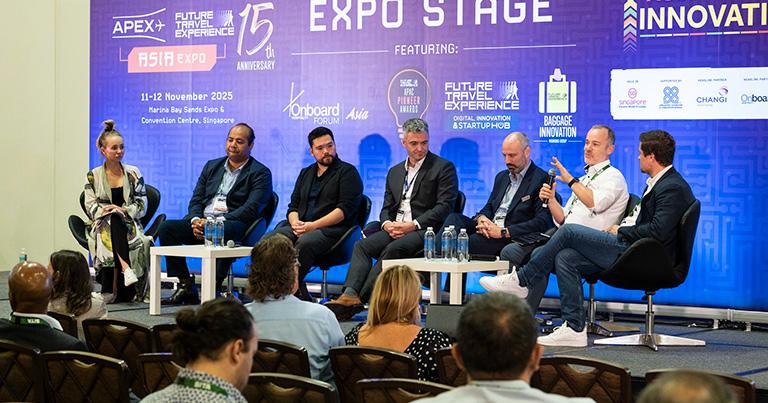
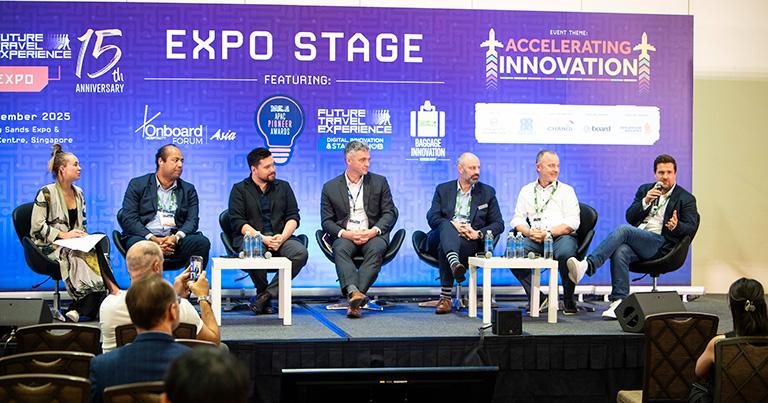
At APEX FTE Asia Expo 2025, which took place in Singapore on 11-12 November, a key session titled ‘Taking inflight entertainment and connectivity to new heights – opportunities and challenges’, brought together leaders from across the inflight entertainment, connectivity and content ecosystem. Moderated by Maryann Simson, Director, Jetway Communications, the panel featured senior representatives from Fiji Airways, Qantas, SES, Safran Passenger Innovations, Spafax and dgtlsky. Across the discussion, the panellists explored how airlines can personalise the inflight experience, move faster on innovation, navigate complex content licensing, use AI in smart ways, and prepare for a world where high-speed connectivity is expected, and increasingly free. Inflight Connectivity (IFC) will also be among the core focus areas at APEX TECH, taking place in Los Angeles on 27-28 January 2026.
View the full APEX FTE Asia Expo 2025 report >> Mark your diary for APEX FTE Expo Asia, Singapore, 18-19 November 2026 >>Content is key
A recurring theme was the shift from IFE as a static content library to IFE as a dynamic, branded ecosystem that supports storytelling, marketing and revenue generation.
Opening the discussion, Fiji Airways’ Chief Customer Officer Akuila Batiweti, said: “For us, the future of IFE is more personalised experiences and more authentic content. Content is key – it’s based around Fiji and the unique experiences of Fiji, and we use it as part of our marketing to promote the country.”
From the content service provider (CSP) side, Spafax emphasised that curation now spans the entire passenger experience, not just the seatback screen. “Content becomes not just a library – it’s an entertainment ecosystem,” said Dimitrios Tsirangelos, Vice President Business Development IFE Technology & Innovation, Spafax. “All CSPs are trying to help airlines engage with customers not only within the aircraft, but across the whole journey.”
That shift is also driving new thinking in advertising. CSPs are helping airlines position advertising, placed “at the right moment, for the right person” – to support revenue without overwhelming the passenger experience.
Breaking silos: building a connected digital cabin
Another key focus was the convergence of onboard digital systems, personal devices, crew tools, embedded IFE, and connectivity platforms, into a single, connected ecosystem.
“Historically, all these systems haven’t talked to each other,” said David Kondo, Executive Manager, Inflight Customer Experience, Qantas. “We’re now at the stage where they’re really starting to come together, and we’re building a digital platform and ecosystem around IFE and connectivity onboard.”
Jonas von Kruechten, Principal Advisor & Founder, dgtlsky, framed this as the emergence of the “digital cabin” – where touchpoints from lounges to personal devices and seatback screens are underpinned by common data and infrastructure. “Everything we put onboard happens in context,” he said. “As systems become more modular and API-based, the world opens up. New services can be plugged into an overall digital ecosystem, with connectivity and entertainment playing a key role.”
Suppliers like Safran Passenger Innovations (SPI) see their role as enablers of that ecosystem. “We don’t own the data – we facilitate it,” explained Ben Asmar, Vice President, Products and Strategy, Safran Passenger Innovations. “Data is the feed for deep personalisation. You have to integrate complex systems through APIs and secure data exchange. If we don’t move faster on that, we’ll be talking about personalisation five years from now while everyone else already has it.”
Connectivity: fast, free and fundamental
Passenger expectations around inflight connectivity have shifted dramatically. High-speed WiFi is becoming a basic expectation, while the model of charging for it is rapidly fading.
“For us, what’s hot right now is super-fast internet available the entire flight,” said Kondo. “What’s not is paying for WiFi. It’s becoming ‘not cool’ very quickly.”
From the satellite side, SES agreed. “The business model of a profitable standalone IFC product is in the past,” said Victor Brault, Senior Advisor, Airline Accounts, SES. “WiFi will be free, and it will enable new onboard experiences.”
For smaller carriers like Fiji Airways, the challenge is balancing expectation with economics. “Anything we add costs real money,” Batiweti noted, pointing to patchy coverage and US-dollar cost structures. Still, customer expectations are changing fast: “Ten years ago WiFi was a luxury. Today it’s basic.”
Licensing, streaming and what’s realistically possible
While passengers increasingly expect to stream onboard, the panel stressed that licensing remains a significant barrier.
“Content is intellectual property. Whoever uses it needs to pay a licence,” said Tsirangelos. “The principle is simple – but the process is specialised.”
Full integration of personal streaming accounts remains complex, as rights are licensed by territory, not for an aircraft in motion. In the meantime, the industry is exploring alternatives such as modern IPTV, FAST channels and edge-cached content.
There was consensus that the Airline Passenger Experience Association’s (APEX) work on educating the industry and shaping future licensing frameworks is essential to unlocking this space responsibly.
Data, personalisation and new revenue
Data emerged as a central driver of both experience and revenue. “With embedded IFE in every seat, you’ve got golden real estate,” said Kondo. “If you can personalise content and advertising properly, there’s a lot of value to unlock.”
Von Kruechten described a cycle where data enables targeting, which increases engagement, which then improves both loyalty and ancillary performance. Airlines and suppliers increasingly rely on A/B testing, rapid iterations and no-code tools to learn quickly and scale what works.
AI – gains and limitations
Artificial intelligence featured throughout the discussion, but the panellists were clear that AI is not a magic wand, rather a powerful tool for well-defined, repetitive or data-heavy tasks.
The technology is already streamlining content workflows, speeding up metadata generation, and supporting operational efficiency. Fiji Airways is focusing its AI efforts on operations and crew wellbeing first. Batiweti shared examples including AI-enabled cameras at gates to study turnaround efficiency and a new AI-driven crew rostering system designed to address perceptions of fairness. “It’s all about our philosophy of ‘happy people, happy customers, happy shareholders’. AI should buy our crew more time with guests – not take away the human touch,” Batiweti said.
Across the panel, there was caution against letting AI take over decisions that require judgement, particularly content curation. “If AI selects everything, you end up with normalisation,” warned Brault. “You still need a human being behind the experience.”
Tsirangelos also warned that even here, licensing considerations apply: “When you put a movie into an AI model, you’re exposing IP. Studios need to approve those solutions.”
Accessibility and inclusion – designing IFE for everyone
Not every passenger is a tech-savvy digital native, and the panel spent time discussing how to ensure innovation doesn’t leave anyone behind.
At SPI, accessibility has been a major focus over the past two years. “We looked at the broadest range of people who might need to interface with the IFE system,” Asmar explained. “It’s not just people with disabilities, it can be older passengers who need help navigating a complex system.”
The conclusion is that dedicated accessibility modes are essential. “You need a mode that takes away complexity,” he said. “You remove elements people are unlikely to use, keep the path to core functions like watching a movie as simple as possible, and use things like larger buttons and higher-contrast colours. It makes a significant difference.”
On the connectivity side, straightforward offers like free messaging provide inclusive value without requiring passengers to engage with more complex services.
Innovation at speed: testing, hardware challenges and the need for new frameworks
The session closed with a frank discussion about how to innovate faster and smarter.
Software and digital services now lend themselves to quick experimentation. “It’s easier and cheaper to develop a minimum viable product and test it very fast with bold airlines who are happy to be launch customers,” von Kruechten said. No-code platforms, live telemetry and remote updates mean products can be deployed, evaluated and removed in short cycles.
Hardware remains more challenging. “Bringing a new 4K display to the cabin can still take three to five years,” Asmar pointed out. “We can’t be an industry that takes five years to put a new product onboard that’s obsolete the minute it flies.”
Several panellists argued that alongside product innovation, aviation needs innovation in regulatory and certification frameworks – embracing approaches seen in sectors like automotive and healthcare, such as continuous certification and digital twins, without compromising safety.
For Batiweti and Fiji Airways, innovation is ultimately about being agile. “We don’t have the luxury of setting something up and taking it down every week,” he said. “But we’ve done enough over the years to understand what our guests want – multi-generational families, kids through to grandparents. We know we have to evolve, and we’re always looking for the next level of ‘excellent’ we can deliver, cost-effectively.”
This insightful session at APEX FTE Asia Expo 2025 showcased the breadth of innovation unfolding in the world of inflight entertainment and connectivity. With airlines, suppliers, and content providers collaborating to enhance the passenger experience, the future is clearly focused on personalisation, connectivity, and seamless integration. As technology evolves and passenger expectations continue to rise, the industry is moving toward a more dynamic, interconnected digital cabin where content, data, and AI play pivotal roles in shaping the future of air travel. However, as the panel emphasised, balancing these advancements with operational realities, regulatory frameworks, and an unwavering focus on accessibility will be key to ensuring that the passenger experience remains both cutting-edge and inclusive.
Inflight connectivity a core focus area of APEX TECH – Los Angeles, 27-28 January 2026
APEX TECH returns to Los Angeles on 27-28 January 2026 with an evolved format that continues to foster collaboration, inclusivity, and deeper engagement across the airline and passenger experience tech ecosystem. Building on the success of 2025, the Airline Passenger Experience Association (APEX) is bringing back its interactive workshop format and speed networking sessions – both designed to spark more dynamic, real-time exchange between attendees, experts, and airlines. In 2026 APEX TECH will continue to focus on the critical technologies shaping aviation today and tomorrow, while diving deeper into real-world airline use cases, passenger experience applications, and commercial opportunities. Inflight Connectivity (IFC) is among the core focus areas, which also include Media Content & Supply Chain, Data Capture & Intelligence, and Ancillary Revenue & Passenger Experience Use Cases.
Save the date for APEX FTE Expo Asia, 18-19 November 2026 – uniting the world in Singapore for the largest end-to-end passenger experience and innovation expo
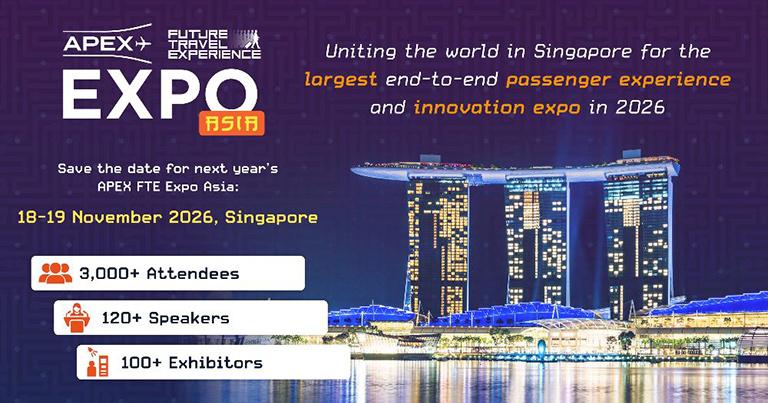
Next year, we’re building on 15 years of incredible momentum, as our long-running regional show evolves into a true global mega event with the launch of the unified APEX FTE Expo Asia, bringing together two of the industry’s most respected brands under one roof at the Marina Bay Sands. APEX will bring its largest event, APEX Global EXPO, to Singapore, combining its unrivalled customer experience heritage with FTE’s long-established regional innovation APAC event, which will now take on a broader global focus.
This powerful new collaboration will unite the world in Singapore for the largest end-to-end passenger experience and innovation expo, connecting airline, airport, and technology leaders from across APAC and beyond to showcase the ideas, solutions, and partnerships redefining the future of travel.
With more than 3,000 participants expected, including representatives from 100+ airlines and airport operators from around the world, attendees will experience a dynamic exhibition and conference programme featuring C-suite interviews, case studies, and discussions exploring the strategies, technologies, and collaborations driving the next era of air transport innovation.
Mark your diary for APEX FTE Expo Asia, Singapore, 18-19 November 2026 >>