




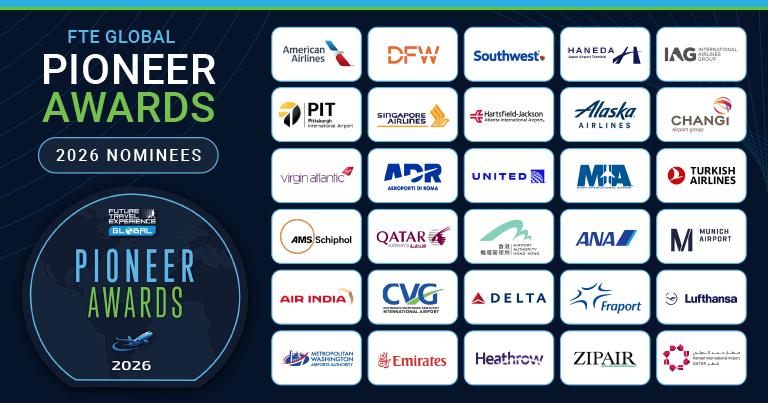
The shortlists for the FTE Global Pioneer Awards 2026 have been unveiled. Read our full awards preview in which we recognise the broad, long-term commitment of these 30 pioneering airlines and airport operators from across the world that are consistently pushing the boundaries to enhance the passenger experience, drive innovation and redefine the future of air travel. Six of the 30 nominees will be presented with an ‘Outstanding Achievement’ trophy during the presentation ceremony in Dallas, Texas. The ceremony will take place during the FTE Global Networking Welcome Party on 8 September, with the FTE Global Pioneer Awards Ceremony sponsored by Assaia, providing the perfect opportunity to honour global innovators among industry friends and colleagues. Congratulations to all of the airlines and airport operators that have been nominated.
See the FTE Global schedule at a glance >> Register for FTE Global >>FTE Global Airline Pioneer Awards 2026 nominees:
American Airlines
 American Airlines – a Headline Partner of FTE Global, taking place in Dallas, Texas, on 8 to 10 September 2026 – is continuing to transform the customer journey through a series of strategic technology investments spanning boarding, disruption management, digital self-service and the wider airport experience. At the centre of this approach is a focus on giving customers greater control, clarity and confidence throughout their journey.
A key achievement has been the introduction of ACE, a modern, device-agnostic web-based boarding platform that replaced a legacy application which had supported the airline for more than 25 years. Fully sunset in March 2026, ACE now supports boarding operations across more than 300 airports globally and provides a scalable foundation for further innovation. It has enabled intelligent boarding validation and real-time alerts, helping American consistently enforce boarding groups and ensure customers receive the benefits associated with their fare, loyalty status and premium products. Building on this platform, American also became the first major U.S. network carrier to deploy airline-specific electronic boarding gates at scale, first introduced at the new Terminal C expansion at Dallas Fort Worth International Airport.
American is also using digital technology to make disruption management more transparent and actionable. New delay and cancellation explanations in the airline’s app and website help customers understand what is happening and why, while an enhanced disruption platform brings rebooking, checked-bag tracking and eligible hotel, meal and transportation resources together in one place. Tailored push notifications, emails and text messages further ensure customers receive timely information, while automation is helping accelerate recovery, including automated meal vouchers and check-in for eligible customers on rebooked itineraries.
Meanwhile, American’s redesigned mobile app is evolving into a digital travel companion, bringing trip information, boarding passes, flight status, disruption support and other self-service tools together in a more intuitive experience. More than two million customers have already opted into TSA PreCheck Touchless ID, helping eligible travellers move through participating security checkpoints without presenting a physical ID or boarding pass.
Together, these initiatives demonstrate American’s strategy of using technology to remove complexity at every stage of travel – from booking and boarding to disruption recovery and airport security – while delivering measurable improvements in customer satisfaction and the overall travel experience.
Hear more from American Airlines at the 20th anniversary edition of FTE Global, taking place in Dallas, Texas, on 8 to 10 September 2026. Jim Moses, Senior Vice President of DFW Operations, American Airlines, is speaking alongside Mohamed Charkas, EVP, Chief Development and Infrastructure Officer, Dallas Fort Worth International Airport, in a session titled ‘Case Study Spotlight: Future airport design, collaboration and operating strategies’ with a presentation titled ‘A deep dive on the new Terminal F at DFW International Airport’. Meanwhile, Gary Tomasulo, Vice President, Corporate Security & Chief Security Officer, American Airlines, is participating in the U.S. CBP Symposium.
See the FTE Global schedule at a glance >> Register for FTE Global >>Southwest Airlines
 Southwest Airlines – a Headline Partner of FTE Global, taking place in Dallas, Texas, on 8 to 10 September 2026, and a Corporate Partner of the FTE Digital, Innovation & Startup Hub – is transforming its technology foundation and operational model through cloud computing, artificial intelligence (AI), automation and real-time data. In partnership with Amazon Web Services (AWS), Southwest is transitioning from a largely on-premises environment to a cloud-based, AI- and agent-enabled architecture by 2028, creating a more flexible foundation for how it operates, builds and serves customers.
A major focus is modernising its technology and data environment. Southwest is expanding its AWS footprint while developing new platforms to support complex applications, data science, analytics, optimisation and system integration. AI and agent-based capabilities are being introduced across the business to automate tasks, accelerate decision-making and simplify processes. More than 2,700 developers are using AWS’ Kiro agentic coding service to modernise Southwest’s website, refactor legacy code, build features, automate testing and generate cloud infrastructure, turning tasks that previously took hours into processes completed in minutes.
This shift is also creating a new approach to software development through the AI-Driven Development Lifecycle, with AI agents helping move development forward while engineers remain responsible for guiding and validating outcomes. AI is also being applied to operational decision-making, including predicting flight risks and providing actionable alerts to help teams manage disruptions. Robotics, IoT and predictive analytics are similarly being explored across staffing, maintenance and ground operations.
On the ramp, Southwest is moving Smart Ramp technologies from trials into live operations, using real-time data and automation to improve visibility of gate readiness, equipment availability and task sequencing. The aim is to make turnarounds more predictable while reducing injuries, equipment conflicts, damage and avoidable delays.
Southwest is also enhancing the onboard digital experience, with its first Starlink-equipped aircraft now providing high-speed inflight WiFi, with additional aircraft being retrofitted.
Together, these initiatives demonstrate Southwest’s integrated approach to digital transformation, combining AI, cloud, automation, connectivity and real-time data with a strong focus on employees and practical operational outcomes to create a safer, more reliable and seamless journey.
Hear more from Southwest Airlines at the 20th anniversary edition of FTE Global, taking place in Dallas, Texas, on 8 to 10 September 2026:
- Lauren Woods, Executive Vice President & Chief Information Officer, Southwest Airlines, is participating in a Keynote Fireside Chat titled ‘How Southwest Airlines will use technology to achieve its aim to be the world’s most loved, most efficient, and most profitable airline’.
- Andrew Watterson, Chief Operating Officer, Southwest Airlines, is participating in a session focused on ‘Airline and airport leadership strategies to be future-ready’.
- Steve Goldberg, SVP of Operations and Hospitality, Southwest Airlines, is participating in a session titled ‘Towards the smart apron: Automating the turnaround process’.
- Justin Bundick, Vice President, Artificial Intelligence & Intelligence Platforms, Southwest Airlines, is participating in ‘The FTE AI Symposium – Part 1: A little less conversation a little more AI action’ with a presentation titled ‘The Southwest Way: Implementing AI while preserving a people-first culture’.
- Ted Gordon, VP Airport Affairs, Southwest Airlines, is participating in a session titled ‘In, out and around: Future airport mobility approaches’.
- Kevin Kleist, Head of Emerging Trends, Southwest Airlines, is facilitating a workshop titled ‘Successful Change Management Approaches’.
- Tom Garrison, Enterprise Architect Emerging Trends & Innovation, Southwest Airlines, is speaking in a session titled ‘The FTE Data Sharing Think Tank: Will widespread data collaboration ever become a reality?’
- Nicola Smith, Sr. AI Advisor, Southwest Airlines, is speaking in a session focused on ‘How AI and other technologies are reimagining the end-to-end customer journey and empowering the workforce’.
International Airlines Group
 International Airlines Group (IAG) – a Corporate Partner of the FTE Digital, Innovation & Startup Hub – is embedding innovation at the heart of its transformation strategy, using emerging technology, open innovation and Group-wide collaboration to enhance customer experience, improve operational efficiency and support more sustainable aviation. Its initiatives span artificial intelligence (AI), automation, connectivity, baggage, aircraft maintenance and fuel efficiency, creating pathways for technologies to move from experimentation into real-world deployment across its airlines.
A key element is the IAGi Accelerator, which has partnered with more than 120 companies since launch. In 2025, a record 29 startups from 11 countries joined the programme, including 14 companies on the Deploy Track undertaking 12-week proofs of concept with IAG operating companies. Many participants progress to extended trials, commercial agreements or investment through IAGi Ventures, creating a clear route from promising technology to aviation-scale deployment.
One example is AISmartPlan, which partnered with Aer Lingus to transform aircraft maintenance production planning. Its AI-powered platform combines flight schedules, aircraft availability and workforce constraints to generate optimised maintenance plans, reducing a process that previously took hours each day to one completed in minutes. Following a successful proof of concept, AISmartPlan has signed a multi-year commercial agreement with Aer Lingus, with potential to scale across IAG.
IAG is also investing in technologies with sustainability potential. Through IAGi Ventures, it has invested in MAKO, developer of Flightfilm, a shark skin-inspired adhesive film designed to reduce aircraft drag and potentially cut fuel consumption, emissions and operating costs. A pilot with an IAG airline is planned, subject to successful trials and certification.
Meanwhile, IAG’s partnership with Starlink will bring high-speed inflight WiFi to more than 500 aircraft across Aer Lingus, British Airways, Iberia, LEVEL and Vueling, significantly enhancing onboard connectivity.
IAG is also applying technology to baggage through biometrics, enhanced tracking and self-service tools, providing faster information and more proactive support during disruption.
By connecting its accelerator, venture investment and airline operations, IAG has created an innovation ecosystem designed not simply to identify emerging technologies, but to test, refine and scale those capable of delivering measurable improvements across aviation.
Hear more from International Airlines Group (IAG) at the 20th anniversary edition of FTE Global, taking place in Dallas, Texas, on 8 to 10 September 2026. Keith Walters, Group Transformation Lead, International Airlines Group / IAG Airports, is participating in a session titled ‘The FTE Data Sharing Think Tank: Will widespread data collaboration ever become a reality?’
See the FTE Global schedule at a glance >> Register for FTE Global >>Singapore Airlines
 Singapore Airlines – a Headline Partner of APEX FTE EXPO, taking place in Singapore on 18-19 November 2026 – is placing digital innovation at the centre of its customer experience and operational strategy, combining artificial intelligence (AI), generative AI (GenAI), digital collaboration and next-generation connectivity to create more seamless journeys and empower employees.
A key focus is the development of a blueprint for adopting GenAI across the airline. Singapore Airlines is working with OpenAI to develop advanced GenAI solutions capable of interpreting text, audio, diagrams and video to augment customer servicing, streamline processes and improve staff productivity. The collaboration initially focuses on enhancing the airline’s AI-powered virtual assistant, creating a more intuitive way for customers to plan, book and manage their journeys.
Singapore Airlines is also applying AI to support employees and strengthen operational capabilities. Through its Digital Innovation Lab, KrisLab, the airline works with startups and entrepreneurs to identify practical applications of emerging technologies. One example is an AI- and speech-recognition-powered crew language competency app, which provides cabin crew with asynchronous learning tools to improve language skills, enunciation and onboard announcements. This reflects an approach focused not simply on automation, but on augmenting the people delivering the customer experience.
The airline is also preparing to introduce Starlink low Earth orbit satellite broadband progressively from the first quarter of 2027, initially across its Airbus A350-900 long-haul, A350-900 ultra-long-range and A380 fleets. Providing high-speed, low-latency connectivity in all cabin classes, the service will enable customers to stream video, game, use social media and transfer large files throughout their journey. It will build on Singapore Airlines’ existing complimentary inflight WiFi offering.
Innovation is further supported through collaboration across the aviation ecosystem. Singapore Airlines has signed a Memorandum of Understanding to participate in the International Aviation Lab established by the Civil Aviation Authority of Singapore, creating additional opportunities to explore innovation projects with industry partners.
By combining GenAI, AI-enabled employee tools, startup collaboration and next-generation connectivity, Singapore Airlines is turning emerging technologies into practical improvements that make travel more connected, personalised and productive for customers and employees.
Alaska Airlines
 Alaska Airlines – a Corporate Partner of the FTE Digital, Innovation & Startup Hub – is using artificial intelligence (AI), automation, computer vision and next-generation connectivity to transform both operational performance and the customer experience. Its innovation strategy focuses on applying emerging technologies to practical challenges, from baggage and ramp operations to personalised travel discovery and inflight connectivity.
A major focus is the airline’s Smart Ramp programme, which uses AI and automation to improve baggage handling. Algorithms analyse baggage locations, agent positions and flight schedules to optimise the dispatch and routing of baggage handlers. The programme builds on Alaska’s use of Assaia’s AI-powered computer vision and Pattern Labs’ automated bag dispatch technology, with robotics also being explored. By applying real-time intelligence to ramp operations, Alaska aims to ensure more guests and their bags reach their destinations together and on time.
Alaska is also pioneering the use of GenAI for travel discovery. Its Alaska Inspires platform allows travellers to ask questions in natural language and receive personalised destination recommendations, whether planning a family holiday or looking to maximise rewards points. The conversational tool has delivered higher conversion rates than Alaska’s traditional search engine, demonstrating how GenAI can help customers find the right journey rather than simply compete on price.
Looking ahead, Alaska is exploring agentic AI and computer vision to create a more proactive airline. Proofs of concept include personal AI agents for more seamless digital interactions and computer vision for improved baggage tracking, potentially providing greater operational visibility and reducing disruption.
Connectivity is another major focus. Alaska and Hawaiian Airlines have equipped approximately 150 aircraft with complimentary Starlink-powered WiFi, with installations continuing across the mainline fleet. Alaska was the first U.S. carrier to equip its entire regional jet fleet with Starlink and is extending the technology to Boeing 787-9 Dreamliners ahead of its expanding long-haul network.
Together, these initiatives demonstrate Alaska’s human-centred approach to innovation, combining AI-powered operations, personalised GenAI, computer vision, robotics and high-speed connectivity to create a more proactive, reliable and seamless travel experience.
Hear more from Alaska Airlines at the 20th anniversary edition of FTE Global, taking place in Dallas, Texas, on 8 to 10 September 2026. Amber Simonsen, Director, Passenger Service Systems Integration, Alaska Airlines, is participating in a session titled ‘Case Study Spotlight: Big & bold new tech strategies – visions, deployments, learnings and next steps’ with a presentation on ‘Enterprise Transformation at Scale: How Alaska & Hawaiian Airlines transitioned to a single PSS and unlocked a more seamless guest experience’. Bernadette Berger, Director of Innovation, Alaska Airlines, is moderating ‘The FTE AI Symposium – Part 2: A deep-dive into Agentic AI and the move towards Artificial General Intelligence’. Nicole Hodges Austin, Innovation Program Manager, Alaska Airlines, is participating in a session titled ‘Advanced robotics and humanoids: Is the air transport industry ready?’ Meanwhile, Gus Naughton, Principal Software Engineer, Alaska Airlines, is speaking in a session titled ‘The FTE Data Sharing Think Tank: Will widespread data collaboration ever become a reality?’
See the FTE Global schedule at a glance >> Register for FTE Global >>Virgin Atlantic
 Virgin Atlantic is accelerating its digital transformation by combining artificial intelligence (AI), personalisation and next-generation connectivity with the human warmth at the heart of its premium customer experience. The airline is exploring how AI can reshape retailing, customer service and operations, with the aim of using technology to remove friction while giving employees more opportunities to create memorable experiences.
A major milestone is Virgin Atlantic Concierge, an AI-powered travel companion developed with OpenAI and Tomoro. Available across the Virgin Atlantic and Virgin Atlantic Holidays websites, Concierge uses multimodal AI to understand traveller preferences and provide personalised recommendations for flights, holidays and travel experiences through natural conversation. Customers can tap, type or talk, while the tool also supports Flying Club queries and customer assistance. Virgin Atlantic has gone further by becoming the first airline to launch an app within ChatGPT, allowing customers to search for flights using everyday language before completing their booking through Virgin Atlantic’s digital channels.
The airline’s new mobile app brings more of the journey together in one place, enabling customers to search and book flights, select seats and meals, request assistance, check in, access boarding passes, manage Flying Club accounts and receive real-time notifications. Passport-scanning technology simplifies passenger data entry, while Concierge provides personalised support throughout the journey.
Virgin Atlantic is also exploring AI-powered personalised retailing, from tailored offers, premium dining and lounge access to transfers and destination experiences. AI could also improve catering by predicting demand based on route, seasonality, loyalty preferences and other factors, helping reduce waste. During disruption, the technology could understand what customers have purchased and proactively offer appropriate recovery options while preserving ancillary purchases.
Connectivity is another key pillar. Virgin Atlantic is accelerating its Starlink rollout across A350, Boeing 787 and A330neo fleets, targeting fleet-wide coverage by 2027 and providing fast, low-latency WiFi throughout the flight, with free access for Flying Club members.
Together, Concierge, the mobile app, ChatGPT integration, AI-led retailing and Starlink demonstrate Virgin Atlantic’s vision of technology that augments rather than replaces people – creating a more connected, intuitive and personalised journey while preserving the human service that defines the brand.
Hear more from Virgin at the 20th anniversary edition of FTE Global, taking place in Dallas, Texas, on 8 to 10 September 2026. In a compelling keynote, Nicole Huang, SVP Fleet Experience, Virgin Voyages, will share outside of the industry inspiration on reimagining the guest journey.
See the FTE Global schedule at a glance >> Register for FTE Global >>United Airlines
 United Airlines is using artificial intelligence (AI), agentic AI, cloud technology, robotics and next-generation connectivity to create a more personalised, proactive and reliable travel experience. AI is a long-term strategic priority, with investment spanning digital platforms, operations, inflight connectivity and automation to deliver tangible benefits for customers and employees.
A key focus is the evolution from generative AI to agentic AI, with United piloting autonomous AI agents in areas including legacy application modernisation, developer productivity and contextual value engineering. The airline is also exploring applications in predictive maintenance and hyper-personalised customer engagement, using modular architectures, governance and human-in-the-loop controls to integrate agents safely with existing systems.
At the customer-facing level, United is making its app increasingly proactive. More than 84% of customers use the app on the day they fly, with features including Virtual Gate, personalised navigation with walking times, real-time bag tracking, travel-document reminders, biometric boarding options and tailored arrival information. AI helps predict which features will be most useful to individual customers, effectively turning the app into a personal travel assistant.
United is simultaneously transforming the inflight experience. More than 400 aircraft are now equipped with Starlink, with more than 800 targeted by the end of 2026 and full fleet coverage before the end of 2027. More than seven million passengers have already travelled on Starlink-equipped aircraft, with WiFi satisfaction scores nearly doubling. The connectivity also supports enhanced entertainment, including live television and Peacock content across seatback screens and personal devices.
Innovation extends to the physical experience through products such as Relax Row, which will create a couch-like space across three Economy seats, and a new Economy Plus configuration on the Airbus A321XLR providing additional personal space.
Operationally, United is exploring autonomous baggage carts, robotic loading and unloading, automated pushback and autonomous mobility devices with WHILL to improve accessibility.
Together, these initiatives demonstrate United’s vision of an increasingly intelligent airline, connecting agentic AI, personalised digital services, autonomous technologies and high-speed connectivity to give customers greater control while enabling employees to make faster, smarter decisions.
Hear more from United Airlines at the 20th anniversary edition of FTE Global, taking place in Dallas, Texas, on 8 to 10 September 2026. Kushal Pasari, Director of GenAI & ML Engineering, United Airlines, is participating in ‘The FTE AI Symposium – Part 2: A deep-dive into Agentic AI and the move towards Artificial General Intelligence’.
See the FTE Global schedule at a glance >> Register for FTE Global >>Turkish Airlines
 Turkish Airlines is pursuing an ambitious digital transformation strategy with the goal of ranking among the top three global airlines for digital passenger experience. With its centennial in 2033 as a long-term milestone, the airline is investing across artificial intelligence (AI), airline retailing, fintech, biometrics and connectivity to create a more personalised digital journey while strengthening the resilience of its 24/7 operations. Turkish Technology, its technology-focused subsidiary with more than 1,500 employees, plays a central role in developing the capabilities underpinning this transformation.
As part of its comprehensive innovation efforts, the Turkish Airlines Venture Capital Investment Fund was launched in May 2026. This backs early-stage startups focusing on AI, mobility, sustainability, and digital aviation services.
A key focus is modern airline retailing. Turkish Technology has developed a merchandising layer on top of its in-house passenger service system, bringing offer composition, bundling and pricing flexibility together. This enables Turkish Airlines to create contextual offers based on passenger, segment and service characteristics, with dynamic Business Class upgrades already responding to factors such as load, timing and passenger context. Similar capabilities are being extended across ancillary products, marking a shift from traditional fare construction towards more flexible, personalised offer construction throughout the journey.
The airline is also preparing for the growing role of AI-powered travel interfaces. By developing its own underlying capability to construct and manage differentiated offers, Turkish Airlines aims to ensure that emerging AI assistants can present structured, contextual products while the airline retains control of its commercial proposition.
Across the passenger journey, TK Wallet simplifies payment and refunds for Miles&Smiles members, while partnerships with Google and Samsung enable baggage tracking through Find Hub and SmartThings Find. Turkish Airlines is also exploring biometrics, robotics and automation in baggage handling and aircraft turnarounds, with technology designed to augment rather than replace employees.
Connectivity is another major focus. More than 100 narrowbody aircraft are being upgraded through a partnership with Anuvu and Profen, with AI-powered network management delivering more stable connections during periods of high demand. Deployed aircraft have recorded more than nine-fold higher throughput, four-times faster upload speeds and around 25% lower latency.
Together, these initiatives demonstrate Turkish Airlines’ ambition to build a more intelligent, resilient and personalised digital airline, combining control of its core technology and commercial proposition with strategic partnerships to enhance the passenger experience at every touchpoint.
Qatar Airways
 Qatar Airways continues to blend human connection with technological innovation, using artificial intelligence (AI), virtual reality, intelligent digital products and next-generation connectivity to create a more personalised and seamless passenger experience. Its approach focuses on using technology not simply to automate interactions, but to anticipate customer needs, remove friction and create new ways for passengers and employees to engage with the airline.
At the forefront is Sama 2.0, the world’s first AI-powered flight attendant, building on Qatar Airways’ pioneering work with conversational AI and its QVerse virtual travel experience platform. Together, these technologies are opening new possibilities for digital engagement and helping the airline identify customer pain points across the pre-travel journey.
Qatar Airways is also developing intuitive digital products that put passengers in control. Q Search enables customers to ask natural-language questions about products and services and receive immediate conversational answers, while the Qatar Airways app brings together AI-powered features, personalisation and intuitive navigation to make managing journeys faster and simpler.
The airline is extending its digital ambitions into future technologies, with its work in AI and Virtual Reality providing a foundation for potential applications of Augmented Reality (AR) and the Internet of Things (IoT). These could enable context-aware information and smarter connections between airport facilities, aircraft and inflight services.
Connectivity is another major pillar. Qatar Airways has become the first carrier globally to equip the Boeing 787-8 with Starlink, following the completion of its 777 and A350 installation programmes. Nearly 120 widebody aircraft – more than 58% of its widebody fleet – are now Starlink-equipped, delivering speeds of up to 500 Mbps. More than 10 million passengers have experienced the complimentary service, enabling streaming, video calls and high-bandwidth activities throughout their journeys.
Importantly, Starlink is also enhancing employee experience and operational efficiency. Crew can receive instant flight and roster updates and coordinate with ground teams in real time, while engineers can monitor inflight entertainment systems remotely and prepare recovery plans before landing.
Together, Sama 2.0, Q Search, QVerse, the Qatar Airways app and Starlink demonstrate a connected digital strategy spanning discovery, servicing, connectivity and operations, with technology designed to enhance – rather than replace – the human experience.
All Nippon Airways
 All Nippon Airways (ANA) – a Partner of the FTE Baggage Innovation Working Group – is taking a pioneering approach to transforming airport and aircraft turnaround operations through automation, artificial intelligence (AI) and human-machine collaboration. At the heart of this journey is ANA’s participation in the FTE Smart Ramp initiative, which aims to make aircraft turnaround increasingly autonomous, efficient and sustainable.
ANA’s contribution centres on autonomous towing tractors for cargo transportation, designed to move cargo between the warehouse and apron with reduced manual intervention. Following extensive Proof of Concept testing, the autonomous towing tractor entered operational use in 2025, providing valuable insight into the practical challenges of deploying autonomous vehicles in complex ramp environments while demonstrating how robotics can work alongside ground handling personnel.
For ANA, Smart Ramp is about more than individual vehicles. The airline is working with industry partners and the Japan Civil Aviation Bureau (JCAB) to help establish the infrastructure, operational guidance and regulatory framework required for autonomous airport operations at scale. Its human-centred approach recognises that successful automation depends on involving the employees who understand ramp operations and co-creating new ways of working with them.
ANA sees this collaborative model as a potential milestone towards a fundamentally different turnaround operation by 2030, in which autonomous vehicles and people work together to improve safety, productivity and sustainability.
Alongside its work in autonomous ground operations, ANA is pioneering AI for flight safety. The airline became the first in the world to implement an AI-based turbulence prediction service developed by BlueWX, using deep learning trained on a decade of turbulence data. The model achieved 86% accuracy and was validated through trials involving around 2,500 ANA pilots before integration into the airline’s weather data infrastructure. By enabling crews to anticipate turbulence more accurately, the system has the potential to improve passenger comfort and safety while reducing disruption and associated costs.
ANA is also advancing its ANA Smart Travel proposition, enabling passengers to use their smartphones throughout their journey for a smoother, increasingly contactless experience.
Together, ANA’s autonomous ramp programme, AI-powered turbulence prediction and digital passenger services demonstrate a clear strategy of harmonious human-technology collaboration – using intelligent machines to reduce repetitive work and improve decision-making while empowering employees and enhancing the passenger experience.
Air India
 Air India is redefining the inflight experience through a series of proprietary innovations spanning comfort, content and cultural product design. Over the past 12 months, its Onboard Experience function has moved beyond addressing legacy gaps to developing new solutions aligned with the airline’s renewed brand identity, combining passenger satisfaction with operational efficiency.
One example is the Self-Securing Cushion-cum-Mattress Topper, an industry-first product that combines multiple premium-cabin bedding items into a single convertible solution. Engineered with multi-layer padding, breathable fabric and memory foam, it provides daytime seating support and overnight sleep cushioning while reducing premium-cabin bedding weight by around 30%, simplifying storage and saving approximately 8,000 crew effort hours annually.
Air India has also developed Vista Rating, a proprietary 0-100 scoring system designed specifically for inflight entertainment. Combining global viewing trends and popularity data with aviation-specific judgement from IFE experts, the system helps passengers navigate an increasingly extensive entertainment library and reach a confident first choice 22% faster.
Meanwhile, the Cutting Chai Experience brings an iconic Indian ritual into the premium cabin. Developed with Tata Consumer Products, Air India created a bespoke masala chai premix calibrated for taste perception at altitude, paired with a refined interpretation of the traditional glass and served with cookies on an elegant base plate in First and Business Class. Standardising the recipe has reduced preparation time by approximately 70%, while creating a distinctive cultural experience for Indian and international travellers.
The impact of these innovations is reflected in an 11.4% increase in inflight customer satisfaction, alongside more than 21 global awards for inflight experience since Tata’s re-acquisition of Air India. Across the three initiatives, the airline reports more than 88,000 crew effort hours saved annually, together with significant cost savings.
By combining comfort engineering, proprietary content science and authentic cultural storytelling, Air India is demonstrating that passenger experience innovation and operational efficiency can be achieved together. Rather than simply adopting established solutions, the airline is developing original, India-rooted innovations designed to differentiate its onboard experience at scale.
Delta Air Lines
 Delta Air Lines – a Partner of the FTE Baggage Innovation Working Group – continues to put technology, personalisation and human-centric design at the heart of its vision for the future travel experience. The airline is expanding the role of artificial intelligence (AI), digital identity, connected technologies and personalised digital experiences across the passenger journey.
A key focus is the evolution of the Fly Delta app and Delta Concierge, which uses generative AI to create more seamless and personalised experiences. Delta is extending this approach through Delta Locals, a digitally focused travel-planning platform featuring immersive content and curated itineraries created by residents of destinations including Los Angeles, Tokyo, Patagonia and Sicily. The ambition is to become a one-stop shop for dreaming, planning, booking and arriving at a destination, combining technology with authentic human insight.
At the airport, Delta is using digital identity and government partnerships to remove friction. Customers connecting from London Heathrow to Atlanta can increasingly bypass baggage reclaim and recheck at U.S. Customs, while eligible passengers can bypass redundant TSA screening when connecting onward from ATL. App Bag Drop is expanding across Delta hubs, while TSA PreCheck Touchless ID uses facial matching to accelerate bag drop and security processing. Delta says Touchless ID can reduce bag-drop processing by up to 75%, with security processing taking as little as 7–10 seconds.
Personalisation also extends to the commercial proposition, with Basic fare options now available across premium products including Delta First, Delta Premium Select and Delta One, giving customers greater control over price, flexibility and benefits.
The airline is simultaneously investing in its onboard experience. Its next-generation Delta One suite will debut on Airbus A350-1000 aircraft from 2027, alongside upgraded suites, larger 24-inch 4K-quality screens, Bluetooth connectivity, wireless charging and improved accessibility.
Connectivity is another major pillar. Following its rollout of fast, free Wi-Fi, Delta has announced a long-term collaboration with Amazon to introduce Amazon Leo satellite connectivity, with initial installation planned across 500 aircraft from 2028. Combined with cloud technology and AI, this will support faster, more personalised digital experiences onboard.
Together, these initiatives demonstrate Delta’s ambition to make technology increasingly invisible within the travel experience – giving customers greater choice, control and personalisation while retaining the human connection at the heart of its proposition.
Lufthansa
 Lufthansa – a Partner of the FTE Baggage Innovation Working Group – is placing artificial intelligence (AI), digitalisation and personalisation at the heart of its transformation strategy. Through its Digital Hangar business unit, Lufthansa Group is focused on accelerating digital transformation and creating “the world’s best connected travel experience”, with AI increasingly being applied to customer experience, operational efficiency and disruption management.
AI and machine learning are being deployed across areas including personalised customer interactions, smart disruption management and predictive maintenance, supported by a long-term collaboration with Infosys on AI- and data-driven solutions. The Lufthansa Group app continues to act as a digital companion throughout the journey, while the group is developing increasingly connected and personalised customer services.
Personalisation is also central to Lufthansa’s onboard transformation. The airline has launched FOX – Future Onboard Experience across all cabin classes on long-haul services, representing one of its largest investments in customer experience. More than €70 million is being invested in the new premium service during 2026, with redesigned processes, greater choice and new “Signature Moments” across First, Business, Premium Economy and Economy.
Business Class features new culinary concepts and menus created by chef Johann Lafer, while Premium Economy introduces a choice of three hot main courses during the first service. Economy passengers benefit from new amenity kits, upgraded tableware, expanded beverage choices and greater meal selection on longer flights. The approach reflects Lufthansa’s ambition to deliver a more distinctive and personalised experience across the entire aircraft, rather than concentrating innovation solely on premium cabins.
Lufthansa is also exploring immersive and autonomous technologies. Its collaboration with Meta continues to investigate Meta Quest 3 mixed-reality headsets for Allegris Business Class passengers, building on Lufthansa Group’s use of Extended Reality for training and marketing. Autonomous vehicles and automation are also being explored on the ramp to improve operational efficiency and transform how employees work.
Meanwhile, the group is strengthening its digital loyalty proposition. By the end of 2026, Miles & More will become Lufthansa Group Miles & More, creating a more unified loyalty ecosystem across airlines and customer touchpoints, with greater opportunities for personalised experiences.
Together, these initiatives demonstrate Lufthansa Group’s strategy of combining AI and advanced technology with human-centric service – creating a more intelligent, connected and personalised journey while maintaining the premium hospitality at the heart of its brands.
Emirates
 Emirates – a Partner of the FTE Baggage Innovation Working Group – continues to place innovation, technology and customer-centricity at the heart of its strategy, with an increasing focus on artificial intelligence (AI), robotics, Extended Reality (XR) and immersive digital experiences. Its approach spans customer experience, employee engagement, operational efficiency and commercial performance, using emerging technologies to shape the future of aviation.
AI is becoming an increasingly important component of Emirates’ digital transformation. The airline has entered into a strategic collaboration with OpenAI to accelerate AI adoption across the organisation, exploring practical use cases while developing an internal AI champion network and establishing an AI Centre of Excellence. The aim is to build the skills, processes and technology required to embed AI more deeply across the business and generate tangible operational and customer benefits.
Emirates is also exploring immersive technologies for employee experience and training. In collaboration with Amazon Web Services (AWS), the Emirates Group has developed an Extended Reality platform incorporating 3D virtual hubs, virtual training, gamified environments and simulated experiences. Spatial computing and AI are being combined to create more engaging ways for cabin crew, new joiners and industry partners to learn and collaborate.
More broadly, the airline’s Innovation Majlis at its Dubai headquarters provides a platform for exploring robotics, AI, XR, Web 3.0, holograms, hyper-reality and advanced sensor technologies, helping Emirates investigate emerging capabilities and potential applications.
Innovation also extends directly to the passenger experience. Emirates’ One Device Initiative equips cabin crew with connected devices and custom applications to personalise service, streamline operations and enhance safety. Meanwhile, its multibillion-dollar fleet retrofit programme is upgrading cabins and premium seating across the fleet.
The airline is also bringing greater personalisation to Economy Class through its new U-Dream Headrest, which features flexible side wings and adjustable positioning to provide improved head and neck support. It is being introduced across all Emirates A350s and most A380 and Boeing 777 aircraft.
Together, these initiatives demonstrate Emirates’ ambition to combine advanced technology with human expertise. From AI and spatial computing to robotics, connected employee tools and personalised passenger experiences, Emirates is building an innovation ecosystem designed to improve how its people work and how customers experience the airline, while continuing to explore technologies that can support more efficient and sustainable operations.
ZIPAIR Tokyo
 ZIPAIR Tokyo has taken a fundamentally different approach to airline technology, questioning traditional processes and redesigning them from first principles. Since launching scheduled operations in 2020, the airline has built a software-defined operating model in which connectivity, computing, cabin operations and payments work together as a single digital ecosystem.
A key foundation is Starlink, which ZIPAIR deployed across its fleet in May 2026, making it the first airline in Asia with fleet-wide Starlink connectivity. Beyond providing free high-speed Wi-Fi to passengers, the low-latency network connects aircraft and ground systems in real time, supporting payment authorisation, connected cabin operations, cockpit weather information and engineering support.
Building on this connectivity layer, ZIPAIR has deployed a single 16-inch MacBook Pro with an M4 Pro chip as the onboard server across its Boeing 787-8 fleet. This commercial off-the-shelf approach replaces multiple proprietary systems with a portable computing platform supporting entertainment, inflight sales, crew applications and cabin systems, improving reliability, deployment agility and cost efficiency.
Running on this architecture is AltoNex, ZIPAIR’s proprietary inflight cabin operations and digital commerce platform. Passengers can browse, order and pay using their own devices, replacing fixed cart service and reducing cabin interruptions and crew workload. Over more than 20,500 flights, the system has managed around 300 onboard orders and 200 pre-orders on a typical long-haul flight with just seven cabin crew serving up to 290 passengers. Real-time payment authorisation also prevents approximately 30,000 fraudulent transactions annually, avoiding more than US$200,000 in potential losses.
Supporting the ecosystem is ZIPAIR’s Payment Orchestration Platform (POP), which provides reusable payment infrastructure, allowing new products and services to be introduced without separate payment integrations. The airline has also extended its digital commerce capabilities beyond the aircraft through AKIBA GO, connecting Japanese e-commerce and travel fulfilment.
Together, Starlink, edge computing, AltoNex and POP demonstrate ZIPAIR’s software-first approach to aviation. Rather than simply digitising existing processes, the airline is creating a new operating model that combines commercially available technology with proprietary platforms to deliver greater flexibility, efficiency and choice for passengers while establishing a scalable blueprint for the wider industry.
FTE Global Airport Pioneer Awards 2026 nominees:
Dallas Fort Worth International Airport
 Dallas Fort Worth International Airport (DFW) – a Headline Partner of FTE Global, taking place in Dallas, Texas, on 8 to 10 September 2026, and a Corporate Partner of the FTE Digital, Innovation & Startup Hub – continues to make digital transformation a central pillar of its Travel. Transformed strategy, with a clear ambition to reinvent how the airport operates while delivering more seamless, personalised and efficient experiences.
DFW is embracing artificial intelligence (AI), machine learning, autonomous mobility, connectivity and data-driven operations. Its ground-breaking Digital Twin is enabling proactive, real-time decision-making to support sustainability, efficiency and resilience. Meanwhile, DFW is working with Copenhagen Optimization on a cloud-based Resource Management System spanning baggage handling, check-in and gate management. By integrating multiple data sources, the platform will enable real-time optimisation, rapid re-planning during disruption, capacity planning and scenario analysis.
Digital tools are also being placed directly in passengers’ hands. The myDFW ecosystem and DFW Airport app provide real-time parking availability, Prebook Parking, security wait times, flight updates, interactive maps and dining and shopping information. With more than 900,000 travellers using a myDFW account and the app, the launch of myDFW Rewards adds a personalised loyalty dimension, allowing Prebooked Parking customers to earn points towards future savings.
Connectivity is another foundation of DFW’s digital strategy. A partnership with AT&T includes a $10 million investment to modernise wireless infrastructure and expand free public WiFi, while a private 5G network is supporting new Internet of Things (IoT) applications and connected operational use cases. Smart signage is also being deployed to provide more dynamic, data-driven airport communications.
DFW is combining this digital transformation with major physical investment. Together with American Airlines, it has opened nine new gates as part of the Terminal C redevelopment, featuring electronic boarding gates, enhanced wayfinding, expanded seating, power stations and upgraded concessions. Modular construction is helping accelerate delivery while minimising operational disruption. This forms part of the wider DFW Forward programme, with $12 billion being invested to modernise and expand the airport.
Underpinning DFW’s approach is collaborative innovation, including participation in the Airports for Innovation network and partnerships with airlines, technology companies, governments and startups.
Together, these initiatives demonstrate a holistic vision for the digital airport, combining AI, real-time data, connected infrastructure and smart passenger services to create a more responsive, flexible and customer-focused journey from curb to gate.
Hear more from Dallas Fort Worth International Airport (DFW) at the 20th anniversary edition of FTE Global, taking place in Dallas, Texas, on 8 to 10 September 2026. Chris McLaughlin, CEO, DFW, is speaking in the Opening Keynote Session. Mohamed Charkas, EVP, Chief Development and Infrastructure Officer, DFW, is participating in a session focused on ‘Future airport design, collaboration and operating strategies’ alongside Jim Moses, Senior Vice President of DFW Operations, American Airlines, with a presentation titled ‘A deep dive on the new Terminal F at DFW International Airport’. Sharon McCloskey, VP Customer Experience, DFW, is joining a panel discussing ‘How AI and other new technologies are reimagining the end-to-end customer journey and empowering the workforce’. Meanwhile, Jerome Woodward, Executive Vice President of Operations, DFW, is participating in the U.S. CBP Symposium.
See the FTE Global schedule at a glance >> Register for FTE Global >>Japan Airport Terminal Co. Ltd
 Japan Airport Terminal – the organisation responsible for the construction, management and operation of Haneda Airport’s terminals – is at the forefront of airport innovation through its visionary “terminal.0 HANEDA” initiative. This ambitious cross-industry collaboration brings together technology companies, startups and industry stakeholders to reimagine the airport of the future, focusing on cutting-edge technology, sustainability, operational efficiency and passenger experience. The FTE World Innovation Summit, hosted by Haneda Airport, will take place in Tokyo, Japan, on 1-3 March 2027, bringing the global aviation and innovation community together in one of the world’s leading technology hubs.
At the heart of terminal.0 HANEDA is the ambition to develop practical, scalable solutions that can be deployed not only at Haneda but at airports worldwide. The initiative is exploring artificial intelligence (AI), robotics, automation, biometrics and the Internet of Things (IoT) to create a smarter, more seamless passenger journey. AI could enable the airport to predict passenger flows and peak periods, allowing staffing and resources to be allocated proactively, while robotics and automation can support areas such as baggage handling. Biometric technologies, including facial recognition, also have the potential to streamline processes from check-in and security through to boarding.
Sustainability is another core pillar, with terminal.0 HANEDA exploring green technologies, energy-efficient infrastructure and waste-reduction initiatives. The organisation’s commitment is also reflected in the planned opening of the Terminal 1 North Satellite facility on 1 September 2026, featuring a hybrid timber-and-steel structure designed with carbon neutrality in mind.
Crucially, Japan Airport Terminal’s approach is based on collaboration and co-creation, using Haneda as a living testbed where airports, airlines, technology companies and startups can identify challenges, test concepts and develop solutions with potential for wider deployment.
Through terminal.0 HANEDA and its wider innovation programme, Japan Airport Terminal is demonstrating how airports can combine AI, automation, biometrics, connected infrastructure and sustainable design with a strong focus on human experience. As host of FTE World Innovation Summit 2027, it will also provide a global platform for exploring the technologies and ideas shaping the airports of tomorrow.
Pittsburgh International Airport
 Pittsburgh International Airport (PIT) – a Corporate Partner of the FTE Digital, Innovation & Startup Hub – is transforming the passenger journey through its $1.7 billion Terminal Modernization Program, fundamentally rethinking how travellers move through one of the region’s most important civic spaces. Replacing a 1990s-era facility designed for a different era of aviation, the new 811,000-square-foot terminal is tailored to Pittsburgh’s origin-and-destination travel patterns, combining streamlined passenger flows, future-ready technology, accessibility, sustainability and wellbeing.
At the heart of the project is a simpler, more intuitive airport experience. Ticketing, security, baggage claim and ground transportation are consolidated into a single structure, eliminating operational redundancies and creating a clearer journey from curb to gate. A centralised 12-lane security checkpoint and significantly shortened baggage-handling system further improve efficiency, with conveyance lines reduced from approximately eight miles to three to four miles. PIT expects the redesign to increase processing speed by up to 80% while reducing energy consumption, maintenance requirements and operating costs. The airport has also removed its legacy automated people mover, demonstrating a willingness to rethink outdated infrastructure rather than simply layer new technology onto it.
Technology and future-readiness are embedded throughout the terminal, with real-time information displays, dynamic wayfinding and infrastructure designed to support next-generation passenger processing and automation. PIT has also become the first transportation facility to receive Innovative Solutions for Universal Design Certification, reflecting its comprehensive approach to accessibility.
Sustainability and resilience are equally central. The terminal is powered by an on-site microgrid combining solar energy and natural gas, allowing PIT to generate its own power and maintain operations during outages and extreme weather. High-efficiency systems, smart lighting, rainwater capture and durable, locally sourced materials further reduce resource consumption and support long-term performance.
Passenger wellbeing has also shaped the design, with outdoor terraces, natural light, native planting, quiet rooms and sensory-friendly spaces creating a more inclusive environment.
Together, these initiatives demonstrate PIT’s vision of an airport that goes beyond transportation: combining operational efficiency, intelligent infrastructure, universal design, resilience and passenger wellbeing to create a future-ready gateway built specifically for Pittsburgh and its community.
Hear more from Pittsburgh International Airport at the 20th anniversary edition of FTE Global, taking place in Dallas, Texas, on 8 to 10 September 2026. In a compelling keynote, Christina Cassotis, CEO, Pittsburgh International Airport, will share a presentation titled ‘One year on: The biggest lessons learned from the opening of Pittsburgh International Airport’s new terminal’. This will explore the realities of bringing a bold airport vision to life, the operational and passenger experience learnings that have emerged since opening, and the insights other airport leaders can apply to their own transformation programmes.
See the FTE Global schedule at a glance >> Register for FTE Global >>Hartsfield-Jackson Atlanta International Airport
 Hartsfield-Jackson Atlanta International Airport (ATL) is demonstrating that innovation and sustainability leadership can be driven by transparency, accountability and a strong focus on the passenger experience. Through its Environmental, Social and Governance (ESG) Report, ATL has created a comprehensive framework for tracking sustainability performance while progressing towards ambitious targets, including net-zero greenhouse gas emissions by 2050, 100% clean and renewable energy by 2035 and 90% waste diversion from landfills by 2035.
The 2025 ‘A Century in Flight’ ESG Report, published as ATL celebrated its centennial, brings together five years of data across key environmental, social and governance metrics. The report is supported by the airport’s Sustainability Management, Climate Adaptation, Carbon Management, Net Zero and Waste Diversion plans, providing transparency around progress and establishing measurable intermediary targets.
Importantly, ATL has demonstrated that sustainability reporting can directly enable investment. Over the past three years, the airport has raised more than $1.6 billion through green bonds supported by its ESG reporting. In 2025, more than 90% of bonds issued were green bonds, helping fund six capital projects including concourse and gate modernisation, a steam boiler replacement and other sustainable infrastructure.
ATL’s innovation extends beyond environmental performance to creating a more seamless, inclusive and human-centred passenger experience. The airport is using AI, biometrics, customer insights and digital tools to reduce friction while maintaining the value of human interaction. Its approach recognises that technology should complement, rather than replace, staff who provide personal assistance, empathy and support when passengers need it most. ATL is also embedding accessibility into its culture through the ACI Accessibility Accreditation programme.
The FIFA World Cup provided a major real-world test of this approach, with ATL welcoming an unusually high number of international travellers over roughly 45 days and testing its operational readiness, staffing and customer-service capabilities at scale. The experience reinforced the importance of clear, consistent communication and a strong employee culture.
By connecting sustainability, data-driven innovation, accessibility and customer experience, ATL is demonstrating that the airport of the future should not simply move passengers efficiently, but create a place where people feel informed, comfortable and genuinely valued.
Hear more from Hartsfield-Jackson Atlanta International Airport (ATL) at the 20th anniversary edition of FTE Global, taking place in Dallas, Texas, on 8 to 10 September 2026. David Sconzo, Sr. Customer Experience Manager/Assistant FIFA Lead, ATL, is participating in ‘The Customer Experience Leaders Symposium’. Wesley Almeida, Chief Technology Officer, ATL, is delivering a joint presentation with Corey Clothier, Founder & CEO, Aribo & Global Automated Mobility Lead, Arcadis, titled ‘Implementing autonomous vehicles at one of the world’s busiest airports’ in ‘The Autonomous Vehicles Symposium: How can the air transport industry successfully scale the rollout of autonomous vehicles?’ Meanwhile, Jon Pruitt, Chief Data Officer, ATL, will deliver a joint presentation alongside Ashish Sharma, Chief Technology Officer, Nagarro, in a session titled ‘Case Study Spotlight: Big & bold new tech strategies – visions, deployments, learnings and next steps’.
See the FTE Global schedule at a glance >> Register for FTE Global >>Changi Airport Group
 Changi Airport Group (CAG) – a Headline Partner of APEX FTE EXPO, Singapore, 18-19 November 2026 – continues to place digital transformation and innovation at the heart of its ambition to create the airport of the future. Its digital factory, DIVA – Digital, Innovation, Ventures and Analytics – develops, experiments with and launches digital products and services designed to transform operations and enhance the end-to-end traveller experience. Changi Airport Group has also opened a new innovation hub, Terminal X. Designed to bring innovators together under one roof, Terminal X is a dynamic space dedicated to collaboration, creativity, and real-world experimentation. Featuring facilities including a makers’ lab, UI/UX testing environments, and immersive storytelling chambers, it offers a unique glimpse into how the future of travel is being shaped today, reflecting Changi’s continued commitment to accelerating innovations and elevating passenger experience.
Through its SMART Airport Vision, Changi is pioneering the use of artificial intelligence (AI), data analytics, automation, sensors and connected technologies to make travel more seamless, efficient, personalised and sustainable. AI and advanced analytics are being explored across security and airport operations, while biometrics and self-service technologies support faster passenger processing. Changi is also leveraging Extended Reality, machine learning, Internet of Things (IoT) and edge computing across the passenger journey.
This technology-led approach is complemented by innovative infrastructure. Changi has completed its first satellite gate, bringing the comfort and accessibility of an aerobridge experience to flights operating from remote stands. The facility features two aerobridges and a gently sloping 60-metre ramp, improving accessibility for wheelchair users, seniors, families and passengers with wheeled luggage. Designed as a zero-energy facility, it is powered by rooftop solar panels and an off-grid battery system, while smart building technology automatically activates air-conditioning based on flight information and wirelessly alerts maintenance teams to electrical faults.
Changi is also developing a new private terminal and premium amenities cluster, scheduled to open in mid-2027, offering personalised journeys including private suites, bespoke dining, wellness experiences and direct access to boarding.
Looking further ahead, Terminal 5 is central to Changi’s long-term transformation. Construction began in May 2025, with completion planned for the mid-2030s. Meanwhile, CAG is investing S$3 billion over six years across Terminals 1 to 4 to modernise baggage, check-in, immigration and Skytrain systems ahead of rising demand.
Through DIVA and collaboration with industry partners and the Civil Aviation Authority of Singapore’s International Aviation Lab, CAG is creating a living testbed for emerging technology. From AI and biometrics to zero-energy infrastructure and immersive experiences, Changi is continually reinventing both the operational foundations and passenger experience of the smart airport.
Aeroporti di Roma
 Aeroporti di Roma (ADR) – a Corporate Partner of the FTE Digital, Innovation & Startup Hub – is delivering measurable impact across passenger experience, operational efficiency and sustainability.
At the heart of this approach are the Innovation Hub at Rome Fiumicino Airport and the Runway to the Future acceleration programme, which give startups access to a live airport environment in which solutions can be tested under real operational, security and passenger-service conditions. The programme has attracted more than 1,280 startups and generated 1,683 innovation proposals, leading to more than 40 Proofs of Concept, with approximately half progressing to deployment.
Recent trials have focused on artificial intelligence, generative AI, robotics, automation and smart infrastructure, including baggage-handling automation, autonomous cleaning systems, digital inspection platforms and sustainability technologies. One baggage automation pilot with Azalea Robotics reduced baggage-transfer execution time from approximately two minutes to around eight seconds during testing, highlighting the potential for technology to deliver significant operational efficiencies.
ADR is also embedding innovation across its workforce. Its Innovation Cabin Crew programme has involved 72 employees from different business units as innovation ambassadors and startup mentors, while the Hangar internal entrepreneurship programme has generated more than 100 employee ideas across two editions.
Beyond its own operations, ADR is helping shape innovation across the wider aviation ecosystem through Airports for Innovation (A4I), a global alliance representing more than 800 million passengers. Its first joint startup call attracted 292 proposals from 36 countries, demonstrating the potential of collaborative innovation and shared startup scouting.
More recently, ADR has moved from experimentation to large-scale deployment of Outsight’s Spatial Intelligence technology across common-use areas in Rome Fiumicino’s Schengen zone. Using LiDAR and Physical AI, the system provides real-time insights into passenger flows, queues and congestion, supporting data-driven resource allocation and laying the foundations for more predictive airport operations.
Together, these initiatives demonstrate ADR’s ability to connect experimentation with adoption, while engaging employees and partners to create measurable, scalable innovation across the airport and the wider aviation industry.
Miami International Airport
 Miami International Airport (MIA) – a Corporate Partner of the FTE Digital, Innovation & Startup Hub – is undergoing a major digital transformation, with the Miami-Dade Aviation Department (MDAD) building a secure, self-managed technology infrastructure designed to support a smarter, more connected and predictive airport. At the foundation is a Private Wireless Network (PWN), providing high-bandwidth, low-latency connectivity across the airport and enabling real-time data sharing between critical systems.
This is complemented by an enterprise Common Data Environment (CDE) and Modern Data Estate, creating a single source of truth for operational data and enabling faster, data-driven decision-making. Building on this architecture, MDAD has deployed what it describes as the world’s first large-scale, geo-aware, agentic AI-powered airport hologram assistants. Supporting more than 40 languages, the life-sized holograms provide conversational, location-aware wayfinding and passenger assistance, with the same digital engine extending across MIA’s web and messaging channels to create a seamless omnichannel experience.
MIA is also using its data infrastructure to drive sustainability and employee-led innovation. During an airport Hackathon, internal developer teams created an AI-powered environmental chatbot that draws directly on CDE data streams, allowing employees to access live sustainability metrics and environmental indicators. This demonstrates how MDAD’s infrastructure can provide a platform for rapidly developing solutions to real-world operational challenges.
The airport is extending its technology transformation into operations and security. A new $33 million Airport Operations Center and Digital Monitoring Hub, scheduled for completion in 2027, will feature AI-powered cameras, real-time digital tower technology and an integrated panoramic video wall providing visibility across MIA’s airside, landside and terminal areas. Meanwhile, biometric technology is streamlining the passenger journey, with CLEAR eGates introduced at two screening checkpoints and TSA PreCheck Touchless ID available at concourses D, E and H.
Together, these initiatives demonstrate MIA’s approach to digital transformation: building secure core infrastructure, harnessing its own data and applying AI, biometrics and automation to improve operations, security, sustainability and the passenger experience. The result is a scalable blueprint for a more intelligent, connected and future-ready airport.
Hear more from Miami International Airport at the 20th anniversary edition of FTE Global, taking place in Dallas, Texas, on 8 to 10 September 2026. Maurice Jenkins, Chief Innovation Officer, Miami International Airport, is participating in ‘The FTE AI Symposium – Part 1: A little less conversation a little more AI action’ with a presentation titled ‘How MIA is embracing AI to deliver tangible benefits across the business’.
See the FTE Global schedule at a glance >> Register for FTE Global >>Amsterdam Airport Schiphol
 Royal Schiphol Group – a Corporate Partner of the FTE Digital, Innovation & Startup Hub – is accelerating its digital transformation agenda with an ambitious vision to become Europe’s smartest airport by 2030. Schiphol is pursuing its Vision 2050 strategy, which categorises innovation across ‘Earth’ (incremental), ‘Moon’ (transformational) and ‘Mars’ (disruptive) projects, with the ultimate ambition of achieving fully autonomous, zero-emission airside operations by 2050.
Artificial intelligence (AI), machine learning, robotics, automation and the Internet of Things (IoT) are increasingly forming the backbone of Schiphol’s operational transformation. The airport is moving towards an orchestrated, data-driven ecosystem in which real-time data, predictive analytics and human expertise work together to optimise capacity, improve operational predictability and create a more seamless passenger experience. AI-powered tools including Dynamic Time Slots, Real-time Passenger Flow Balancing and Gate Planning Insights are already delivering measurable results. Dynamic Time Slots have steered 7.5% of passengers away from peak moments – rising to 22% on critical days – with 99.6% of passengers waiting less than 10 minutes for security. Meanwhile, Flow Balancing uses real-time sensor data, predictive models and digital twin technology to prevent congestion.
Schiphol is also taking the next step towards autonomous airport operations through collaboration across the aviation ecosystem. Its Aviation Solutions division brings proven innovations to market, while partnerships with airlines, technology companies and innovation programmes are accelerating robotics, automation and autonomous ground operations. A notable example is a new electric, self-driving baggage vehicle developed with KLM and Aurrigo International, which is designed to optimise baggage handling, reduce emissions and improve working conditions for ground crews. Schiphol has also deployed a private 5G network, providing the secure, real-time connectivity infrastructure required for increasingly automated and connected airside operations.
Meanwhile, Schiphol is combining its digital transformation with a major programme to improve the physical passenger experience. Its long-term Schiphol Master Plan will invest in the quality, functionality and comfort of the airport, supported by a unified design vision that aims to restore Schiphol to a position among Europe’s top three hub airports for quality. New in-house architectural teams will work across the terminal to create a more consistent, recognisable and sustainable environment, with a particular focus on intuitive wayfinding, passenger comfort, modular construction and long-term efficiency.
This combination of technology, data, design and collaboration reflects Schiphol’s ambition to redefine what a modern airport can be. By bringing AI-powered decision-making, digital twins, autonomous systems, private 5G and human expertise together across the airport ecosystem, Schiphol is not simply digitising existing processes but fundamentally rethinking how airport capacity, operations and passenger flows are managed – establishing a potential blueprint for Europe’s next generation of smart, seamless and sustainable airports.
Airport Authority Hong Kong
 Airport Authority Hong Kong (AAHK) is positioning Hong Kong International Airport (HKIA) at the forefront of the Airport 4.0 era, leveraging high-performance connectivity, automation, biometrics and smart technologies to transform the airport into a smarter, safer and more convenient “Airport City”.
A key enabler is HKIA’s Enterprise 5G Infrastructure, which allows all Hong Kong mobile network operators and HKIA’s private 5G network to deliver services through a shared infrastructure. The high-capacity, ultra-reliable and low-latency network provides the digital backbone for connected devices, autonomous vehicles and intelligent airport systems. In 2025, AAHK expanded its autonomous vehicle fleet to 70, while private 5G is also supporting autonomous apron line-marking robots that automate complex taxiway and runway work, improving safety and efficiency.
AAHK is deploying 5G, Internet of Things (IoT) and artificial intelligence (AI) across the airport to enhance operations and passenger experience. More than 150 5G-enabled movable display panels provide real-time flight information and wayfinding, while connected infrastructure supports remote monitoring, preventive maintenance and more predictive airport operations.
Meanwhile, HKIA is delivering a seamless biometric passenger journey through the full deployment of Flight Token (One ID) across departure checkpoints. Facial recognition is embedded into check-in and security processes, while cloud-based, 5G-enabled smart kiosks further streamline passenger processing.
The newly opened Terminal 2 represents a major milestone, with extensive use of smart technology including 68 express self-bag-drop counters, 58 smart check-in kiosks, 20 e-Security Gates using facial recognition, 15 smart security screening channels, 35 e-Channels and 60 immigration counters. Large-scale LED displays and immersive 3D content add a strong digital dimension to the passenger environment.
AAHK is also continuing to expand automation across the wider airport, integrating autonomous vehicles, robotic apron operations, 5G-enabled IoT infrastructure and advanced video analytics.
Together, these initiatives demonstrate how 5G, AI, biometrics, IoT, robotics and autonomous mobility can be deployed at scale. With Terminal 2 providing a digitally enabled gateway and Flight Token connecting key passenger touchpoints through trusted digital identity, HKIA is establishing a compelling blueprint for the smart, connected and passenger-centric airport of the future.
Munich Airport
 Munich Airport – a Corporate Partner of the FTE Digital, Innovation & Startup Hub – is strengthening its position as a Premium Innovation Hub, combining advanced technology with industry partnerships and a human-centred approach to digital transformation. Its strategy focuses on using robotics, automation and artificial intelligence (AI) not simply to automate existing processes, but to empower employees, improve operational efficiency and create a more seamless passenger experience.
A major focus is the deployment of collaborative robotics and autonomous systems across the airport. Service robots including JEEVES, a self-driving robot delivering snacks and beverages, and Ottobot, an autonomous passenger assistant providing information, rebooking and refund support, are demonstrating how robotics can work alongside employees to enhance customer service. In partnership with Fraunhofer IML, Munich Airport is also pioneering BagBOT and evoBOT, robotic systems designed to support aircraft loading and unloading, handle hazardous goods and reduce the physical burden of heavy lifting.
Meanwhile, Munich Airport is increasingly applying AI, generative AI, process mining and data-driven decision-making to optimise operations. AI-supported turnaround management and real-time asset tracking help employees make faster decisions, while the Next Best Process project combines process mining and AI to identify opportunities to improve operational speed and efficiency. Its AIRHART platform and corporate data lake bring together previously disparate data sources, supporting predictive incident management and AI-driven decision-making.
Collaboration is central to this strategy. Munich Airport participates in the Airports for Innovation network and FTE Smart Ramp initiative, exploring how robotics, automation and autonomous vehicles can transform aircraft turnaround. Its MUC2030 innovation roadmap and Loyalty Hub partnership with Lufthansa and Miles & More are also using collaboration, data sharing and digital services to create more personalised passenger experiences.
The airport’s LabCampus provides a real-world testbed where startups, research institutions and established companies can develop and test smart infrastructure, digital services and mobility concepts in an operational airport environment.
Together, these initiatives demonstrate Munich Airport’s vision of technology and people working hand-in-hand. By using intelligent automation to reduce physical strain, simplify tasks and give employees better information and tools, Munich Airport is building a more efficient, resilient and passenger-centric airport while reinforcing its position at the forefront of aviation innovation.
Hear more from Munich Airport at the 20th anniversary edition of FTE Global, taking place in Dallas, Texas, on 8 to 10 September 2026. Thomas Hoff Andersson, Managing Director & Chief Operating Officer, Munich Airport, is participating in a session focused on ‘Airline and airport leadership strategies to be future-ready’.
See the FTE Global schedule at a glance >> Register for FTE Global >>Cincinnati/Northern Kentucky International Airport
 Cincinnati/Northern Kentucky International Airport (CVG) – a Corporate Partner of the FTE Digital, Innovation & Startup Hub – is one of the aviation industry’s most progressive real-world testing environments for robotics, automation, artificial intelligence (AI) and emerging technologies. CVG’s innovation team takes a practical, experimentation-led approach, using its 7,700-acre campus as a living laboratory where new technologies can be tested, refined and scaled in an operational airport environment.
CVG’s robotics journey began in 2019 with the introduction of autonomous floor scrubbers and sweepers, and the airport has continued to push the boundaries of what autonomous technology can deliver. It became the first airport innovation team to introduce Gita, Piaggio Fast Forward’s following robot, into an airport environment, using the technology for traveller surveys and ‘surprise and delight’ passenger engagement initiatives. CVG has since introduced Ottonomy’s autonomous goods-delivery robot and Aurrigo’s Auto-DollyTug, an autonomous baggage tractor designed to transform the handling of baggage and other ground operations. These initiatives demonstrate CVG’s willingness to move emerging technologies beyond demonstrations and into practical airport use cases.
AI and machine learning are also becoming increasingly important to CVG’s innovation strategy. The airport is collaborating with Tuatara Consulting to implement scalable, AI-enabled software for critical limits evaluation and alternative routing, helping maximise strategic growth opportunities while identifying and mitigating potential operational bottlenecks. At the same time, CVG is exploring how AI can support a more personalised and inclusive passenger experience.
Accessibility is another distinctive area of innovation. CVG has achieved success with Signapse for AI-powered American Sign Language (ASL) digital signage, trialled MagnusCards to support non-English-speaking employees, and tested autonomous wheelchairs. These projects reflect the airport’s broader philosophy of using technology to remove barriers and create a more accessible experience for passengers and employees.
CVG is also actively expanding its innovation ecosystem through its Innovation Partner Program, working with a broad range of startups and technology companies to identify, test and develop new solutions. Its latest collaboration with Germany’s GATE Alliance formalises an international partnership focused on airport supplier innovation, technology testing and cross-border business collaboration. A joint working group will facilitate technology demonstrations, pilot projects, introductions and potential investment opportunities across areas including automated and electric mobility, advanced manufacturing, low-emissions fuels and energy infrastructure.
This combination of robotics, AI, accessibility technology, autonomous mobility, startup collaboration and real-world experimentation has given CVG a distinctive role within the aviation innovation ecosystem. By opening its airport campus to emerging technologies and creating pathways for startups and established technology companies to test solutions in live operational conditions, CVG is demonstrating how airports can become innovation platforms in their own right – accelerating the journey from promising proof of concept to practical aviation deployment.
Hear more from Cincinnati/Northern Kentucky International Airport (CVG) at the 20th anniversary edition of FTE Global, taking place in Dallas, Texas, on 8 to 10 September 2026. Brian Cobb, Chief Innovation Officer, CVG Airport, is participating in a session titled ‘Case Study Spotlight: Big & bold new tech strategies – visions, deployments, learnings and next steps’. He will deliver a joint presentation alongside Miles Garner, Chief Commercial Officer, Aurrigo, focused on ‘Two regulators, one runway: How CVG and Aurrigo are writing the rules for human-in-the-loop autonomy’. Meanwhile, Beth Larkcom, Director of Strategic Innovation, CVG Airport, is moderating a session titled ‘In, Out and Around: Future Airport Mobility Approaches’.
See the FTE Global schedule at a glance >> Register for FTE Global >>Fraport
 Fraport – a Corporate Partner of the FTE Digital, Innovation & Startup Hub – continues to place digital transformation at the heart of its long-term Fraport.2030 strategy, with more than 100 digital projects running across its operations. These span cloud technologies, private 5G, digital twins, Internet of Things (IoT), robotics, biometrics and artificial intelligence (AI), with the objective of increasing digital maturity, reducing costs, creating new revenue opportunities and enhancing customer and employee experiences.
Fraport’s AI@Fraport initiative is exploring generative AI, large language models, computer vision, reinforcement learning and cyber-autonomous systems as horizontal capabilities that can improve decision-making, efficiency and resilience. At Frankfurt Airport, the Intelligent Dispatching Agent (IDA) uses deep reinforcement learning and real-time data to dynamically assign ground-handling tasks and optimise complex aircraft turnaround operations.
AI is also transforming airport security. APIDS (Automatic Prohibited Item Detection Systems) automatically identifies prohibited items in X-ray images while keeping security personnel responsible for the final decision. Meanwhile, Fraport’s large-scale biometric ecosystem enables passengers to use facial recognition from enrolment through automated pre-security gates and self-boarding, creating a more seamless journey.
The Digital Factory is a key engine of Fraport’s innovation ecosystem, using rapid Proofs of Concept and Minimum Viable Products to identify and develop promising solutions. More than 65 MVPs have been developed and over 50 digitalisation projects scaled, including autonomous wheelchairs, Foreign Object Debris-detection robots and other robotics applications.
Fraport is also leading the AeroAS Autonomous Airport Operations Program, bringing together more than 120 airports worldwide to accelerate adoption of autonomous technologies across areas such as logistics and crew transportation. By sharing expertise, development costs and standards, the programme aims to make autonomous operations more scalable across aviation.
Crucially, Fraport recognises that transformation depends on people and culture as much as technology. Its “virtual employee” concept allows staff to join digital projects temporarily, building expertise and ownership while spreading agile ways of working. Successful pilots are progressively exposed to operational and regulatory complexity before being scaled.
By combining AI, robotics, automation, biometrics and a disciplined approach to innovation, Fraport is moving from reactive towards increasingly predictive and autonomous airport operations – while demonstrating how digitalisation can deliver measurable improvements in efficiency, resilience and customer experience.
Metropolitan Washington Airports Authority
 Metropolitan Washington Airports Authority (MWAA) – a Corporate Partner of the FTE Digital, Innovation & Startup Hub – has spent the past decade building a strong culture of in-house innovation through its technology innovation team, MWAA Labs. The team is exploring artificial intelligence (AI), agentic AI, robotics, automation, digital twins, Internet of Things (IoT), cloud services and predictive analytics to transform operations, passenger experience and commercial performance across Washington Dulles International Airport and Ronald Reagan Washington National Airport.
A key focus is moving beyond AI that simply analyses information towards agentic AI that can sense, decide and act. MWAA Labs is developing this capability through its Queue Hub platform, which combines real-time sensing with AI-driven decision-making to predict and optimise passenger flows, vehicle movements and resource allocation. Rather than simply reporting conditions, Queue Hub can recommend or initiate actions such as reallocating TSA staff, opening customs lanes or dispatching mobile lounges based on predicted demand. The technology is also being explored for predictive maintenance, parking optimisation and curbside congestion management.
This action-oriented approach is being applied to practical challenges. At Dulles, MWAA is testing automated taxi dispatch that can release 10 taxis at a time when curbside demand requires it. At Reagan National, virtual queuing will allow taxi drivers to join the queue remotely when entering a defined geofence, reducing congestion while freeing drivers from having to wait at the airport.
MWAA is also transforming the wider passenger journey through virtual queueing, passenger-flow optimisation and a digital marketplace bringing airport products and services together through a single platform. As a member of the FTE Smart Ramp programme, it is exploring autonomous technologies that could make aircraft turnaround increasingly efficient and autonomous.
The scale of transformation at Dulles provides an important platform for these innovations. MWAA, United Airlines and the U.S. Department of Transportation have announced a more than $20 billion investment programme over the next decade, including new and modernised concourses, enhanced terminal facilities, improved baggage handling and upgraded AeroTrain connections.
MWAA’s technology-agnostic approach emphasises data integration, explainability, cybersecurity, resilience and human oversight. By combining agentic AI, autonomous technologies and collaborative innovation, MWAA is helping move airports towards action-oriented, self-optimising operations while keeping safety, people and the passenger experience at the centre.
Hear more from Metropolitan Washington Airports Authority (MWAA) at the 20th anniversary edition of FTE Global, taking place in Dallas, Texas, on 8 to 10 September 2026. Christian Kessler, Airport Transformation & Innovation Division Manager, MWAA, is participating in a session titled ‘The FTE Data Sharing Think Tank: Will widespread data collaboration ever become a reality?’
See the FTE Global schedule at a glance >> Register for FTE Global >>Heathrow
 Heathrow – a Corporate Partner of the FTE Digital, Innovation & Startup Hub – is accelerating digital transformation through artificial intelligence (AI), intelligent automation and smart connected technologies designed to improve operational efficiency, safety, resilience and customer experience across the airport ecosystem.
Heathrow is deploying AI, machine learning, Internet of Things (IoT), data analytics, robotics and autonomous technologies across applications including customer service, cleaning, baggage handling, smart displays and passenger-flow monitoring. Together, these technologies are creating a more connected operating environment in which real-time data can help anticipate issues, optimise resources and improve the passenger journey.
A major milestone is Heathrow’s selection of the AIRHART platform as its new digital backbone. Delivered by Smarter Airports with implementation and future innovation support from Netcompany, AIRHART will replace the existing Airport Operational Database with a flexible data foundation supporting Airport Collaborative Decision Making and a predictive, continuously optimised Airport Operations Plan. The platform will help Heathrow connect people, processes and systems while progressively operationalising predictive AI capabilities.
AI is also being deployed directly across the airside operation. As part of a £1.3 billion infrastructure investment programme in 2026, Heathrow is installing a network of cameras across aircraft stands, with AI analysing the resulting data to help accelerate turnarounds, improve resilience and reduce costs for airlines and ground handlers. Full coverage is expected by the end of 2026.
Baggage innovation is another priority. Heathrow is developing a new dedicated Terminal 2 baggage system capable of handling up to 31,000 bags per day, while upgrading existing operations with semi-automated processes and exploring robotics to improve efficiency and reduce misconnected bags.
Technology is also supporting a more accessible and personalised journey. Heathrow’s Tailored Travel Guide provides passengers with accessibility needs with personalised, step-by-step information about their journey, while new assistance facilities and mobility equipment are being introduced across the airport.
Heathrow’s approach is deliberately pragmatic: testing minimum viable products in live environments, engaging stakeholders early and scaling solutions that demonstrate real operational value. By combining AI, IoT, automation, robotics and the AIRHART digital backbone, Heathrow is building a more predictive, connected and resilient hub airport while keeping measurable benefits for passengers, employees, airlines and the wider airport community at the centre of its transformation.
Hear more from Heathrow at the 20th anniversary edition of FTE Global, taking place in Dallas, Texas, on 8 to 10 September 2026. Stephen Glenfield, Head of Digital, Heathrow, is participating in ‘The FTE AI Symposium – Part 1: A little less conversation a little more AI action’.
See the FTE Global schedule at a glance >> Register for FTE Global >>Hamad International Airport
 Hamad International Airport (HIA) – a Corporate Partner of the FTE Digital, Innovation & Startup Hub – is accelerating its digital transformation through artificial intelligence (AI), biometrics, autonomous systems and advanced data platforms, with the ambition of creating a more seamless, intelligent and personalised airport experience.
A major focus is HIA’s pioneering 3D Digital Twin, which integrates real-time data from across the airport ecosystem, including airlines and ground handlers, to provide actionable insights and support predictive decision-making. By bringing complex operational data together in a single digital environment, HIA is moving from reactive processes towards a more coordinated and intelligent operating model.
AI is increasingly embedded across both airport operations and the passenger journey. The EMMA system is helping improve aircraft movement efficiency, while AI-powered smart screening, intelligent wayfinding and generative AI customer-service solutions are enhancing operational performance and passenger engagement. Autonomous Passenger Digital Assistance Kiosks are also providing travellers with convenient access to information and assistance.
One of HIA’s most significant developments is Fast Pass, its biometric passenger journey developed with Qatar Airways and SITA. More than 700 touchpoints are connected through a single biometric journey, allowing passengers to use their face instead of a boarding pass for check-in, bag drop, security and boarding. Passengers enrol once through the Qatar Airways mobile app or a self-service kiosk before facial verification is used throughout the journey. The voluntary system is designed around secure digital identity and data protection, with conventional processing remaining available.
HIA is also exploring autonomous airport operations. In collaboration with Qatar Aviation Services, it has trialled autonomous buses and unmanned logistics tractors equipped with LiDAR, cameras and GPS. The vehicles can operate continuously with automated charging, demonstrating the potential for autonomous mobility to improve safety, efficiency and resource utilisation.
Innovation is supported by an open ecosystem of technology companies, startups and research organisations, with collaborations spanning networking, cybersecurity, robotics, reinforcement learning, immersive technologies and generative AI.
As HIA continues to expand, including through new Concourses D and E, it is embedding these technologies into its infrastructure. By combining AI, biometric identity, digital twins and autonomous systems, HIA is establishing the foundations for a more connected, predictive and passenger-centric airport of the future.
See the FTE Global schedule at a glance >> Register for FTE Global >>You may also be interested in
12 technology and CX trends that can enhance airline and airport operations in 2026
FTE World Innovation Summit relocates to Tokyo for 2027 edition hosted by Haneda Airport – 1-3 March
Vote now: What will be aviation’s most game-changing technology over the next 20 years?