





Finnair is extending personalised retailing beyond the booking flow and into the onboard experience, using customer data and digital innovation to reduce friction, enhance passenger choice and drive ancillary revenue growth. At the recent APEX FTE EMEA and Ancillary & Retailing 2026 in Dublin, Salla Rinta-Kanto, Head of Products and Retailing Development, shared how Finnair is applying modern retailing principles throughout the passenger journey. From personalised ancillary offers during booking to a new onboard ordering platform, Rinta-Kanto demonstrated how customer data, digital technology and operational innovation can work together to improve passenger experience while increasing ancillary revenues.
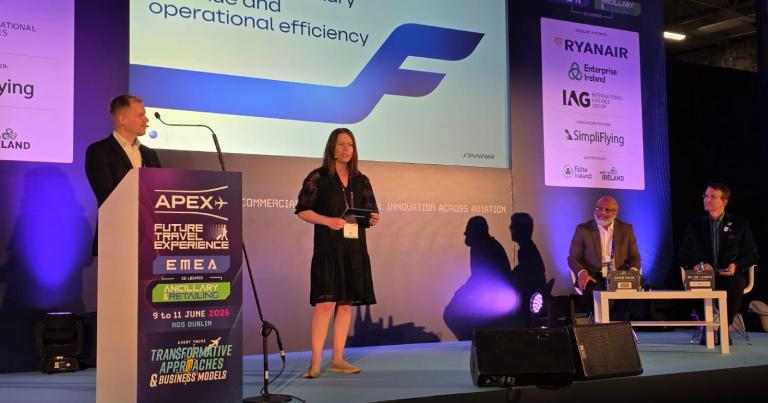
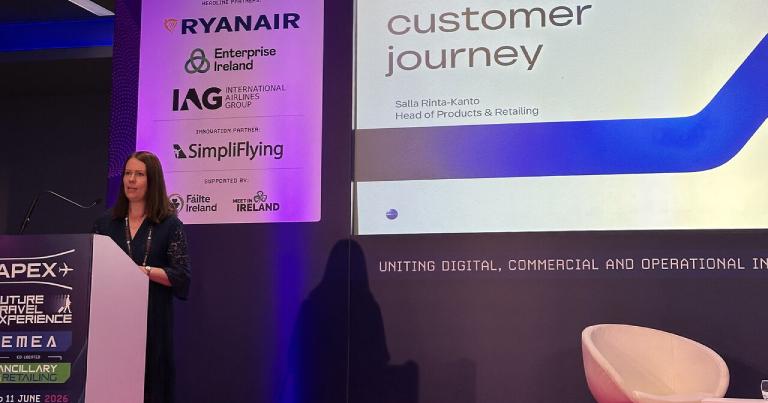
Modern airline retailing is increasingly moving beyond static offers and isolated sales opportunities. During a case study presentation at APEX FTE EMEA and Ancillary & Retailing 2026, Rinta-Kanto explained how Finnair is embedding personalised retailing throughout the customer journey, using digital innovation to improve customer choice, reduce friction and strengthen commercial performance. Rather than treating ancillary sales as a series of standalone transactions, Finnair’s strategy is centred on making retailing continuous, delivering relevant, contextual offers before departure and extending digital purchasing opportunities onboard the aircraft itself.
“Customer choice is really at the core of modern retailing,” Rinta-Kanto explained. “It’s about giving customers the freedom to decide what they need for their journey. The goal is ensuring that we are giving customers relevant, increasingly personalised and frictionless user experiences.”
She added that delivering those experiences is fundamental not only to improving customer satisfaction but also to achieving the airline’s ambitious ancillary revenue goals. Throughout the presentation, one theme remained consistent: personalisation is most effective when it removes friction from the customer journey while creating measurable commercial value.
Moving beyond one-size-fits-all promotions
The first case study explored how Finnair has rethought traditional discount campaigns by replacing broad promotional offers with targeted, behaviour-driven incentives. Conventional ancillary discounts often reduce margins without guaranteeing incremental demand, while treating customers with very different purchasing habits in exactly the same way. To address this, Finnair analysed customer purchasing behaviour and identified two groups for a personalised pre-order meal campaign: passengers who had previously purchased meals but had stopped doing so, and customers who had never purchased a pre-order meal before. Those customers were presented with a personalised 20% discount within the booking flow through a simple message on the airline’s travel extras page.
Despite requiring only a modest user interface change, the trial produced clear improvements in conversion rates and revenue per passenger. It also succeeded in encouraging both first-time purchases and repeat purchases from previously inactive customers. Importantly, the initiative demonstrated that personalisation is not solely about maximising immediate sales. It can also become a tool for rebuilding customer relationships.
Rinta-Kanto explained that some passengers may have abandoned ancillary purchases following previous disruptions, such as not receiving a pre-ordered meal because of operational issues. Targeted offers provided an opportunity to encourage those customers to return while recognising that different passenger segments have different levels of price sensitivity and willingness to buy.
The wider implication is that airlines can move beyond simply asking whether discounts work. Instead, the more valuable question becomes which customers should receive an incentive in the first place, and at what point in their journey it is most likely to influence behaviour.
Extending retailing into the onboard experience
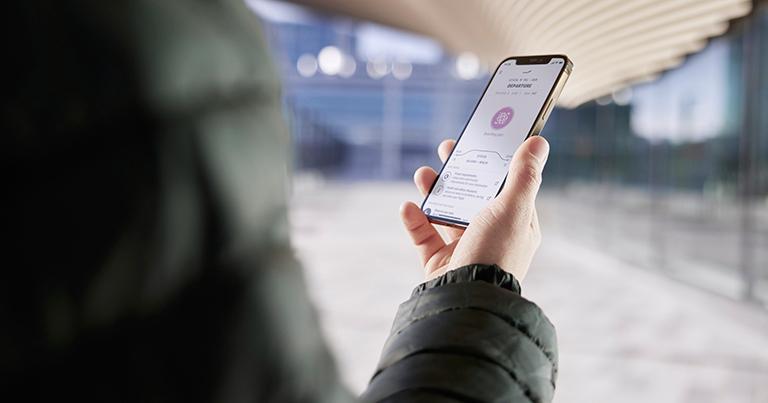
Finnair’s second example illustrated that modern retailing does not end once a passenger boards the aircraft. Rinta-Kanto introduced the airline’s new ‘Order to Seat’ service, deployed on European Airbus-operated flights, which allows passengers to browse, purchase and pay for food and beverages from their own mobile devices throughout the flight.
The platform addresses several longstanding sources of friction associated with traditional inflight sales. Passengers no longer need to wait for the trolley service, rely solely on printed menus or interrupt cabin crew between service rounds to make a purchase. Instead, they can browse the full menu, receive product recommendations, access bundled offers, complete payment using digital wallets, payment cards or Finnair loyalty currency, and monitor the progress of their order before purchasing again whenever they choose. The solution complements rather than replaces traditional cabin service, giving customers additional flexibility while preserving the onboard experience many passengers still value.
Customer experience and operational efficiency reinforce one another
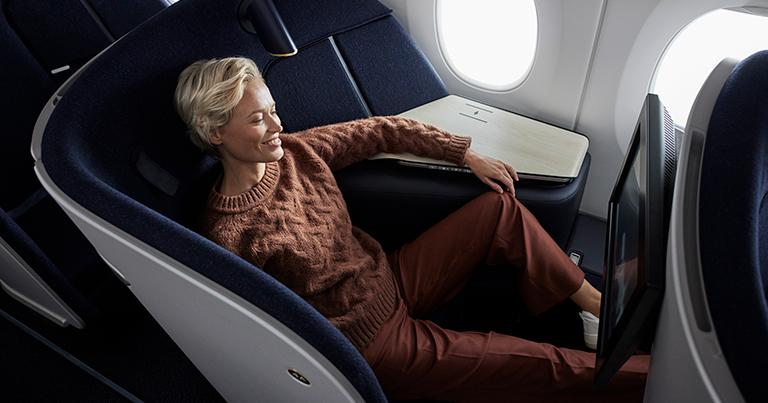
One of the strongest messages from the presentation was that improvements in passenger experience and operational efficiency do not need to compete for investment. In Finnair’s approach, they are mutually reinforcing. For passengers, digital ordering reduces waiting time and makes onboard purchasing significantly more convenient. For cabin crew, it reduces payment processing, unnecessary walking through the cabin and congestion around the galley, allowing multiple orders to be delivered more efficiently.
Commercially, those improvements have translated into higher conversion rates, larger basket sizes and increased repeat purchases. Rather than viewing ancillary retailing as a separate commercial activity, the case study suggested it can become an integrated part of service design, simultaneously improving customer satisfaction, supporting crew workflows and increasing revenue opportunities.
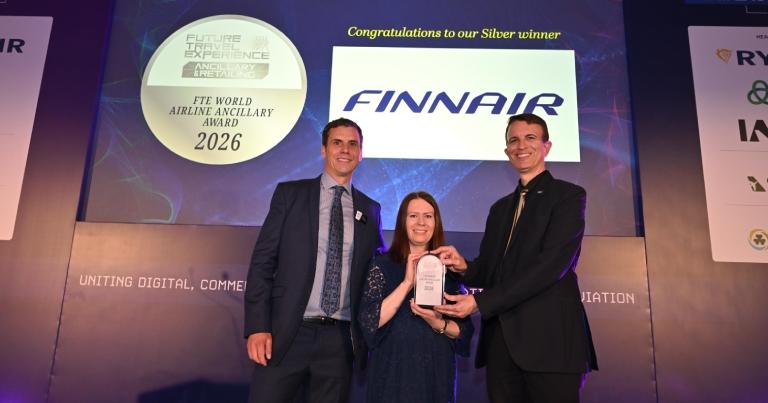
Continuous retailing will define the next phase of airline commerce
Concluding the session, Rinta-Kanto argued that personalisation should no longer be confined to booking flows, mobile apps or manage booking platforms. Instead, it should become a continuous capability spanning every stage of the customer journey. Achieving that requires more than technology alone. Airlines must understand their customers well enough to solve genuine problems, recognising that convenience, timing and relevance are often just as important as the products themselves.
“We’re already seeing revenue impact from these use cases, and we’re really only just getting started,” Rinta-Kanto concluded. “Personalisation is a really big focus area for us, and we see huge potential.”
Taken together, Finnair’s two case studies illustrate a broader shift taking place across airline retailing. Whether through behaviour-driven offers during booking or digital commerce in the cabin, the objective is increasingly the same: create a seamless retail experience that follows passengers throughout their journey while delivering measurable value for both the customer and the airline.
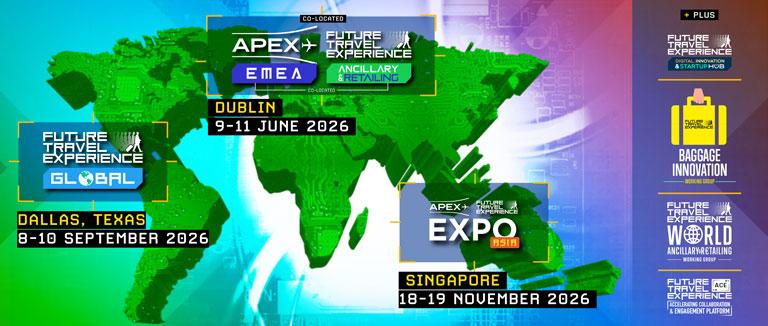
What’s next – FTE Global, Dallas, Texas, 8 to 10 September 2026, and APEX FTE EXPO Asia, Singapore, 18 to 19 November 2026
You may also be interested in
12 technology and CX trends that can enhance airline and airport operations in 2026
Vote now: What will be aviation’s most game-changing technology over the next 20 years?