





Future Travel Experience (FTE) will launch an exclusive Commercial Collaboration Playbook at APEX FTE Ancillary & Retailing, co-located with APEX FTE EMEA in Dublin on 9 to 11 June 2026. Developed with Munich Airport and available only to attendees in Dublin, the unique Playbook will provide a practical and proven blueprint for how air transport industry stakeholders can create a significantly bigger revenue pie for all stakeholders to share in by working in progressive new ways. It will focus on collaborative approaches to retailing and revenue growth, examining how new partnership models, data strategies and enabling technologies can support more integrated, customer-centric commercial outcomes. Dr Jan-Henrik Andersson, Chief Commercial Officer, Munich Airport, will launch the Commercial Collaboration Playbook in a session titled ‘Commercial collaboration: Embracing innovation and collaboration to create new revenue streams for airlines, airports and their partners’. He will then join an interactive panel discussion, featuring Martin Kamlah, Vice President – Professional Services, Munich Airport International; Ian Upton, Head of Category for Operations, Logistics, Contracts and Sustainability, Heathrow; and Emre Devrim, Product & Customer Experience Manager, AJet. Here, in a series of in-depth interviews, they each share their perspectives on the importance of effective commercial collaboration.
Explore the full APEX FTE EMEA and APEX FTE Ancillary & Retailing agenda at a glance >> Register for the co-located APEX FTE EMEA and APEX FTE Ancillary & Retailing events – free for airlines, low-cost for airports >>Munich Airport: “Collaboration done properly increases speed, relevance and commercial impact”
In what promises to be an undoubted highlight of the APEX FTE Ancillary & Retailing agenda, Dr Jan-Henrik Andersson, Chief Commercial Officer, Munich Airport, will present the ‘Exclusive launch of the Commercial Collaboration Playbook, in partnership with Munich Airport’.

“The first message is simple and unavoidable: traffic has recovered, value has not,” he says. “Our industry is quietly absorbing a structural non-aviation revenue gap. That gap will not close through optimisation or incremental tweaks. The second message is more disruptive: the traditional operating model is no longer fit for purpose. Airports, airlines and commercial partners still work in silos, even though value is created across the journey. The Playbook challenges that logic. It argues that collaboration must become a core growth strategy, not a side initiative. What we will introduce in Dublin is not a catalogue of projects, but a new way of thinking about commercial leadership: airport-led, partner-enabled orchestration across the entire passenger journey – from pre-trip to post-trip. That is the mindset shift the Playbook is designed to provoke.”
At its core, the Playbook reframes collaboration from good intention to operating system. It sets out why orchestration beats isolated optimisation, and why airports must take a more active role in aligning partners around shared commercial outcomes. “A central theme is OneJourney Munich – an airport-led, partner-enabled approach that treats the passenger journey as one cohesive commercial space, rather than a series of separate transactions,” Dr Andersson explains. “Another key pillar is the use of personas as an operational layer. Not marketing profiles, but a shared decision logic that allows multiple partners to act consistently at the right moment, with the right offer. The Playbook also takes a clear position on trust-based data collaboration: growth does not require uncontrolled data sharing. It requires privacy-safe, purpose-driven collaboration, where partners align on signals, timing and intent. The message is clear: collaboration done properly increases speed, relevance and commercial impact.”
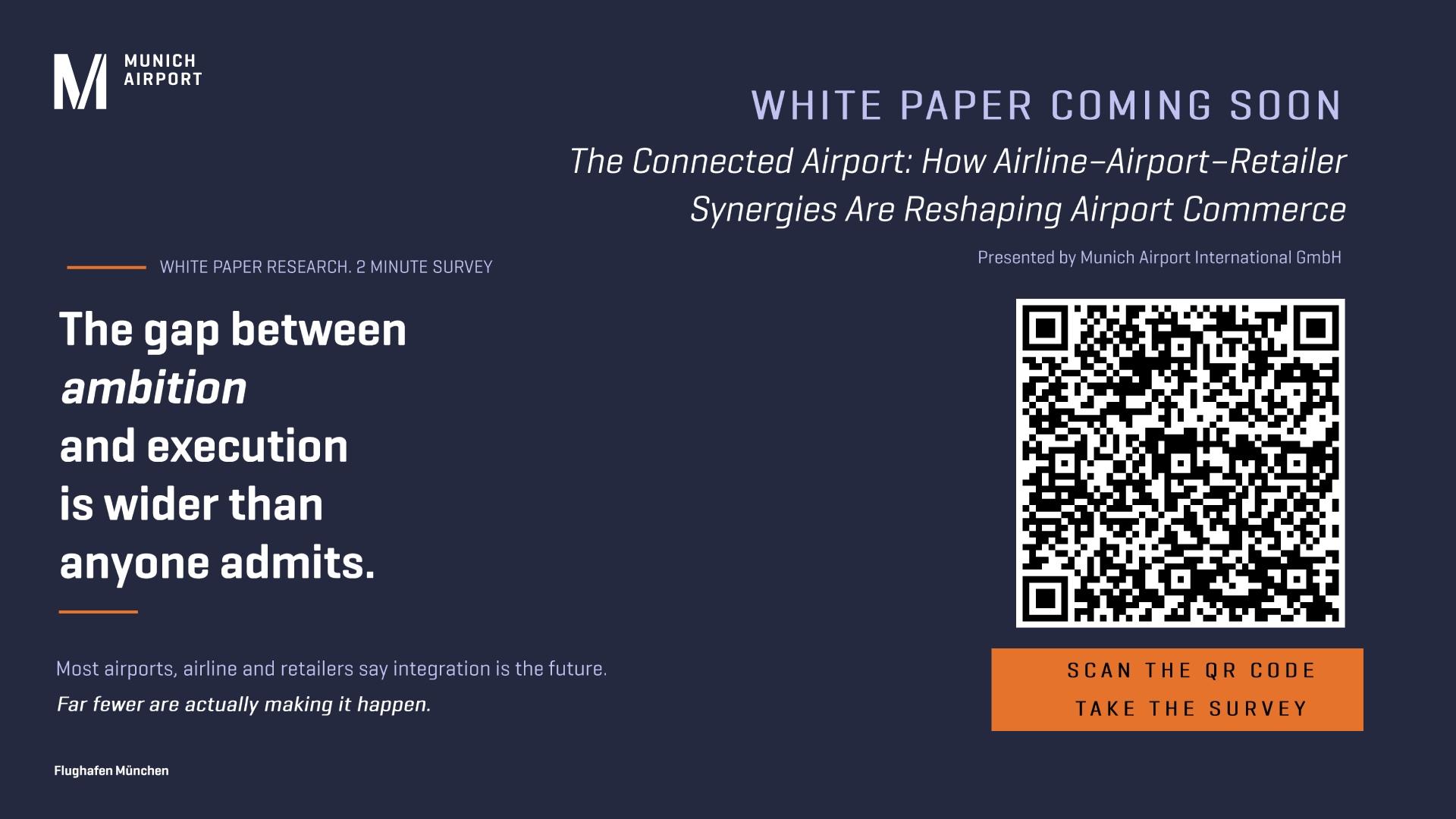
This Playbook is not written only for large hub airports. That is a deliberate choice. The principles outlined therein are aligned incentives, ecosystem orchestration, persona-led activation and a disciplined test-measure-learn mindset. These principles apply regardless of airport size or geography. “Scale helps, but it is not the decisive factor – leadership intent is,” Dr Andersson shares. “The key takeaway is that collaboration is no longer about experimentation. It is about building repeatable, evidence-based models that can scale over time. Airports that embrace this shift will unlock new growth. Importantly, this is not the end of the conversation. It is the beginning. Our colleagues at MAI, the consulting subsidiary of Munich Airport will soon launch a White Paper that expands this Playbook into a broader industry framework – showing what airports of any size can realistically do to activate collaboration, given their specific constraints and opportunities. I invite readers to scan the QR code, complete the short survey, and support this initiative. Their input will directly shape the White Paper and help turn collaboration from an aspiration into a shared industry blueprint. If we want a stronger, more resilient commercial future for aviation, we must build it together. This Playbook is our contribution and an open invitation to the industry to act.”
Looking ahead, Dr Andersson is eager to participate at the co-located APEX FTE EMEA and Ancillary & Retailing events, taking place in Dublin on 9 to 11 June 2026. “APEX FTE Dublin is where strategy meets execution. It brings together senior decision-makers from airlines, airports, retail and technology – the very people who can actually change the way how our industry works. For me, this is not about presenting and moving on. It’s about challenging assumptions, testing ideas, and starting real conversations about joint value creation. The Playbook launch is designed to do exactly that: provoke discussion and invite collaboration. Munich Airport is participating not as an observer, but as a driver of change, bringing its perspective to the tables with the clear ambition to help shape the next era of commercial growth in non-aviation.”
MAI White Paper to help industry build repeatable, revenue generating collaboration models
From the perspective of Munich Airport’s subsidiary MAI, the key message ahead of the Playbook launch is that collaboration needs to move from aspiration to execution. “While the Playbook will outline a strategic direction, its relevance will ultimately be defined by how airports, airlines, and partners translate those ideas into day-to-day decision-making,” says Martin Kamlah, Vice President – Professional Services, Munich Airport International (MAI). “What matters most is a shift in how value is created away from isolated optimisation and toward shared outcomes across the ecosystem. That requires rethinking roles, incentives, and ways of working, not simply adding new initiatives on top of existing structures.”

Airlines, airports and partners succeed in collaboration when they stop treating it as a project and start treating it as an operating choice. The first step, Kamlah explains, is alignment around the passenger journey, not organisational boundaries or individual P&Ls. “From MAI’s perspective, successful collaboration is built on three fundamentals,” he says. “Clear orchestration, where roles, decision rights and incentives are explicitly defined. Shared commercial logic, using common personas and journey moments as an operational layer rather than isolated marketing initiatives. And discipline, through a test-measure-learn approach that allows partners to scale what works and stop what doesn’t. Airports of any scale can adopt these principles if leadership is willing to challenge legacy roles and redesign how value is created across the ecosystem.”
To support the industry in moving from intent to execution, Munich Airport International will shortly launch a White Paper following the Playbook, translating these principles into practical, size-agnostic guidance for airports of all types. “We actively invite stakeholders to scan the QR code and complete the short survey, so this work reflects real-world challenges and helps the industry build repeatable, revenue-generating collaboration models,” says Kamlah.
The biggest challenge is legacy thinking, not capability. Airlines and airports are still organised around separate P&Ls, KPIs, and decision cycles. “That structure rewards optimisation in isolation and actively discourages shared value creation,” Kamlah shares. “The opportunity lies in breaking that pattern. When airlines and airports align around the passenger journey as a single commercial system, they unlock revenue that neither side can capture alone. This is where collaboration becomes a growth lever rather than a compromise. Airports of any size face the same structural barriers and can unlock the same benefits if leadership is willing to rethink entrenched roles. MAI’s role is to support airports and airlines navigate that shift pragmatically, turning collaboration from a strategic ambition into repeatable, revenue-generating reality.”
Looking ahead, Kamlah is eager to participate at the co-located APEX FTE EMEA and Ancillary & Retailing events, taking place in Dublin on 9 to 11 June 2026. “APEX FTE Dublin is where commercial ambition meets operational reality. It brings together airlines, airports, retailers, and technology providers who are all confronting the same question: how to turn traffic recovery into sustainable value. From MAI’s perspective, this event is about listening as much as contributing. Understanding where collaboration breaks down in practice is critical to helping the industry move forward. Those insights will directly shape our upcoming White Paper, ensuring it reflects real constraints, not theoretical models. If we leave Dublin with sharper alignment and a shared willingness to act, then the conversation has achieved its purpose.”
Explore the full APEX FTE EMEA and APEX FTE Ancillary & Retailing agenda at a glance >> Register for the co-located APEX FTE EMEA and APEX FTE Ancillary & Retailing events – free for airlines, low-cost for airports >>Heathrow: Passenger-centric collaboration can unlock greater value across the travel ecosystem
Heathrow’s Ian Upton, Head of Category for Operations, Logistics, Contracts and Sustainability, emphasises that collaboration needs to move beyond a conversation about who owns the revenue. At its best, it should be about how to grow the overall opportunity together. “Too often the industry still defaults to value redistribution rather than value creation,” says Upton. “The shift we need is towards shared outcomes, where success is defined by the total value we unlock across the ecosystem, not how it’s split.”

A passenger-first mindset is crucial. Commercial models work best when they’re built around the end-to-end passenger journey, not organisational boundaries. “Airports, airlines and partners all play a role, but the passenger doesn’t see those silos,” Upton explains. “If we design around their needs, rather than our own structures, we create a much stronger and more consistent experience.”
He also highlights the role of data: “Data is one of the biggest unlocks for better collaboration, but only if we’re willing to use it differently. It’s not just about infrastructure or systems, it’s about sharing insight. When stakeholders are more open with data, we can deliver more personalised, timely and relevant propositions, which ultimately benefits everyone.”
Operational delivery and a partnership approach are also key elements of successful commercial collaboration. “Operational excellence is what underpins any successful commercial strategy,” Upton shares. “If the basics around availability, fulfilment and service consistency aren’t right, then collaboration won’t scale. In my experience, execution matters just as much as the strategy itself. We also need to move from more transactional relationships to genuine partnerships. That means building trust over time, being flexible, and listening to each other. The strongest outcomes tend to come from long-term relationships where there’s a shared understanding of what success looks like.”
Discussing how airlines, airports and other stakeholders can successfully embrace new forms of collaboration to create mutually beneficial revenue-generating opportunities, Upton highlights four key areas:
- Aligning on outcomes: “It starts with being clear on what success looks like across all parties. Whether that’s revenue growth, yield, customer experience or dwell time, alignment early on makes a big difference. If we’re not aligned on outcomes, it’s very easy for collaboration to drift or become diluted. Getting that clarity upfront helps keep everyone focused on the same end goal.”
- Joint propositions across the journey: “There’s a real opportunity to co-design commercial propositions across the end-to-end journey – from pre-trip through to onboard and post-arrival. Where this works best is when it feels seamless to the passenger. The challenge for us is moving away from fragmented touchpoints and thinking much more holistically about how those experiences connect.”
- Using data to personalise: “Data has a key role to play, particularly when we bring together different perspectives – airline booking data, airport flow insights and retail behaviour. The value comes from turning that into something actionable. If we can use it to deliver more targeted, timely and relevant offers, that’s where we start to see real benefit at scale.”
- Simplifying the journey: “A big part of this is simply making it easier for passengers to buy. Reducing friction through more integrated payments, fulfilment and collection or delivery options can make a material difference. It’s less about adding more choice, and more about making the overall experience straightforward and intuitive.”
There are, of course, still some real challenges to work through if we want collaboration to scale in a meaningful way. “Firstly, there are legal, technical and cultural barriers when it comes to sharing meaningful customer insight,” says Upton. “Even where the technology exists, trust and ways of working often lag behind. Alongside that, legacy commercial models and the inherent operational complexity of the airport environment can make change harder to deliver in practice. At the same time, the opportunity is significant if we get it right.
There’s clear potential to unlock more value across the end-to-end journey, rather than treating each touchpoint in isolation. Smarter use of data, particularly when it comes to personalisation, can drive higher conversion and increased spend per passenger, but only if it’s applied in a way that adds real value for the customer. We’re also starting to see the emergence of new partnership models, supported by technology as an enabler rather than the end solution. Ultimately, if we can bring these elements together, there’s a real opportunity to strengthen customer loyalty and create a more consistent, joined-up experience.”
Looking ahead, Upton is eager to participate at the co-located APEX FTE EMEA and Ancillary & Retailing events, taking place in Dublin on 9 to 11 June 2026. “A big part of it is hearing how others are approaching the same challenges in practice. There’s a lot of commonality across the industry, but also different approaches depending on region, scale and business model, so that perspective is always valuable. It’s also an opportunity to connect with partners across the ecosystem – airlines, airports, retailers and technology providers. In my experience, that’s often where the most interesting ideas and future partnerships come from. Finally, it’s about sharing Heathrow’s perspective, but also learning from others. Given the scale and complexity we operate at, combined with the strength of our retail and operational ecosystem, there’s a lot we can contribute, but just as much we can take away.”
Explore the full APEX FTE EMEA and APEX FTE Ancillary & Retailing agenda at a glance >> Register for the co-located APEX FTE EMEA and APEX FTE Ancillary & Retailing events – free for airlines, low-cost for airports >>AJet: Integrated travel ecosystems will define the future of ancillary revenue growth
From AJet’s perspective, one of the key messages highlighted by Emre Devrim, Product & Customer Experience Manager, is that the future of ancillary revenue will no longer be shaped by standalone product sales alone, but by integrated ecosystems and connected end-to-end customer journeys. “We believe airlines, airports, technology providers and other stakeholders must move beyond traditional supplier relationships and start acting as integrated commercial partners that jointly create value,” he says.

As a fast-growing low-cost carrier, AJet sees significant opportunities in combining operational agility with digitalisation to create scalable, sustainable and customer-centric revenue models. The industry is evolving toward a much more connected travel experience, where every touchpoint – from booking and airport services to onboard offerings and post-flight engagement – becomes part of a seamless and personalised journey.
“Another important point for us is that ancillary growth should never come at the expense of customer trust or customer experience,” Devrim explains. “Sustainable ancillary strategies must be built on transparency, simplicity, accessibility and genuine value creation for passengers. Today’s travellers are no longer looking only for additional products; they expect services that meaningfully improve their overall journey and make travel more convenient, comfortable and personalised.”
AJet also wants to differentiate itself from the traditional ultra low-cost carrier approach. The ambition is not simply to sell more products, but to create a travel ecosystem where passengers can choose experience-enhancing services based on their personal preferences and expectations. “For passengers willing to pay more for comfort, speed, convenience or premium touchpoints, we aim to offer products that genuinely elevate the travel experience,” Devrim shares. “In many ways, we are trying to position customer experience itself as a product. We believe future competition in aviation will not be shaped only by ticket prices, but increasingly by the overall quality, intelligence and personalisation of the passenger experience.”
Successful collaboration starts with aligning incentives. Historically, airlines and airports have often approached commercial opportunities from separate perspectives. However, today’s passenger journey is interconnected, and revenue opportunities should be approached in the same way. “The most successful models are those where all stakeholders jointly focus on improving the end-to-end customer experience while also sharing commercial upside,” says Devrim. “This requires transparency, shared KPIs and long-term partnership models rather than purely transactional relationships. Digitalisation is another critical enabler. Shared data environments, integrated retailing platforms and AI-powered customer engagement tools can help stakeholders better understand passenger behaviour and deliver more personalised offers across multiple touchpoints. For example, airports can evolve from being infrastructure providers into active commercial partners by integrating lounge services, fast-track products, retail offers, transportation solutions and airport services directly into the airline journey. Airlines, in turn, can support airports with customer insights, digital reach and operational integration. Ultimately, collaboration succeeds when stakeholders stop optimising individual silos and start designing the passenger journey together.”
One of the biggest challenges is that airlines and airports operate with different commercial structures, priorities and cost realities. “Airports are generally focused on long-term infrastructure investments and asset returns, while especially low-cost carriers operate with much stricter cost discipline and significantly lower margins,” says Devrim. “Naturally, this can create differences between commercial expectations and operational priorities. Another important challenge is technological fragmentation. Many of the systems used by airports, airlines and third-party providers still operate independently from one another. This makes seamless retailing experiences, customer recognition, personalised offers and real-time commercial integration far more difficult to achieve. In addition, operational complexity, security requirements and process management also remain important barriers to closer collaboration.”
However, despite these challenges, AJet believes the opportunities are significantly greater. “Today’s passengers expect the same level of seamless, connected and personalised experiences they receive in other digital industries,” Devrim explains. “This creates a major opportunity for airlines and airports to redesign the airport journey through integrated digital services, data-driven offers and frictionless customer experiences. In many ways, every passenger is still largely a ‘black box’ from the airport perspective, while airlines know their customers extremely well – including their travel habits, purchasing behaviour and spending patterns. At the same time, airports provide extensive physical touchpoints, dwell time and commercial visibility opportunities throughout the passenger journey.”
Bringing together the customer insight and behavioural intelligence of airlines with the physical commercial ecosystem of airports has the potential to become a true game-changer for the industry. “When two different commercial organisations start acting in a more integrated way, with shared objectives and a unified passenger experience mindset, it can create significantly stronger and more sustainable revenue opportunities while also improving the overall customer experience,” Devrim adds.
Looking ahead, Devrim is eager to participate at the co-located APEX FTE EMEA and Ancillary & Retailing events, taking place in Dublin on 9 to 11 June 2026. “Events such as APEX FTE EMEA and Ancillary & Retailing are extremely valuable because they bring together different stakeholders from across the aviation ecosystem on a single platform. At the same time, they provide an important opportunity to closely observe global best practices, emerging trends and the future direction of the industry. We are particularly looking forward to sessions focused on AI-powered customer engagement, modern airline retailing structures, digital ancillary strategies and next-generation airport collaboration models. The aviation industry is evolving very rapidly, and platforms like these play a critical role in accelerating innovation through open dialogue, collaboration and the exchange of ideas.”
A new blueprint for commercial growth in aviation
Taken together, the perspectives shared by Munich Airport, Munich Airport International (MAI), Heathrow and AJet point to a clear industry direction: the future of commercial success in aviation will depend less on individual optimisation and more on meaningful collaboration across the travel ecosystem.
While each organisation brings a different perspective, there is striking alignment around the need to break down traditional silos, create shared commercial objectives, make smarter use of data, and place the passenger journey at the centre of decision-making. From integrated retailing and personalised offers to new partnership models and ecosystem-wide value creation, the opportunity lies in designing connected experiences that benefit passengers while unlocking sustainable revenue growth for all stakeholders.
These themes will be explored in greater depth at APEX FTE Ancillary & Retailing, where attendees will gain exclusive access to the Commercial Collaboration Playbook developed in partnership with Munich Airport. More than simply a framework for discussion, the Playbook aims to provide practical guidance on how airports, airlines and their partners can turn collaboration into a repeatable growth strategy.
As the industry looks beyond traffic recovery and focuses on long-term value creation, one message stands out: the organisations that succeed will be those willing to move beyond traditional boundaries and work together in new ways. The conversation starts in Dublin, but the opportunity to reshape the future of aviation retailing and commercial growth extends far beyond the event itself.
Explore the full APEX FTE EMEA and APEX FTE Ancillary & Retailing agenda at a glance >> Register for the co-located APEX FTE EMEA and APEX FTE Ancillary & Retailing events – free for airlines, low-cost for airports >>You may also be interested in
12 technology and CX trends that can enhance airline and airport operations in 2026
FTE launches new podcast to explore the realities of successful innovation
ADR, MUC, AMS, IST, LHR, DOH & more among FTE Airport Digital Transformation Power List EMEA 2026