





Munich Airport – a member of the pioneering FTE Smart Ramp initiative and a Corporate Partner of the FTE Digital, Innovation & Startup Hub – is pursuing an ambitious digital transformation agenda centred on passenger experience, operational efficiency, innovation and collaboration. In this video interview, following her participation at APEX FTE EMEA and Ancillary & Retailing 2026 in Dublin, Vera Jakobsen, Vice President Digital, Munich Airport, shares details of the airport’s autonomous freight transport Proof of Concept with Lufthansa as part of the FTE Smart Ramp initiative; discusses the launch of its new airport operations orchestration platform, CHIMP; outlines Munich Airport’s approach to artificial intelligence (AI); and explains why collaboration remains at the heart of its innovation strategy.
Autonomous freight transport helping define the airport operations of the future
As a member of the pioneering FTE Smart Ramp programme, Munich Airport is working closely with Lufthansa on a Proof of Concept focused on autonomous freight transport, with ambitions to expand into autonomous baggage transport in the future. Fraunhofer IML – also a Corporate Partner of the FTE Digital, Innovation & Startup Hub – is a close collabator in the Smart Ramp pilots being undertaken by Munich Airport and Lufthansa.
Importantly, the initiative is not primarily focused on proving that autonomous vehicles can navigate airport environments. Instead, Munich Airport is using the project to understand what will be required to successfully scale autonomous operations across the airport ecosystem.
“We’re bringing in a project on autonomous freight transport, which will be the basis, and then we advance into autonomous baggage transport as a next step,” Jakobsen explains. “It’s not about testing the vehicle so much, whether it can drive autonomously, but much more about testing our airport.”
The project is helping Munich Airport explore future concepts of operation, including how remote control capabilities should be structured, how surrounding processes need to be redesigned, and what organisational and operational requirements must be established before autonomous solutions can be deployed at scale. “It’s really about figuring out all preconditions for scaling,” says Jakobsen.

Lufthansa partnership driving innovation across multiple areas
According to Jakobsen, close collaboration with Lufthansa has become a cornerstone of Munich Airport’s innovation strategy, delivering tangible outcomes across operations, passenger services and commercial activities.
The partnership extends across numerous initiatives within Terminal 2, which is jointly operated by Munich Airport and Lufthansa. These include service robotics deployments, operational data sharing, commercial collaboration through Miles & More, research projects, and process mining initiatives designed to improve efficiency and decision-making.
“I would say it’s a very pivotal part of our innovation strategy,” Jakobsen shares. “Over the past couple of years, it has led to a lot of tangible outcomes.”
This collaborative approach allows both organisations to accelerate innovation, test new concepts more effectively, and identify opportunities to improve both operational performance and the passenger experience.
CHIMP and Airside 360 enhancing operational awareness and disruption management
Among the digital initiatives currently generating the most excitement at Munich Airport is the launch of its new airport operations orchestration platform, CHIMP, developed jointly with Smarter Airports. The airport has recently introduced the platform’s first major capability, Airside 360, which combines a digital twin of airside operations with mobile task management functionality.
Jakobsen believes the platform has the potential to significantly improve day-to-day operational performance by providing teams with greater situational awareness and stronger disruption management capabilities. “Airside 360 is basically a digital twin of all airside operations combined with mobile task management,” she explains. “This will massively increase situational awareness as well as disruption handling in our day-to-day operations.”
The initiative reflects the growing industry focus on leveraging real-time operational data, orchestration platforms and digital twin technologies to create more connected, resilient airport operations.
Building AI capability across the entire organisation
Like many leading airports, Munich Airport sees significant opportunities for AI to transform both operational processes and the passenger journey. However, Jakobsen emphasises that the airport’s strategy extends beyond individual use cases. She describes Munich Airport’s AI approach as consisting of two distinct layers. The first focuses on targeted applications across operations, passenger experience and commercial functions, where AI can deliver measurable business value. The second focuses on creating widespread AI literacy and capability across the entire organisation.
“There’s of course these vertical use cases with plenty of interesting prospects for AI in operations, for passenger experience, for commercial steering and so on,” says Jakobsen. “But then there’s also this horizontal layer, meaning the AI literacy and enablement across the whole organisation.”
To support this vision, Munich Airport has developed an AI enablement and training programme designed for employees across the business. The objective is to ensure that teams understand how to use AI effectively while also encouraging innovation from within. “We believe that if everyone is able to handle AI pretty well, the overall productivity increases, and we will come up with more ideas and more innovation for the vertical AI cases,” Jakobsen explains.
Recognition reflecting a culture of innovation
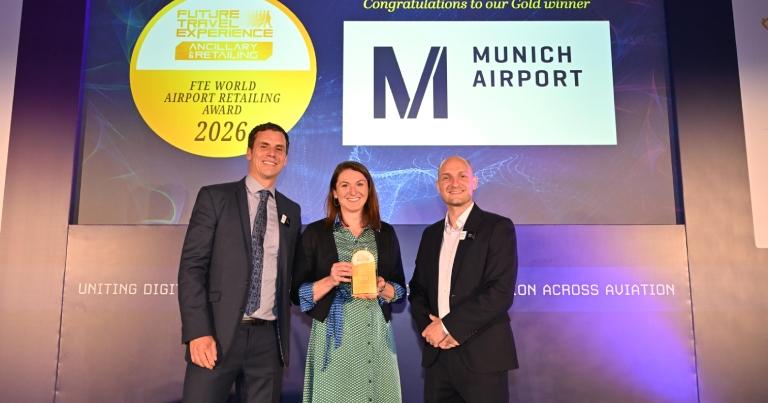
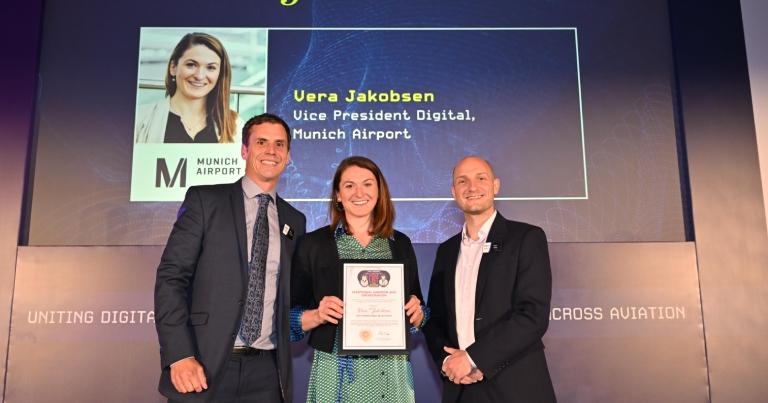
Jakobsen was recognised as a member of the FTE Airport Digital Transformation Power List EMEA at APEX FTE EMEA and Ancillary & Retailing 2026, while Munich Airport also received the Gold FTE World Airport Retailing Award (read our full awards report here), reflecting the airport’s continued commitment to innovation across both operations and passenger-facing initiatives. The recognition represents more than individual or project success. For Jakobsen, it reflects the broader culture of innovation that exists across Munich Airport. The awards acknowledge the efforts of teams across the organisation who continue to challenge established processes, embrace new technologies and pursue continuous improvement.
“Of course, it fills us with a lot of pride,” says Jakobsen. “These awards go to the whole teams working relentlessly on pushing innovation in Munich Airport, always hitting some boundaries, but still pushing through.”
As Munich Airport continues to explore autonomous operations, expand AI capabilities and deploy next-generation operational technologies, that culture of innovation is likely to remain a key driver of its digital transformation journey. “It is a motivation, of course, to keep on going,” Jakobsen concludes.
What’s next – FTE Global, Dallas, Texas, 8 to 10 September 2026, and APEX FTE EXPO Asia, Singapore, 18 to 19 November 2026

You may also be interested in
12 technology and CX trends that can enhance airline and airport operations in 2026
FTE launches new podcast to explore the realities of successful innovation