




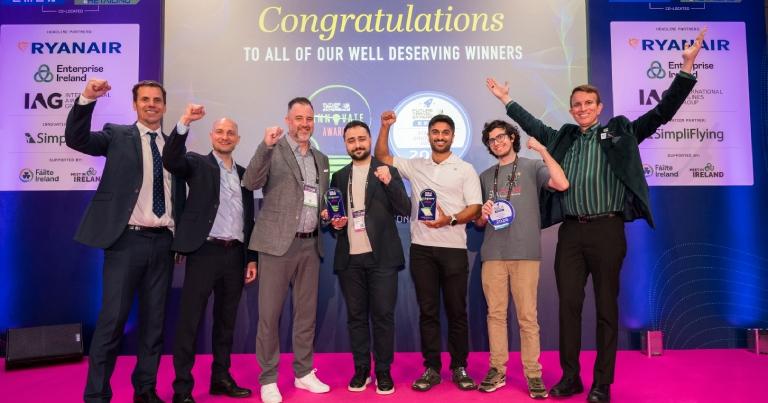
The co-located APEX FTE EMEA and Ancillary & Retailing (Dublin, 9 to 11 June 2026) concluded with the FTE Innovate Awards. These landmark awards are truly unique and are the industry’s most respected platform for recognising innovation with real-world impact. Each of the shortlisted airlines, airports and vendors from around the world competed head-to-head, as they pitched their trailblazing initiatives live on stage, in an effort to impress our Provocateurs – Javed Malik, Managing Director, Auj Saudi Arabia, and Dr Joe Leader, Group CEO, APEX/FTE/IFSA – and our audience, whose all-important votes decided who won. There were three awards categories: Finnair, AirAsia, Air France-KLM, Air Canada, Qatar Airways and SunExpress were shortlisted for Most Innovative Airline Initiative; Aena, Brussels Airport, Fraport, Aeroporti di Roma, Munich Airport and Fraport Twin Star Airport Management were shortlisted for Most Innovative Airport Initiative; and Aero-Sec, NewSense Engineering, Arrow Analytics, Aware, PnrGo and Metcove were shortlisted for Best New Transformative Concept. The ceremony also saw the presentation of the FTE EMEA Startup Innovation Award.
Most Innovative Airline Initiative – Air Canada
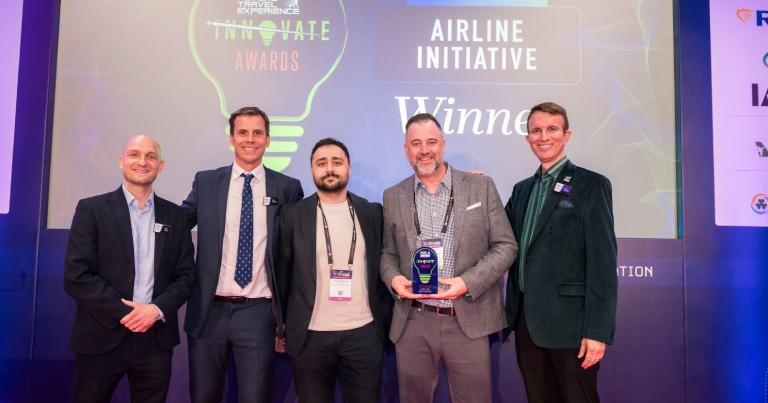
Air Canada received the Most Innovative Airline Initiative award, which was collected by Jason Odey, Director Baggage & Airside Innovation, Air Canada, and Hassan Masoudi, Manager Baggage & Airside Innovation, Air Canada. The airline was recognised for its groundbreaking baggage transformation initiative, which is redefining the customer and employee experience.
The initiative follows a six-phase maturity journey that systematically redefines baggage operations – from reactive handling to autonomous, intelligence-driven systems:
- Phase 1 – Identify: Comprehensive 5-point baggage scanning tracks every bag from check-in to carousel and, in rare delays, through to final delivery at passengers’ doorsteps.
- Phase 2 – Connect: Scan data is integrated with airport operations, linking each bag to real-time flight schedules, gate assignments, and connections.
- Phase 3 – Understand: Advanced analytics reveal operational patterns, bottlenecks, and station-specific vulnerabilities invisible to manual observation.
- Phase 4 – Predict: Machine learning models forecast mishandling risk, simulate staffing scenarios, and flag at-risk bags before errors occur.
- Phase 5 – Deliver: Passenger-facing innovations include an industry-first feature displaying the name of the team member handling their bag, enhancing trust and reducing anxiety.
- Phase 6 – Automate (In Progress): Autonomous baggage vehicles, robotic handling systems, and artificial intelligence (AI)-powered connection runners are being deployed on a foundation validated through prior phases.
The transformation has delivered measurable operational, customer, and financial improvements: mishandled bags have decreased by 36%, recovery speed has improved by 57%, and delayed bags are rerouted 43% faster. Customer satisfaction has increased, and the reduction in mishandling costs allows reinvestment in further innovation.
Air Canada’s phased, intelligence-first approach ensures that automation operates on validated operational insights rather than guesswork. By combining data, AI, and customer-centric design, the airline has redefined both the passenger and employee experience in baggage handling. The initiative exemplifies leadership in operational efficiency, technological innovation, and service excellence – setting a new benchmark for the industry.
Most Innovative Airport Initiative – Brussels Airport
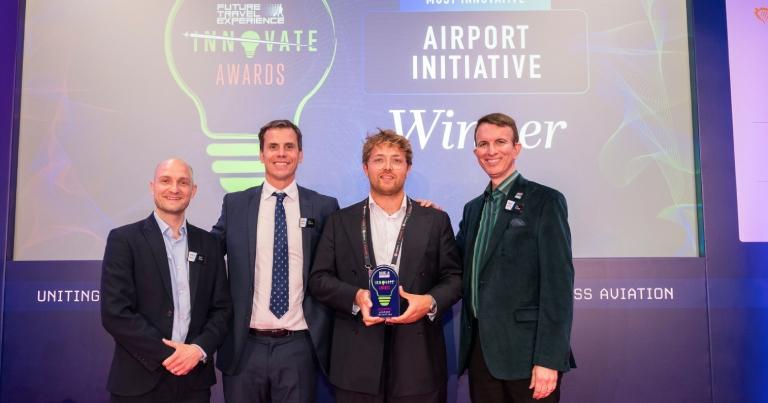
Brussels Airport (BRU) received the Most Innovative Airport Initiative award, following a compelling pitch by Bernd Bries, Chatbot & Conversation Designer, Brussels Airport. BRU was recognised for BRUce, its digital travel assistant.
Launched in July 2025, BRUce addresses one of the most common passenger concerns: “Can I bring this onboard?” From lithium batteries to unusual objects, these questions create stress for travellers and extra workload for airport teams. BRUce combines conversational artificial intelligence (AI), a continuously updated knowledge base, and photo recognition to provide instant, reliable answers. Passengers simply snap a picture of an item, and BRUce confirms whether it is allowed in hand luggage or checked baggage, delivering responses in Dutch, French, or English across the website, app, WhatsApp, and Messenger – 24/7.
BRUce reduces anxiety at security checkpoints by providing clear, immediate guidance for unusual items that are often absent from traditional FAQs. This has translated into strong passenger satisfaction, with an NPS of 45, demonstrating high trust and usability.
The upgraded system significantly reduces repetitive contacts to Customer Care. In 2024, security-related questions generated over 1,500 manual enquiries; post-upgrade, BRUce handled nearly 25,000, and in the first four months alone supported over 200,000 conversations with more than 3.5 million messages exchanged. The photo feature was used 15,000+ times, resolving questions across 250+ categories and improving successful resolution rates by 17.3%.
BRUce’s photo recognition is rare in airport operations, offering intuitive assistance without requiring passengers to describe items accurately. Behind the scenes, advanced AI and a custom airport database ensure accurate, rule-based responses where precision is critical, avoiding the risks of purely generative systems.
BRUce demonstrates how smart digital tools can reduce passenger stress, streamline operations, and operate at scale while keeping safety and accuracy at the forefront. It sets a new benchmark for AI-driven self-service in airports, improving both the travel experience and operational efficiency.
Best New Transformative Concept – Arrow Analytics
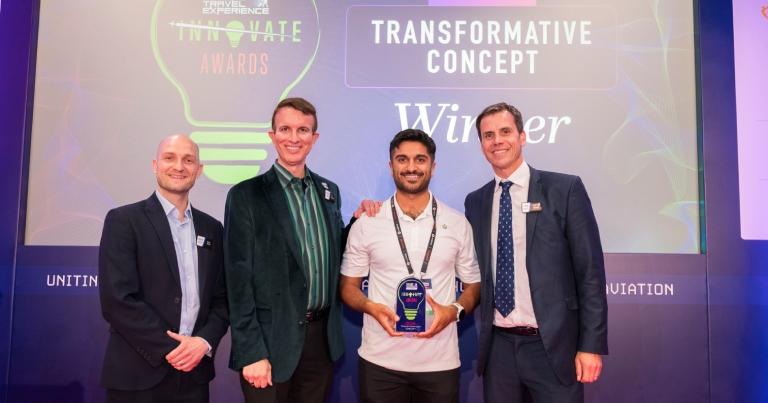
Arrow Analytics received the Best New Transformative Concept award for its artificial intelligence (AI)-powered carry-on baggage detection and monitoring system. The award was collected by Akku Kumar, CEO, Arrow Analytics.
Launched in February 2026, the system brings real-time visibility to one of the most manual and variable aspects of airport operations: boarding gate carry-on baggage management. Using existing camera infrastructure, the fully non-intrusive solution detects, tracks, and sizes baggage in real time, providing objective data to gate agents and operations teams without altering airline workflows or gate systems.
Manual baggage estimation at boarding often leads to inconsistent enforcement, last-minute interventions, and delays. Arrow Analytics enables gate agents to proactively manage boarding flow by understanding carry-on volume and overhead bin usage in real time. Early deployment has tracked over 5,000 bags across 30 full boarding processes, demonstrating reliable performance under real-world conditions, including varying passenger flows, occlusions, and lighting. Even minor reductions in boarding time per flight can translate into substantial cost savings and improved on-time performance.
Passengers benefit from more consistent enforcement of carry-on policies, reduced gate conflicts, and a more predictable boarding experience. The system’s advisory-only nature ensures that operational improvements are seamless and unnoticed by travellers, enhancing satisfaction without disruption.
Detailed baggage data supports smarter operational planning, boarding strategies, and potential monetisation opportunities. Faster boarding reduces aircraft ground time, lowering fuel burn and CO₂ emissions, delivering both environmental and financial benefits.
The system installs in 1-2 hours per gate using off-the-shelf hardware and edge computing, making it highly scalable across airports worldwide. Current live pilots include Southwest Airlines at Gerald R. Ford International Airport and London Heathrow.
Arrow Analytics addresses a persistent operational blind spot with a practical, data-driven solution, delivering measurable improvements in efficiency, passenger experience, commercial outcomes, and sustainability.
FTE EMEA Startup Innovation Award – SkyFood Airport Delivery
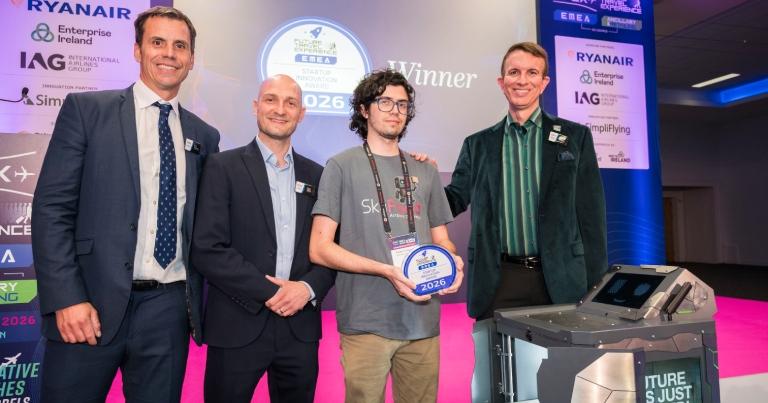
SkyFood Airport Delivery was voted winner of the FTE EMEA Startup Innovation Award, which was collected by Felipe Catapano, Robotics Engineer, SkyFood Airport Delivery. The APEX FTE EMEA and Ancillary & Retailing Startup Pitch Session provided a platform for high-potential startups to showcase their products and services that have been developed to enhance the customer experience, operational efficiency and commercial performance. Catapano delivered a successful pitch on ‘SkyFood Airport Robot Delivery: Transforming Waiting Time into an Experience’.
SkyFood Airport Delivery is a unique marketplace designed to digitise commerce in airport terminals. It seamlessly integrates airport commerce, allowing passengers to purchase items from any airport retailer via app and receive their orders directly at their boarding gate.
APEX FTE EMEA and Ancillary & Retailing 2026 attendees received a first-hand experience with SkyFood’s autonomous delivery and media robots, including ‘media in motion’ technology. SkyFood is the only robot globally equipped with three integrated LCD advertising screens designed for high-impact terminal marketing. SkyFood also demonstrated its advanced navigation system, which features state-of-the-art cameras and sensors tested in high-density environments to ensure proactive, collision-free pedestrian manoeuvring.
The ecosystem’s software capabilities mean its proprietary app not only delivers real-time flight and boarding gate updates directly to passengers, but it also enables airlines to issue digital food vouchers and gift cards within the platform, valid for consumption across any retailer in the airport.
You may also be interested in
12 technology and CX trends that can enhance airline and airport operations in 2026
FTE launches new podcast to explore the realities of successful innovation