




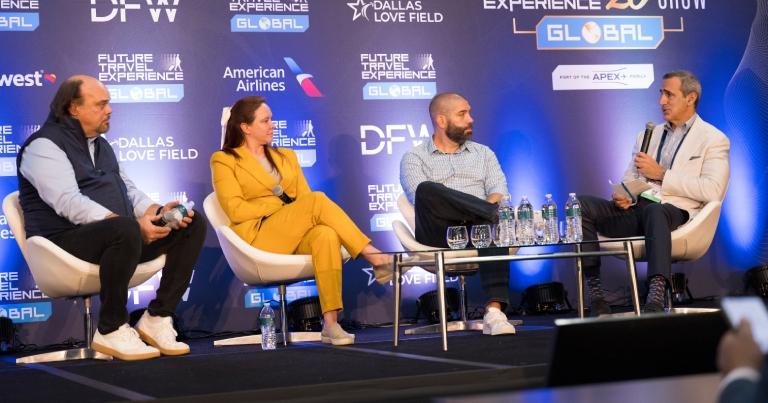
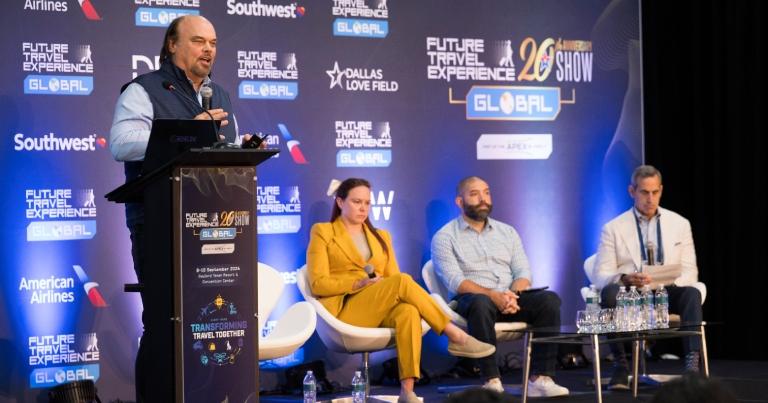
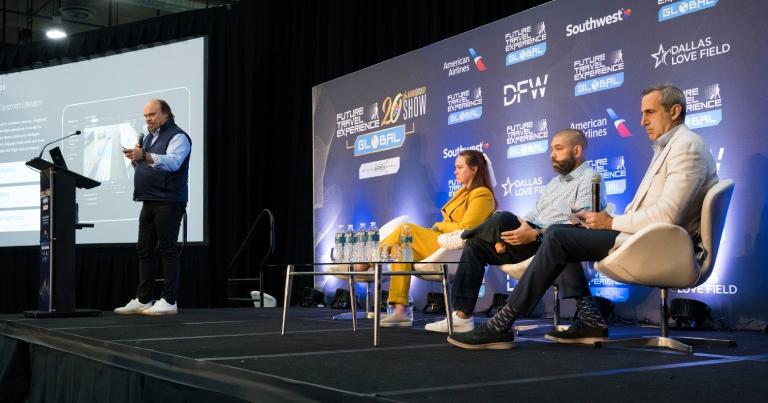
At the recent FTE Global 2026 event in Dallas, Texas, industry leaders from Southwest Airlines, Worlds, Dallas Fort Worth International Airport, and more explored how Physical AI could transform airline and airport operations, enhance the passenger experience and redefine the relationship between people, data and technology. It was standing room only for a session exploring one of the most compelling emerging developments in aviation technology: Physical AI. The discussion examined how intelligent systems that can perceive and respond to the physical world could create new possibilities for the air transport industry.
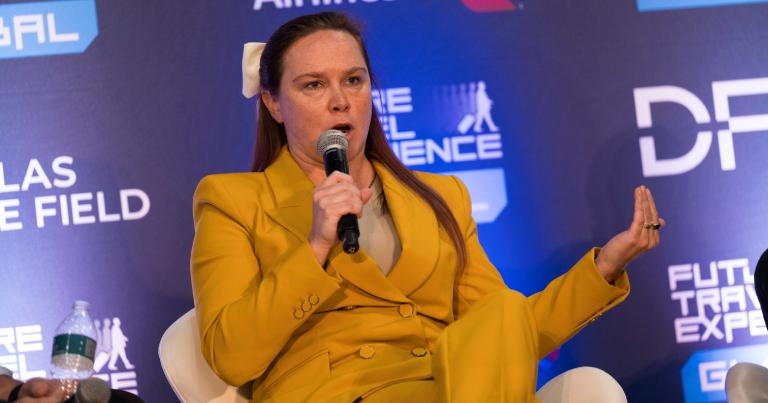
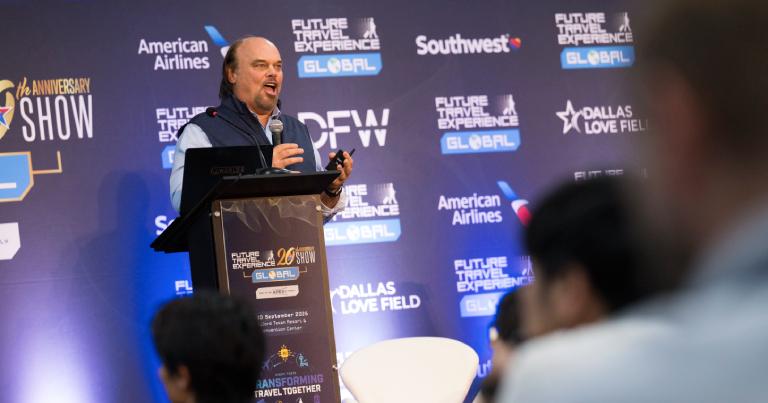
Moderated by Paul Puopolo, EVP, Chief Technology & Innovation Officer at Dallas Fort Worth International Airport, the session featured a scene-setting presentation from Dave Copps, Serial Entrepreneur, Technologist, Futurist, and CEO & Co-founder of Worlds, followed by a panel discussion with Kevin Kleist, Head of Emerging Trends at Southwest Airlines, and Nicole Austin, formerly Innovation Program Manager at Alaska Airlines. The discussion moved beyond the familiar applications of artificial intelligence to consider how AI could understand what is happening across complex physical environments, connect previously disconnected data sources and enable more intelligent operational decisions. From baggage handling and workplace safety to workforce transformation and the future of robotics, a central theme emerged: realising the potential of Physical AI will require organisations to rethink not just their technology, but also how they work.
Mark your diary for FTE Global 2027 – 7 to 9 September, Las Vegas >>Southwest Airlines: Preparing people and operations for the Physical AI era

Kevin Kleist, Head of Emerging Trends, Southwest Airlines (a Corporate Partner of the FTE Digital, Innovation & Startup Hub), emphasised that the industry should view Physical AI as more than a technology transformation. Instead, he suggested, it presents an opportunity to rethink how work is organised and delivered across the operation. “It’s not really about an AI transformation,” Kleist explained. “Instead, we’re thinking about it as really an operating model reinvention.”
As robotics, autonomous vehicles, sensors and automation become more capable, airlines will need to reconsider how tasks are performed, how teams are structured and how employees work alongside increasingly intelligent systems. For Kleist, the ultimate objective is to reduce friction in an inherently complex industry, improving conditions for employees while delivering safer and more efficient operations for customers.
However, he cautioned against assuming that organisations already know exactly what the future workforce will look like. Airlines will need to redesign roles and develop new skills as the technology evolves. Employees may increasingly be required to supervise autonomous systems, interpret information from connected environments, manage exceptions and make decisions in situations where safety and operational priorities intersect. “We want humans to do what humans are meant to do,” Kleist said, emphasising the importance of human judgement in environments where decisions can have significant consequences.
He added that airlines cannot simply rely on today’s job descriptions and skill-sets as the operating model changes. Recruitment, training and workforce development will need to evolve alongside the technology. This transformation also depends on trust. Employees must understand not only how a new system works, but why it is being introduced and how it is intended to improve their working environment. “With trust comes transparency,” Kleist said.
He argued that organisations have a responsibility to explain how Physical AI will benefit employees, customers and the overall travel journey. Without that transparency, employees may resist the technology, making implementation more difficult and undermining its potential benefits.
Beyond workforce considerations, Kleist highlighted the organisational challenges associated with connecting intelligent devices and their data. Historically, an operational team might be responsible for a vehicle or piece of ground equipment, with maintenance focused on its physical condition and power requirements. Introducing autonomous capabilities adds a new layer of complexity: the equipment also collects data, uses AI models and interacts with its surroundings. This raises questions about who owns the technology, who manages the associated data and how responsibility should be divided between operational teams, facilities functions and technology specialists.
Southwest Airlines is considering how these responsibilities should be organised, including the role of its AI and data teams in managing model accuracy, data quality and governance. Kleist warned against allowing autonomous vehicles, robotics and sensors to become isolated systems, each with its own data and management structures. Instead, airlines need to consider the wider ecosystem from the outset, ensuring that the necessary infrastructure exists to connect technologies and information across the operation.
This is particularly relevant as Physical AI expands beyond individual use cases. A collection of intelligent devices will only deliver its full potential if they can share information and operate as part of a coherent system. Data management will be another important consideration. Kleist noted that aircraft already generate terabytes of data, creating substantial demands on airlines to process, transmit and store information. He sees opportunities to use AI to process more information locally, at the edge, and transmit only what is necessary for further analysis or decision-making. “We need to be very smart about how we look at that data, how we understand the data,” Kleist said.
For Kleist, the challenge is to retain enough information to understand the environment and support effective decisions without assuming that storage capacity is unlimited. His contribution underlined the scale of the organisational task ahead. Deploying Physical AI will require more than installing robots or connecting cameras: airlines will need to redesign workflows, develop employee capabilities, establish clear governance and build an integrated infrastructure that supports the technology over time.
Worlds: Turning the physical world into live, actionable data

For Dave Copps, Serial Entrepreneur, Technologist, Futurist, and CEO & Co-founder of Worlds, the significance of Physical AI lies in its ability to bridge the gap between digital systems and the real-world environments in which airlines and airports operate.
He emphasised that conventional enterprise software has largely relied on structured information entered into systems, such as schedules and operational records. Yet the physical world is constantly changing, and many of the events that matter most to operational performance have traditionally been difficult for software to interpret.
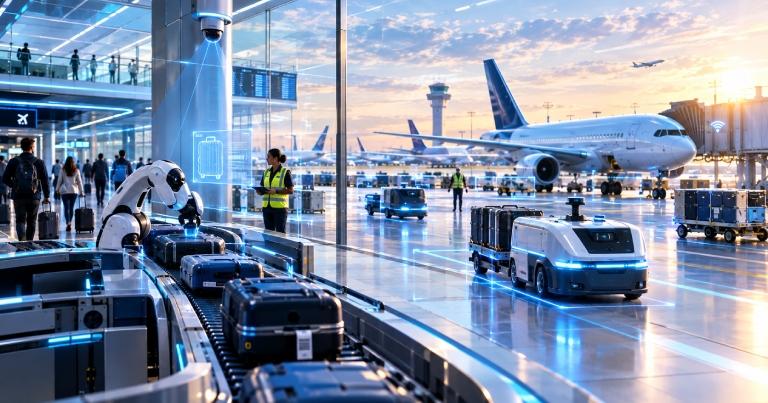
Consider an airport environment, where aircraft move across the apron, baggage travels through complex handling systems and equipment operates alongside employees in constantly changing conditions. Although these activities are central to day-to-day operations, conventional software has not always had a real-time understanding of what is happening on the ground. “Software’s not able to see that,” Copps explained, describing how organisations have consequently relied on people to monitor physical operations.
Physical AI, he argued, changes this relationship by enabling software to perceive and interpret activity in the real world. He challenged the audience to consider what might become possible if physical operations could be represented as a continuously updated data source. “Would it be possible in your environment if your physical operations was served up as live data, like a system of record for the physical world as it’s unfolding?”
For Copps, this is the key opportunity: creating a live operational picture that can be integrated with existing enterprise systems, providing the foundation for applications and AI agents that can respond to events as they happen. He also drew an important distinction between Physical AI and conventional computer vision. Rather than simply identifying objects in an image, Physical AI can interpret their movement, behaviour and relationships with their surroundings. “Computer vision was really about what’s in the picture, and Physical AI is really about what’s happening in the world,” Copps said.
This distinction has significant implications for aviation. Knowing that a bag is present is useful; understanding where it is moving, what condition it is in, which flight it is associated with and whether it is following the expected journey can provide much richer operational intelligence.
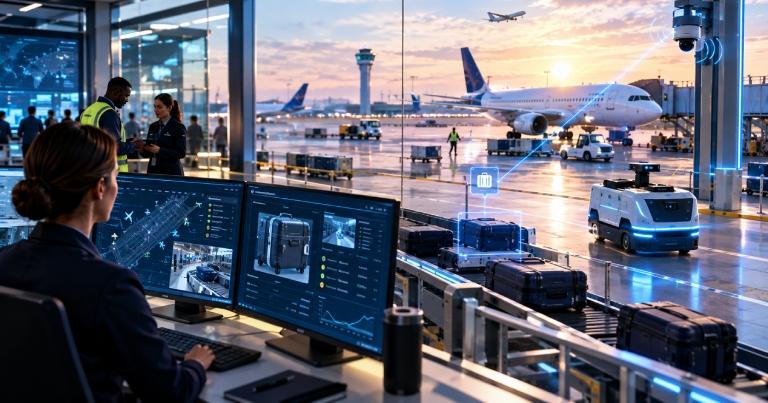
Copps described how Worlds uses cameras and other sensors to establish a real-time picture of physical activity, combining that information with enterprise data to support more responsive workflows. One application involves baggage operations, where a bag can be associated with multiple characteristics and contextual details, potentially allowing different events to trigger different actions. This could help airlines identify damaged baggage more effectively, understand where damage occurred and improve traceability throughout the handling process. Similar principles could be applied to equipment monitoring, logistics and workplace safety.
The broader proposition is to move away from disconnected point solutions towards a shared understanding of what is happening across an operation. As Copps put it, individual tools may be effective at specific tasks, but “your business is not one of them. Your business is 100 things.”
A connected, live data layer could help organisations coordinate those activities more effectively, rather than requiring them to stitch together numerous separate systems.
Copps also highlighted the potential of smart environments to enhance robotics. A robot operating in an environment equipped with connected cameras and sensors could benefit from a much broader understanding of its surroundings than its onboard sensors alone might provide. His message was clear: intelligent devices become more capable when they operate within intelligent environments.
However, Copps stressed that the objective should be to augment people rather than simply replace them. He argued that AI could take on particular tasks, improve safety and make jobs more effective, creating opportunities for employees to focus on work that requires human judgement and experience. For aviation organisations exploring Physical AI, the opportunity therefore extends beyond automation. It is about making the physical operation more visible, understandable and responsive, creating a foundation for improvements that would be difficult to achieve with isolated technologies alone.
DFW: Rethinking how airports understand and measure operations
As moderator, Paul Puopolo, EVP, Chief Technology & Innovation Officer at Dallas Fort Worth International Airport (a Corporate Partner of the FTE Digital, Innovation & Startup Hub), helped frame the discussion around the practical implications of Physical AI for airport operators and the wider air transport ecosystem. His opening summary captured the fundamental distinction between traditional AI and systems that can interact with the physical world. “Traditional AI can deal with information,” Puopolo observed. “Physical AI actually does something with that information, so it actually changes the way the physical world works.”
For airports, that shift could have far-reaching implications. Their operations involve a constant flow of aircraft, passengers, baggage, vehicles, equipment and employees, often across large environments in which multiple processes must work together. The ability to interpret activity as it unfolds could provide airport operators with a richer understanding of operational performance, helping them identify emerging issues and respond before they affect the wider system.
Puopolo’s questions also brought several challenges into focus, particularly the need to prepare workforces for new technologies, determine who will own and manage intelligent systems, and establish the data foundations required to support them. These questions are especially relevant for airports, where technology and operational responsibilities are often distributed across multiple departments, airlines, ground handlers, service providers and other partners. Physical AI could make it possible to connect information across these boundaries, but achieving that outcome will require organisations to address questions of data access, governance, accountability and integration.
Another important implication concerns how airports measure performance. Traditional operational metrics often record what has already happened: a delay, a missed connection, an equipment failure or a safety incident. But if AI can identify patterns that indicate a problem is developing, organisations may be able to intervene before the event occurs. As Puopolo observed during the discussion, this changes the way organisations think about their key performance indicators and dashboards. If a system prevents an incident rather than simply recording it, conventional measures may not fully capture the value being created.
That presents a challenge for airport and airline leaders. They will need to consider how to measure the benefits of earlier intervention, improved predictability and more effective coordination, alongside familiar measures such as punctuality, throughput, cost and safety performance.
The discussion also highlighted that organisations are starting from different levels of data maturity. Some may already have extensive sensor networks and established data platforms, while others will first need to understand what is happening across their physical environments.
For Puopolo and the wider industry, the implication is that Physical AI should not be treated as a standalone technology project. It raises broader questions about how airports organise their data, integrate their systems and define operational success. As intelligent environments become more capable, the opportunity will be to move from simply monitoring operations towards understanding them in real time and acting on that understanding.
Making automation work for people and passengers

Nicole Austin, formerly Innovation Program Manager at Alaska Airlines, brought the discussion firmly into the operational realities of an airline. At Alaska Airlines (a Corporate Partner of the FTE Digital, Innovation & Startup Hub), the innovation team focuses on technologies that could become relevant over a three-to-five-year horizon, assessing whether they can work in the airline’s environment and deliver a return on investment.
Robotics and computer vision are among the areas being explored, particularly in operational settings where tasks are physically demanding, repetitive or associated with high employee turnover. Baggage handling is one example. The work can involve heavy lifting, uncomfortable conditions and physically challenging environments. For Austin, technology offers an opportunity to supplement the workforce and redistribute labour more effectively.
Austin challenged the assumption that automation necessarily means eliminating jobs, drawing a comparison with the evolution of commercial aviation. As aircraft technology advanced and cockpit crew requirements changed, the industry was able to expand and develop in new ways. Her point was that technological progress can change the nature of work while creating opportunities elsewhere. Crucially, however, Austin believes that successful adoption depends on bringing employees into the process from the beginning. She highlighted Alaska Airlines’ automated baggage dispatch programme, developed in partnership with technology providers, as an example of how operational improvements can benefit both employees and passengers. The programme was designed to help dispatchers prioritise baggage movements, move bags more efficiently and improve the handling of tight connections. Rather than presenting the technology as something imposed on the workforce, the airline sought out an enthusiastic employee who could act as an advocate for the programme. That individual helped demonstrate its value to colleagues, encouraging wider acceptance. Austin explained that employees began to recognise that the technology was not a threat, but something that could make their work substantially easier and more enjoyable.
Austin’s advice to other organisations was straightforward: “Find that advocate that gets excited about that, bring them on, train them up.”
Employee engagement is particularly important because, as Austin acknowledged, AI is not yet capable of handling every operational nuance independently. “We need a human to say, hey, actually, this doesn’t make sense,” she explained, pointing to the practical knowledge employees possess about moving bags through complex airport environments when connections are tight.
That operational knowledge can provide valuable feedback to AI systems, helping them improve over time while ensuring that decisions remain grounded in the realities of airline operations.
Alaska Airlines is also exploring computer vision applications that could improve baggage visibility. Austin cited a proof of concept involving the counting, sizing and identification of carry-on baggage as it moves towards aircraft, which reportedly achieved 96-97% accuracy during testing. She also discussed the potential to identify damaged baggage more quickly and establish where damage occurs. Such applications could improve operational consistency, reduce manual effort and provide better information for resolving passenger issues.
Yet Austin emphasised that accuracy alone is not enough. Airlines must also consider safety, accountability and the safeguards needed when introducing AI into complex operating environments. Drawing parallels with technologies such as autopilot, she noted that public confidence develops over time, particularly when people can see that systems perform reliably. However, aviation’s safety record also demonstrates the importance of safeguards and procedures designed to manage risk. For Austin, responsibility cannot be left ambiguous when AI is introduced into operational processes. Contracts and agreements need to establish ownership of intellectual property, define how data can be used and clarify access to systems and APIs.
Ultimately, Austin argued, organisations must be prepared to take responsibility for the outcomes of the technology they deploy. The same pragmatic approach applies to implementation. Austin advocated using innovation programmes and controlled proofs of concept to test emerging technologies in real operating conditions, with clear baselines against which performance can be assessed. Her perspective reinforces a central lesson for airlines considering Physical AI: success is not simply a question of whether the technology works. It must also improve the operation, earn employees’ confidence and deliver measurable benefits for passengers.
From intelligent systems to intelligent environments
The FTE Global discussion demonstrated that Physical AI is about more than the next generation of robots. It represents a potential shift in how the air transport industry connects digital intelligence with the physical environments in which travel takes place.
Copps outlined how live data from the physical world could create a foundation for more responsive operations. Austin showed how airlines can explore practical applications while involving employees and maintaining human oversight. Kleist highlighted the organisational changes, skills and governance required to make these technologies work at scale. Puopolo brought the discussion back to the implications for airports, including the need to rethink data integration and operational performance measurement.
Together, their perspectives suggest that the greatest opportunities may emerge when individual technologies are connected within environments that can understand what is happening and respond accordingly. For airports and airlines, this could mean better visibility of baggage movements, earlier identification of operational issues, safer working environments, more effective use of resources and, ultimately, a smoother passenger journey.
Realising that potential will not be automatic. Organisations will need to establish reliable data foundations, demonstrate measurable value, address sustainability and governance concerns, and bring their workforces along as roles and responsibilities evolve.
But the direction of travel is becoming clearer. As AI moves beyond analysing digital information and begins to interpret and influence the physical world, the opportunity for the air transport industry is to rethink how its operations work as a whole. The next phase of aviation innovation may therefore depend not just on making individual devices smarter, but on making the environments in which they operate smarter, too.
Mark your diary for FTE Global 2027 – 7 to 9 September, Las Vegas >>What’s next – APEX FTE EXPO, Singapore, 18 to 19 November 2026

You may also be interested in
12 technology and CX trends that can enhance airline and airport operations in 2026
How Nice Airport is blending personalisation, experiential retail and omnichannel innovation
Air Canada targets more proactive, personalised passenger experience with AI and better data