




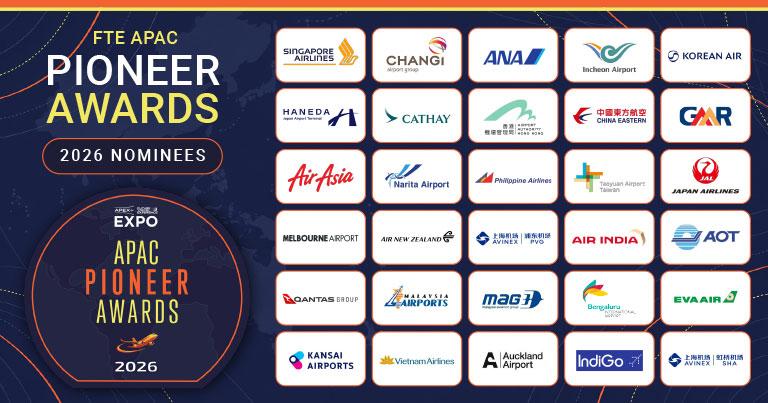
The shortlists for the FTE APAC Pioneer Awards 2026 have been unveiled ahead of the presentation ceremony at the free-to-attend APEX FTE EXPO, which takes place in Singapore on 18 to 19 November 2026. The FTE APAC Pioneer Awards shine a light on the 30 airlines and airports from across Asia-Pacific who are pushing the boundaries of innovation, enhancing the customer experience, and playing a vital role in advancing the air transport industry. Six of the 30 nominees will be presented with an ‘Outstanding Achievement’ trophy during the presentation ceremony in Singapore, which will provide the perfect opportunity to honour the region’s innovators among industry peers and colleagues. Congratulations to all of the airlines and airports that have been nominated!
See the APEX FTE EXPO Agenda Overview >> See the 14 reasons to attend APEX FTE EXPO >> Register for APEX FTE EXPO >>FTE APAC Airline Pioneer Awards 2026 nominees:
Singapore Airlines
 Singapore Airlines – a Headline Partner of APEX FTE EXPO, taking place in Singapore on 18-19 November 2026 – is placing digital innovation at the centre of its customer experience and operational strategy, combining artificial intelligence (AI), generative AI (GenAI), digital collaboration and next-generation connectivity to create more seamless journeys and empower employees.
A key focus is the development of a blueprint for adopting GenAI across the airline. Singapore Airlines is working with OpenAI to develop advanced GenAI solutions capable of interpreting text, audio, diagrams and video to augment customer servicing, streamline processes and improve staff productivity. The collaboration initially focuses on enhancing the airline’s AI-powered virtual assistant, creating a more intuitive way for customers to plan, book and manage their journeys.
Singapore Airlines is also applying AI to support employees and strengthen operational capabilities. Through its Digital Innovation Lab, KrisLab, the airline works with startups and entrepreneurs to identify practical applications of emerging technologies. One example is an AI- and speech-recognition-powered crew language competency app, which provides cabin crew with asynchronous learning tools to improve language skills, enunciation and onboard announcements. This reflects an approach focused not simply on automation, but on augmenting the people delivering the customer experience.
The airline is also preparing to introduce Starlink low Earth orbit satellite broadband progressively from the first quarter of 2027, initially across its Airbus A350-900 long-haul, A350-900 ultra-long-range and A380 fleets. Providing high-speed, low-latency connectivity in all cabin classes, the service will enable customers to stream video, game, use social media and transfer large files throughout their journey. It will build on Singapore Airlines’ existing complimentary inflight WiFi offering.
Innovation is further supported through collaboration across the aviation ecosystem. Singapore Airlines has signed a Memorandum of Understanding to participate in the International Aviation Lab established by the Civil Aviation Authority of Singapore, creating additional opportunities to explore innovation projects with industry partners.
By combining GenAI, AI-enabled employee tools, startup collaboration and next-generation connectivity, Singapore Airlines is turning emerging technologies into practical improvements that make travel more connected, personalised and productive for customers and employees.
All Nippon Airways
 All Nippon Airways (ANA) – a Partner of the FTE Baggage Innovation Working Group – is taking a pioneering approach to transforming airport and aircraft turnaround operations through automation, artificial intelligence (AI) and human-machine collaboration. At the heart of this journey is ANA’s participation in the FTE Smart Ramp initiative, which aims to make aircraft turnaround increasingly autonomous, efficient and sustainable.
ANA’s contribution centres on autonomous towing tractors for cargo transportation, designed to move cargo between the warehouse and apron with reduced manual intervention. Following extensive Proof of Concept testing, the autonomous towing tractor entered operational use in 2025, providing valuable insight into the practical challenges of deploying autonomous vehicles in complex ramp environments while demonstrating how robotics can work alongside ground handling personnel.
For ANA, Smart Ramp is about more than individual vehicles. The airline is working with industry partners and the Japan Civil Aviation Bureau (JCAB) to help establish the infrastructure, operational guidance and regulatory framework required for autonomous airport operations at scale. Its human-centred approach recognises that successful automation depends on involving the employees who understand ramp operations and co-creating new ways of working with them.
ANA sees this collaborative model as a potential milestone towards a fundamentally different turnaround operation by 2030, in which autonomous vehicles and people work together to improve safety, productivity and sustainability.
Alongside its work in autonomous ground operations, ANA is pioneering AI for flight safety. The airline became the first in the world to implement an AI-based turbulence prediction service developed by BlueWX, using deep learning trained on a decade of turbulence data. The model achieved 86% accuracy and was validated through trials involving around 2,500 ANA pilots before integration into the airline’s weather data infrastructure. By enabling crews to anticipate turbulence more accurately, the system has the potential to improve passenger comfort and safety while reducing disruption and associated costs.
ANA is also advancing its ANA Smart Travel proposition, enabling passengers to use their smartphones throughout their journey for a smoother, increasingly contactless experience.
Together, ANA’s autonomous ramp programme, AI-powered turbulence prediction and digital passenger services demonstrate a clear strategy of harmonious human-technology collaboration – using intelligent machines to reduce repetitive work and improve decision-making while empowering employees and enhancing the passenger experience.
Korean Air
 Korean Air is accelerating its digital transformation by moving artificial intelligence (AI) and cloud technologies from strategic initiatives into practical applications across customer service, aircraft maintenance and next-generation aviation. The airline is combining digital innovation with strategic technology partnerships to improve the passenger experience, empower employees and develop new operational capabilities.
A major development in 2026 is the launch of Korean Air’s new generative AI chatbot, which analyses customer questions in natural language and draws on the airline’s extensive rules and operational data to provide more accurate, personalised responses. Available across the airline’s website and mobile channels in 13 languages, the service moves beyond scripted chatbot interactions to understand the intent behind more complex customer questions.
AI is also being embedded into aircraft maintenance. Developed with LG CNS and Amazon Web Services, Korean Air’s new generative AI and cloud-based maintenance defect analysis system enables engineers to search and analyse maintenance records using natural language. The system can identify similar cases, standardise unstructured maintenance notes and automatically extract key information, helping technicians make faster, more informed decisions.
The airline is also exploring robotics and AI to transform physical aircraft inspections. Its AI-based inspection system combines drones and ground robots to examine aircraft exteriors, with AI analysing captured imagery to identify defects. Korean Air says the approach could reduce inspection times for large aircraft from eight to 10 hours to around 50 minutes, while reducing the need for technicians to undertake work at height.
Beyond its core airline operations, Korean Air is developing AI-powered autonomous aviation technologies, including its AI Pilot system and ACROSS integrated traffic-control solution for future air mobility. Its partnership with Anduril to develop autonomous aircraft further extends this focus into next-generation aerospace systems.
By applying AI across customer service, maintenance, physical operations and future aviation, Korean Air is demonstrating how digital technologies can move beyond individual use cases to reshape the way an airline operates, while creating new possibilities for the wider aviation ecosystem.
Cathay Pacific
 Cathay Pacific is turning its digital transformation into a platform for practical innovation, using artificial intelligence (AI), real-time data, digital operations and next-generation connectivity to enhance the customer experience while making its own aviation technology available more widely across the industry.
A key development is the evolution of Cathay Technologies, the airline’s wholly-owned subsidiary established in 2025 to commercialise digital solutions developed within the Cathay Group. Its Electronic Flight Folder (EFF) is now being taken beyond Cathay, with Cargolux partnering with Cathay Technologies in 2026 to deploy the solution across its flight operations. The EFF gives pilots access to digital flight information and real-time operational data, replacing paper-based processes with a more connected and streamlined environment.
AI is also becoming increasingly embedded across Cathay’s operations. The airline has developed more than 85 machine learning models supporting areas including operational optimisation and simulation of Hong Kong International Airport’s Three-Runway System. Enterprise Retrieval Augmented Generation (RAG) capabilities are helping employees access internal knowledge, while Microsoft Copilot has been deployed to most back-office teams, demonstrating how Cathay is using AI to augment employees and improve productivity.
Cathay is also applying AI to aviation’s environmental challenges. In partnership with Google, the airline is trialling AI-powered contrail avoidance technology, becoming Google’s first commercial airline partner in Asia-Pacific to trial the technology and the first airline globally to test contrail avoidance on ultra-long-haul flights. More than 80 flights in the initial trial followed contrail-avoidance routes, with Google estimating a reduction in their contrail warming impact.
The customer journey continues to benefit from Cathay’s digital capabilities, with AI-powered disruption assistance, biometric boarding and high-speed inflight WiFi now complementing its digital booking and journey management services. By developing AI and data capabilities internally, commercialising its own aviation technology and collaborating with technology partners, Cathay is extending digital innovation from individual customer touchpoints into the wider operation and increasingly across the aviation industry.
China Eastern Airlines
 China Eastern Airlines is making artificial intelligence (AI) a central pillar of its digital transformation, applying intelligent technologies across customer service, operations, maintenance, safety and airport services to create a more connected and responsive aviation ecosystem.
A major development is the airline’s Digital Human + Multi-Agent Smart Aviation Service System, launched through the China Eastern app. Using a digital human as a single entry point, multiple AI agents work together to support passengers through natural-language interactions covering pre-trip planning, in-trip services and post-trip feedback. The system now covers dozens of process-guidance and business-handling scenarios, moving digital customer service beyond simple information retrieval towards more comprehensive journey assistance.
China Eastern is also expanding AI into physical airport operations. In 2026, the airline showcased robots equipped with large-model capabilities for passenger enquiries, check-in guidance, baggage services and transfer assistance, alongside autonomous baggage-handling technology. At its catering facility in Shanghai, an AI-powered robotic food-plating line combines flexible robotic arms with an AI nutrition model to automate meal preparation while providing nutritional information.
Operational efficiency is another major focus. China Eastern has developed AI applications across safety, marketing, ground services, operations and maintenance, including predictive aircraft health-management tools and digital flight-support systems. Its Bridge Connection Assistant uses real-time monitoring and intelligent alerts to reduce excessive aircraft-bridge occupancy, while a self-developed AI network-management platform monitors inflight connectivity and satellite links.
The airline is also extending AI into commercial services. In 2026, China Eastern partnered with Alibaba’s Qwen AI app to enable customers to search for flights, book and pay, select seats and check in through natural-language interactions. It has also partnered with KAYAK to introduce AI-powered overseas travel services, extending its digital reach to international customers.
By combining multi-agent AI, robotics, predictive analytics and conversational commerce, China Eastern is embedding intelligent technology across the complete aviation journey – from booking and airport services to flight operations, maintenance and inflight connectivity.
AirAsia
 AirAsia is continuing its transformation from a low-cost airline into a digitally driven travel ecosystem, with AirAsia MOVE bringing flights, hotels, attractions, transfers, insurance, payments, loyalty and other travel services together on a single platform. The focus is on using technology, data and partnerships to make travel more accessible, flexible and seamless across Asia and beyond.
AirAsia MOVE has significantly expanded its proposition beyond AirAsia flights, now offering access to more than 700 airlines and over one million hotels worldwide. In March 2026, the platform added global attractions through a partnership with GetYourGuide, enabling travellers to search and book activities and experiences alongside flights and accommodation. This strengthens MOVE’s ambition to support the complete travel journey within one digital ecosystem.
AI and personalisation are also becoming increasingly important. MOVE’s AI-driven AskBo chatbot is being enhanced to provide more intuitive customer support, while a refreshed interface and features including Cancel for Any Reason are designed to give travellers greater choice and control. The platform is also using first-party behavioural data to understand travel intent and provide more relevant recommendations, content and offers.
The ecosystem is supported by a growing network of strategic partnerships. MOVE added direct relationships with airlines including Ethiopian Airlines, Vietjet Air and Garuda Indonesia during 2025, taking its direct airline partnerships to more than 70, while partnerships with tourism organisations are using data, technology and content to create more personalised destination experiences.
Payment innovation is another part of the transformation, with MOVE partnering with Antom and 2C2P to broaden local payment options, streamline cross-border transactions and create a more seamless checkout experience. By combining AI, data, connectivity, payments and an expanding portfolio of travel products, AirAsia is evolving its digital platform from an airline booking tool into a comprehensive, technology-led travel ecosystem for the region.
Philippine Airlines
 Philippine Airlines (PAL) is continuing to accelerate its digital transformation, using artificial intelligence (AI), customer data, cloud technology and next-generation connectivity to create more seamless passenger journeys while improving the efficiency of its operations and empowering employees.
A major focus is the continued development of PAL’s AI-powered customer service capabilities. Following the deployment of Salesforce Customer 360 across its contact centre and customer feedback management, the airline is using a unified view of customer interactions to provide faster and more personalised support. PAL has also continued to explore generative AI and automation to streamline service processes, including its pioneering use of Slack AI to re-engineer the refund process, enabling employees to spend more time resolving complex customer issues.
PAL is also advancing how it sells and personalises its products through New Distribution Capability (NDC). Its dynamic booking and selling platform, powered by Amadeus, provides travel partners with richer access to PAL’s products and services, from flight schedules and seat selections to meals and ancillary offerings. This enables the airline to create more personalised offers while giving customers greater choice and transparency throughout the booking process.
Digital innovation is also being applied to the operational backbone of the airline. PAL is working with SITA to modernise its network infrastructure and end-user computing environment, creating a more scalable technology foundation to support future digital initiatives. The airline is also investing in the connectivity and digital capabilities needed to support employees as technology becomes increasingly embedded across its operations.
Together, these initiatives reflect a broader shift in PAL’s approach to digital transformation: using technology not simply to automate individual processes, but to connect customer information, employee tools, commercial systems and operational infrastructure. By combining AI, data, digital distribution and a stronger technology foundation, Philippine Airlines is building a more responsive and personalised experience while equipping its people and operations for the future.
Hear more from Philippine Airlines at APEX FTE EXPO, taking place in Singapore on 18 to 19 November 2026. Richard Nuttall, President, Philippine Airlines, is participating in the ‘Opening APEX Keynote Panel Discussion: The State of the Industry’.
Register for APEX FTE EXPO >>Japan Airlines
 Japan Airlines (JAL) is entering a new phase of digital transformation, placing artificial intelligence (AI), data and robotics at the heart of its strategy to improve customer and employee experiences, enhance operational productivity and create new value across aviation and next-generation mobility.
A major step forward is the establishment of JAL Digital in 2025, bringing together JAL’s digital technology functions and creating a stronger platform for innovation. Under its new DX strategy, JAL plans to invest approximately 260 billion yen (US$1.6bn) in technology between 2026 and 2030, while developing digital capabilities across the Group. The airline is targeting 10% of its workforce becoming DX talent by 2030, helping move digital transformation from a technology function into an organisation-wide capability.
AI is central to this transformation. JAL is applying AI and advanced technologies to areas including maintenance failure forecasting, crew communication and information access, flight crew scheduling and airport operations. The airline is also expanding automation and robotics, including autonomous technologies and humanoid robots, to improve productivity and enable employees to focus on higher-value activities. JAL has established AI principles centred on human oversight, reflecting its approach of using AI to augment human judgement rather than replace it.
Customer experience is another key focus, with JAL combining digital technology and human hospitality to create more seamless and personalised journeys. Initiatives include facial-recognition boarding and connections, AI-powered customer support and greater use of data to understand passenger needs and deliver more tailored services.
JAL is also looking beyond traditional aviation. Through its Air Mobility Operation Platform (AMOP), the airline is developing digital infrastructure to support next-generation mobility, using its aviation expertise and operational data to help create safer and more connected air mobility networks.
By combining substantial technology investment with AI, data, robotics and next-generation mobility, JAL is moving into a new phase of digital transformation designed to improve the experience for customers and employees while reshaping how aviation operations are delivered.
Air New Zealand
 Air New Zealand is continuing its ambition to become the world’s leading digital airline, combining artificial intelligence (AI), cloud technology, data and digital product development to create simpler customer journeys, empower employees and improve operational performance. At the same time, the airline continues to link innovation with its long-term sustainability ambitions.
A major focus is the airline’s five-year strategic partnership with Tata Consultancy Services (TCS), which is accelerating cloud migration, AI-powered automation, digital retail and the development of digital, AI and cyber capabilities across Air New Zealand. The airline is also building dedicated internal AI expertise, with new roles focused on developing and scaling generative AI solutions for personalised digital experiences, smarter operations and AI-assisted employee tools.
Air New Zealand’s adoption of ChatGPT Enterprise has also expanded its AI capabilities beyond individual experiments. Thousands of corporate employees have access to the technology, with teams developing custom GPTs to support collaboration, automate repetitive tasks and improve areas including customer service, planning and information access. This is helping establish AI as an everyday productivity tool across the organisation.
Digital transformation is also supporting the passenger experience, with Air New Zealand continuing to develop its digital channels and self-service capabilities to make travel simpler and more intuitive. Its focus extends across the journey, from booking and disruption management through to airport and inflight experiences, with digital tools increasingly designed around the individual needs of customers.
Alongside its digital strategy, Air New Zealand continues to pursue next-generation aircraft technologies through its Mission Next Gen Aircraft programme. The airline’s collaboration with BETA Technologies on electric aircraft forms part of a broader effort to explore lower-emission solutions for regional aviation and help build the ecosystem required to support new forms of aircraft and propulsion.
By combining AI, digital skills, cloud transformation and next-generation aircraft technology, Air New Zealand is connecting its digital and sustainability ambitions. Its approach is focused on using technology not simply to automate processes, but to create a more personalised, efficient and sustainable airline for customers and employees.
Air India
 Air India is accelerating its transformation into a digitally enabled global airline, using artificial intelligence (AI), biometrics, connected technology and data to modernise the customer journey while creating a more agile and efficient organisation. Under its Vihaan.AI transformation programme, digital innovation is increasingly being embedded across the airline’s operations.
AI is playing a growing role in both customer service and employee productivity. Air India’s revamped website and mobile app incorporate generative AI capabilities to provide more intuitive assistance, while internally the airline is deploying Microsoft 365 Copilot and its myAI enterprise platform to give employees faster access to information and digital tools. These initiatives reflect a broader shift towards using AI to augment employees and simplify complex processes.
The airline is also continuing to pioneer biometric and digital airport experiences. Air India introduced India’s first biometric-enabled self-bag-drop facility at Bengaluru Airport, enabling passengers to complete baggage processes with greater speed and convenience. Its AEYE Vision platform combines AI, augmented reality and smartphone camera technology to bring multiple travel services together within the Air India app, creating a more interactive digital journey.
Connected travel is another major focus. Air India has expanded inflight WiFi across its growing fleet, including Airbus A350 and Boeing 787-9 aircraft, while integrating Apple AirTag functionality into its baggage-tracking experience to provide customers with greater visibility over their luggage. These services extend the digital journey beyond the airport and into the aircraft.
Behind the scenes, Air India is also investing heavily in the technology infrastructure required to support its transformation, modernising its IT systems, strengthening digital platforms and building capabilities to support a rapidly expanding fleet and network.
By combining AI, biometrics, connected devices, digital self-service and employee technology, Air India is moving beyond individual digital initiatives towards a more integrated technology ecosystem. The result is a transformation designed not only to modernise the passenger experience, but to create the digital foundations of a new-generation global airline.
Qantas Group
 Qantas Group is embedding artificial intelligence (AI), data and digital technology across its airlines to transform customer experiences, improve operational performance and create new ways of working. With technology now a core component of the Group’s transformation strategy, Qantas and Jetstar are applying AI and advanced analytics across the customer journey and the wider operation.
A major development is the establishment of a new Product Innovation Centre in Adelaide, which opened in 2026 and is expected to create more than 420 technology roles over three years. Bringing product managers, digital designers, software engineers and data and AI specialists together, the Centre is focused on developing new digital experiences, AI-powered customer tools and technology to support frontline employees.
AI is being deployed across multiple operational use cases, including predictive maintenance, flight planning, catering optimisation and network performance. The Group is also using data and analytics to improve aircraft turnaround times, reduce delays and strengthen operational resilience, while AI-powered tools are being explored to improve safety through smart hazard detection. Qantas is also expanding the use of generative AI to support employees and streamline enterprise processes.
Customer experience remains central to the strategy. The Group is developing more personalised digital interactions across its channels, with a new Qantas website incorporating a conversational AI assistant and enhanced app functionality designed to simplify the journey. Existing digital capabilities include real-time baggage tracking, while the Qantas Frequent Flyer programme is increasingly integrated into the digital experience, giving members easier access to rewards and personalised travel options.
The Group is also investing in modern airline retailing, using data to enable more personalised offers, dynamic pricing and flexible fare and ancillary bundles across Qantas and Jetstar.
By combining AI, data, digital product development and operational analytics across its airline portfolio, Qantas Group is moving beyond isolated technology projects towards an enterprise-wide transformation. The focus is on using technology to make travel more personalised and responsive while improving the efficiency, resilience and sustainability of the operation.
Malaysia Aviation Group
 Malaysia Aviation Group (MAG), the parent company of Malaysia Airlines, Firefly and AMAL by Malaysia Airlines, is entering the next phase of its transformation with digital technology at the centre of its ambition to build a future-ready aviation and travel services group. Its ‘Digital is Our Universe’ strategy is translating into practical innovations across the customer journey, commercial operations and the wider Group.
A major development has been MAG’s collaboration with Adobe, Google, Skyscanner and Visa, bringing together expertise in digital engagement, personalisation, metasearch and payments to create a more connected, data-driven travel experience. The partnership aims to help travellers discover, engage with and book journeys more seamlessly, while enabling MAG to deliver more relevant and personalised offers.
MAG is also simplifying the airport experience through digital self-service. Malaysia Airlines became the first airline in Southeast Asia to introduce TravelReady, integrating digital passport and visa verification into its online and mobile check-in process. The initiative allows eligible passengers to verify their travel documents before reaching the airport, reducing friction at check-in and creating a more streamlined journey.
The Group is continuing to enhance its digital distribution capabilities through Malaysia Airlines’ MHplus platform, which uses IATA’s New Distribution Capability (NDC) standard to provide richer content, ancillary services, fare families and personalised offers through travel partners and other channels. This supports MAG’s wider ambition to move towards more flexible, customer-centric airline retailing.
Digital transformation is also supported by a broader technology ecosystem. MAG continues to work with Microsoft on technologies including artificial intelligence (AI), data analytics, machine learning, augmented reality and robotics, while Malaysia Airlines’ existing collaboration with Google is using AI and digital marketing to strengthen commercial performance and create more tailored customer experiences.
By combining AI, personalisation, digital identity, modern distribution and strategic technology partnerships, MAG is moving digital innovation beyond individual projects and into the wider travel ecosystem. As the Group progresses into its next transformation phase, technology is becoming an increasingly important enabler of a more seamless, connected and customer-focused Malaysian aviation experience.
EVA Air
 EVA Air is accelerating its digital transformation through artificial intelligence (AI), automation, data and connected platforms, using technology to create more personalised customer experiences, empower employees and build smarter operations across both passenger and cargo services.
A major focus is the airline’s enterprise generative AI strategy. EVA Air has established a dedicated enterprise AI platform to support secure internal knowledge applications and is expanding the use of external generative AI tools alongside agent-based AI. An enterprise intelligent support system is also being developed as an employee assistant, while robotic process automation is enabling business teams to create their own workflows and reduce manual processes.
Customer service is another key area of innovation. EVA Air has introduced generative AI into its customer-service robots, providing intelligent bilingual Chinese and English assistance through its website and app. The airline is also integrating its global cloud customer-service system with live text channels, allowing service data and resources to be used more flexibly across markets.
EVA Air is simultaneously advancing digital services throughout the passenger journey. Its BizFam global business travel platform provides a one-stop travel management and electronic redemption service, while digital iCoupon has been rolled out across North American stations, enabling passengers to redeem offers using their digital boarding passes. The airline is also developing a revised app designed to provide more context-aware information and services throughout the journey.
Digital transformation extends into cargo, where EVA Air has joined IATA’s Digitalization Leadership Charter in 2026. The airline is implementing IATA ONE Record to enable secure, real-time data exchange across the cargo supply chain, while developing a next-generation cargo data analytics platform incorporating AI and automated notifications.
By combining enterprise AI, customer-service automation, digital self-service and real-time cargo data, EVA Air is creating a connected digital ecosystem that spans employees, passengers and partners, using technology to make the travel experience more responsive while improving efficiency across the operation.
Vietnam Airlines
 Vietnam Airlines is accelerating its ambition to become a leading digital airline in Asia-Pacific by 2030, using artificial intelligence (AI), cloud technology, data and modern digital platforms to transform both the customer experience and the airline’s underlying operations.
A major focus is the continued development of the airline’s strategic technology partnership with FPT, which is supporting Vietnam Airlines in deploying generative AI, big data, cloud computing, blockchain and Internet of Things (IoT) technologies. The collaboration is helping move the airline towards a more integrated digital ecosystem, with technology increasingly embedded across commercial, operational and customer-facing functions.
A key element is the development of a next-generation e-commerce platform designed to provide more personalised offers and expand the range of services available through Vietnam Airlines’ digital channels. The airline is also deploying AI-powered customer engagement tools, including chatbots, voice bots and automated content generation, helping customers access information and services more quickly while reducing manual workloads for employees.
Vietnam Airlines is strengthening the data foundations behind these experiences through a Customer Data Platform (CDP), enabling information from different customer interactions to be brought together and used to support more relevant and personalised engagement. New CRM and ERP systems, mobile e-commerce capabilities and internal self-service platforms are also helping modernise the airline’s wider digital infrastructure.
The airline is simultaneously upgrading core passenger systems. Its adoption of Amadeus’ enhanced Passenger Service System is supporting more efficient reservation, ticketing and check-in processes, providing a stronger technology foundation as Vietnam Airlines expands its network and digital services.
Together, these initiatives demonstrate a shift from individual digital projects towards an integrated transformation spanning customer engagement, commerce, data and core airline systems. By combining AI and advanced technologies with modern digital infrastructure and strategic partnerships, Vietnam Airlines is building the capabilities required to deliver a more personalised, connected and efficient travel experience while progressing towards its 2030 digital-airline ambition.
IndiGo
 IndiGo is accelerating its digital transformation as it expands across India and international markets, using artificial intelligence (AI), cloud technology, data and automation to create more seamless customer journeys while improving operational efficiency and supporting the airline’s rapid growth.
A key development is the continued evolution of 6Eskai, IndiGo’s generative AI-powered virtual assistant. Integrated into WhatsApp, the platform enables customers to interact with the airline using natural language to search and book flights, check-in, access boarding passes and manage their journeys. By bringing multiple services together within a familiar conversational interface, 6Eskai is helping IndiGo make digital self-service more intuitive and accessible.
AI and data are also being applied directly to flight operations. IndiGo has expanded the use of the SkyBreathe Pilot App across its Airbus fleet, providing pilots with real-time, data-driven insights throughout each phase of flight. The tool supports more informed decision-making and fuel-efficiency improvements, helping the airline reduce operational costs and environmental impact while maintaining a strong focus on safety.
The airline is also building the digital foundations required to support its growth. Following a large-scale cloud migration, IndiGo is using modern cloud infrastructure to improve the scalability, resilience and responsiveness of its customer-facing and operational systems. This provides greater flexibility as the airline expands its fleet, network and digital services.
Collaboration remains another important element of IndiGo’s innovation strategy. Through its digital aviation consortium with GMR Hyderabad International Airport, the airline is bringing together aviation stakeholders to explore technologies including AI, Internet of Things (IoT), blockchain and Data Mesh. The initiative aims to develop solutions that can improve passenger services, operational efficiency and sustainability across the wider Indian aviation ecosystem.
By combining conversational AI, flight-operations technology, cloud infrastructure and ecosystem-wide collaboration, IndiGo is creating a digital platform capable of supporting its next stage of growth. Its approach demonstrates how technology can simultaneously improve the customer experience, strengthen operational performance and help build a more connected aviation ecosystem.
FTE APAC Airport Pioneer Awards 2026 nominees:
Changi Airport Group
 Changi Airport Group (CAG) – a Headline Partner of APEX FTE EXPO, Singapore, 18-19 November 2026 – continues to place digital transformation and innovation at the heart of its ambition to create the airport of the future. Its digital factory, DIVA – Digital, Innovation, Ventures and Analytics – develops, experiments with and launches digital products and services designed to transform operations and enhance the end-to-end traveller experience. Changi Airport Group has also opened a new innovation hub, Terminal X. Designed to bring innovators together under one roof, Terminal X is a dynamic space dedicated to collaboration, creativity, and real-world experimentation. Featuring facilities including a makers’ lab, UI/UX testing environments, and immersive storytelling chambers, it offers a unique glimpse into how the future of travel is being shaped today, reflecting Changi’s continued commitment to accelerating innovations and elevating passenger experience.
Through its SMART Airport Vision, Changi is pioneering the use of artificial intelligence (AI), data analytics, automation, sensors and connected technologies to make travel more seamless, efficient, personalised and sustainable. AI and advanced analytics are being explored across security and airport operations, while biometrics and self-service technologies support faster passenger processing. Changi is also leveraging Extended Reality, machine learning, Internet of Things (IoT) and edge computing across the passenger journey.
This technology-led approach is complemented by innovative infrastructure. Changi has completed its first satellite gate, bringing the comfort and accessibility of an aerobridge experience to flights operating from remote stands. The facility features two aerobridges and a gently sloping 60-metre ramp, improving accessibility for wheelchair users, seniors, families and passengers with wheeled luggage. Designed as a zero-energy facility, it is powered by rooftop solar panels and an off-grid battery system, while smart building technology automatically activates air-conditioning based on flight information and wirelessly alerts maintenance teams to electrical faults.
Changi is also developing a new private terminal and premium amenities cluster, scheduled to open in mid-2027, offering personalised journeys including private suites, bespoke dining, wellness experiences and direct access to boarding.
Looking further ahead, Terminal 5 is central to Changi’s long-term transformation. Construction began in May 2025, with completion planned for the mid-2030s. Meanwhile, CAG is investing S$3 billion over six years across Terminals 1 to 4 to modernise baggage, check-in, immigration and Skytrain systems ahead of rising demand.
Through DIVA and collaboration with industry partners and the Civil Aviation Authority of Singapore’s International Aviation Lab, CAG is creating a living testbed for emerging technology. From AI and biometrics to zero-energy infrastructure and immersive experiences, Changi is continually reinventing both the operational foundations and passenger experience of the smart airport.
Hear more from Changi Airport Group at APEX FTE EXPO, taking place in Singapore on 18 to 19 November 2026. Jayson Goh, Executive Vice President, Airport Management, Changi Airport Group, is participating in the Opening FTE Keynote Panel Discussion. Jason Lin, Vice President Airport Operations Strategy & Transformation, Changi Airport Group, will deliver a Special Presentation on Changi Airport’s pioneering autonomous vehicles. Meanwhile, Jeffrey Loke, Senior Vice President, DIVA (Digital Factory), Changi Airport Group, will share a presentation on ‘Terminal X: How Changi is building a digital campus for digital innovation and transformation’.
Register for APEX FTE EXPO >>Incheon International Airport Corporation
 Incheon International Airport Corporation (IIAC) is accelerating its transformation into a smarter, more autonomous airport, using artificial intelligence (AI), robotics, biometrics, 5G and digital-twin technologies to enhance both passenger experience and operational efficiency. Over the past year, this strategy has progressed from individual innovation trials towards the deployment of autonomous services at scale.
A major development in 2026 has been the introduction of three new types of autonomous robots at Incheon Airport: self-check-in robots, information and patrol robots, and docent robots. 31 robots entered service in May, combining autonomous navigation, AI, 5G and digital-twin technology to provide passenger assistance and support airport operations. The self-check-in robots represent a world-first commercial deployment, bringing automated check-in directly to passengers, while information and patrol robots provide assistance and monitoring across the airport.
Incheon has also significantly expanded its biometric Smart Pass service. Facial-recognition-based processing was extended in September 2025 to all boarding gates across both Terminal 1 and Terminal 2, enabling registered passengers to use facial recognition at departure and boarding without repeatedly presenting their passport or boarding pass. The expansion further advances Incheon’s vision of a seamless, contactless passenger journey.
AI is also becoming more deeply embedded in the airport’s innovation ecosystem. Through its New Technology Testbed programme, IIAC is giving technology companies access to the airport to trial emerging solutions in real-world conditions. Recent projects include AI-based personalised emergency guidance, autonomous waste collection, and autonomous security and safety robots.
This approach is complemented by X:PORT, a new digital exhibition and experience centre at Terminal 1 showcasing emerging technologies including robotics and AI. Meanwhile, Incheon is developing a dedicated 5G private network and a 5G-enabled digital-twin platform to support its growing ecosystem of autonomous systems.
By combining biometric passenger processing with autonomous robotics, AI, 5G, digital twins and a structured testbed for emerging technologies, Incheon is turning its smart-airport vision into practical applications, continually reshaping both the passenger journey and the way airport operations are delivered.
Japan Airport Terminal Co. Ltd
 Japan Airport Terminal – the organisation responsible for the construction, management and operation of Haneda Airport’s terminals – is at the forefront of airport innovation through its visionary “terminal.0 HANEDA” initiative. This ambitious cross-industry collaboration brings together technology companies, startups and industry stakeholders to reimagine the airport of the future, focusing on cutting-edge technology, sustainability, operational efficiency and passenger experience. The FTE World Innovation Summit, hosted by Haneda Airport, will take place in Tokyo, Japan, on 1-3 March 2027, bringing the global aviation and innovation community together in one of the world’s leading technology hubs.
At the heart of terminal.0 HANEDA is the ambition to develop practical, scalable solutions that can be deployed not only at Haneda but at airports worldwide. The initiative is exploring artificial intelligence (AI), robotics, automation, biometrics and the Internet of Things (IoT) to create a smarter, more seamless passenger journey. AI could enable the airport to predict passenger flows and peak periods, allowing staffing and resources to be allocated proactively, while robotics and automation can support areas such as baggage handling. Biometric technologies, including facial recognition, also have the potential to streamline processes from check-in and security through to boarding.
Sustainability is another core pillar, with terminal.0 HANEDA exploring green technologies, energy-efficient infrastructure and waste-reduction initiatives. The organisation’s commitment is also reflected in the planned opening of the Terminal 1 North Satellite facility on 1 September 2026, featuring a hybrid timber-and-steel structure designed with carbon neutrality in mind.
Crucially, Japan Airport Terminal’s approach is based on collaboration and co-creation, using Haneda as a living testbed where airports, airlines, technology companies and startups can identify challenges, test concepts and develop solutions with potential for wider deployment.
Through terminal.0 HANEDA and its wider innovation programme, Japan Airport Terminal is demonstrating how airports can combine AI, automation, biometrics, connected infrastructure and sustainable design with a strong focus on human experience. As host of FTE World Innovation Summit 2027, it will also provide a global platform for exploring the technologies and ideas shaping the airports of tomorrow.
Airport Authority Hong Kong
 Airport Authority Hong Kong (AAHK) is positioning Hong Kong International Airport (HKIA) at the forefront of the Airport 4.0 era, leveraging high-performance connectivity, automation, biometrics and smart technologies to transform the airport into a smarter, safer and more convenient ‘Airport City’.
A key enabler is HKIA’s Enterprise 5G Infrastructure, which allows all Hong Kong mobile network operators and HKIA’s private 5G network to deliver services through a shared infrastructure. The high-capacity, ultra-reliable and low-latency network provides the digital backbone for connected devices, autonomous vehicles and intelligent airport systems. In 2025, AAHK expanded its autonomous vehicle fleet to 70, while private 5G is also supporting autonomous apron line-marking robots that automate complex taxiway and runway work, improving safety and efficiency.
AAHK is deploying 5G, Internet of Things (IoT) and artificial intelligence (AI) across the airport to enhance operations and passenger experience. More than 150 5G-enabled movable display panels provide real-time flight information and wayfinding, while connected infrastructure supports remote monitoring, preventive maintenance and more predictive airport operations.
Meanwhile, HKIA is delivering a seamless biometric passenger journey through the full deployment of Flight Token (One ID) across departure checkpoints. Facial recognition is embedded into check-in and security processes, while cloud-based, 5G-enabled smart kiosks further streamline passenger processing.
The newly opened Terminal 2 represents a major milestone, with extensive use of smart technology including 68 express self-bag-drop counters, 58 smart check-in kiosks, 20 e-Security Gates using facial recognition, 15 smart security screening channels, 35 e-Channels and 60 immigration counters. Large-scale LED displays and immersive 3D content add a strong digital dimension to the passenger environment.
AAHK is also continuing to expand automation across the wider airport, integrating autonomous vehicles, robotic apron operations, 5G-enabled IoT infrastructure and advanced video analytics.
Together, these initiatives demonstrate how 5G, AI, biometrics, IoT, robotics and autonomous mobility can be deployed at scale. With Terminal 2 providing a digitally enabled gateway and Flight Token connecting key passenger touchpoints through trusted digital identity, HKIA is establishing a compelling blueprint for the smart, connected and passenger-centric airport of the future.
GMR Group
 GMR Group, one of Asia’s largest private airport operators, is continuing to accelerate the digital transformation of its airport portfolio, using artificial intelligence (AI), predictive analytics, digital twins and automation to improve operational efficiency and create more seamless passenger journeys. Over the past year, GMR has moved its technology strategy further into live airport operations, with innovations being deployed across Delhi and Hyderabad.
At Delhi Airport, GMR-led Delhi International Airport Limited (DIAL) has strengthened its use of AI and predictive analytics through the Airport Predictive Operations Centre (APOC). During the 2025-26 winter season, the system integrated real-time operational data, predictive weather models and airside information to support faster decision-making during periods of low visibility. It helps optimise runway utilisation, gate and stand allocation and aircraft sequencing, enabling the airport to respond more proactively to disruption and maintain smoother operations.
GMR has also continued to digitise the passenger journey. Delhi Airport introduced an E-Arrival Card facility for international passengers, eliminating paper-based arrival cards and helping to reduce queues and processing time. A 360-degree virtual navigation map was also launched at Terminal 3, using real images of the terminal to help transfer passengers intuitively locate key facilities including transfer desks, boarding gates and baggage belts.
The transformation extends to the physical airport infrastructure. Delhi Airport’s upgraded Terminal 2, which reopened in October 2025, incorporates six passenger boarding bridges featuring autonomous docking technology, designed to enable quicker and more precise aircraft handling.
Meanwhile, GMR’s wider innovation strategy continues to be driven by GMR Innovex, which develops and introduces digital solutions across the Group’s airport ecosystem. At Hyderabad Airport, the AI-powered digital twin and APOC are being developed as a model that can be adopted across GMR-operated airports, creating a unified, data-driven approach to managing airside, terminal and landside operations.
By combining AI, predictive analytics, digital twins, automation and passenger-facing digital services, GMR is turning its technology strategy into practical solutions at scale, helping shape the next generation of smart airport operations in India and across its wider APAC portfolio.
Narita International Airport Corporation
 Narita International Airport Corporation (NAA) is accelerating its digital transformation through its AIR NARITA strategy, using artificial intelligence (AI), automation, robotics and advanced data technologies to create a more efficient, connected and passenger-centric airport. Over the past year, Narita has strengthened its role as a real-world testbed for emerging technologies while progressing towards its vision for the ‘NEW NARITA AIRPORT’.
A major new initiative is Narita’s participation in BOOST, an international alliance focused on transforming baggage handling through AI and automation. The initiative will explore AI-powered baggage identification using image recognition technology, enabling bags to be identified and tracked through their shape and visual characteristics even when conventional baggage tags are damaged or unreadable. The technology has the potential to improve baggage reliability while reducing manual intervention and operational disruption.
Narita is also experimenting with generative AI to enhance passenger assistance. A new interactive AI-based guidance project is being tested to provide personalised, multilingual responses to passenger enquiries, with the aim of delivering more effective information while reducing the workload on airport staff. This builds on Narita’s wider use of AI-powered customer service and its AIR NARITA strategy of using technology to improve both productivity and the passenger experience.
The airport is simultaneously advancing smart security and autonomous operations. Narita is progressing plans to introduce security robots and AI cameras capable of detecting congestion, queues and suspicious or abandoned objects, while data from security checkpoints is being used to improve capacity and reduce passenger waiting times. Driverless technology is also being developed for airside vehicles, with local 5G supporting remote monitoring of autonomous terminal shuttle bus trials.
Narita is further strengthening its innovation ecosystem through collaboration with academia, startups, airports and other industry partners. In January 2026, NAA signed a comprehensive collaboration agreement with the University of Tokyo’s Research Center for Advanced Science and Technology to develop an innovation ecosystem at the airport.
By combining AI, robotics, autonomous mobility, smart security and open innovation, Narita is evolving from a digitally enabled airport into a living testbed for the technologies that could define the next generation of airport operations and passenger experiences.
Taiwan Taoyuan International Airport
 Taiwan Taoyuan International Airport is accelerating its transformation into a smarter, more connected airport, using artificial intelligence (AI), Internet of Things (IoT), cloud computing, big data and automation to improve operational efficiency and the passenger experience. Over the past year, Taoyuan has made significant progress in developing an integrated smart airport platform while preparing its next generation of automated passenger facilities.
A major focus has been the development of an integrated smart airport operation control system, bringing together data from security, environmental control, flight information, baggage handling, terminal management, transportation and operational monitoring. By connecting previously separate systems and enabling information to be shared in real time, the platform is designed to support smarter decision-making, improve collaboration and enable more proactive management of airport operations.
Taoyuan is also embracing advanced simulation technology to strengthen airside decision-making. A new Airport Airside Simulation and Analysis System uses digital modelling to evaluate flight movements, operational scenarios and infrastructure changes, allowing the airport and aviation authorities to assess different situations before implementing them in the real-world environment. The technology is designed to reduce operational costs, improve efficiency and ultimately minimise passenger waiting times.
Meanwhile, the development of Terminal 3 is providing a platform for a new generation of automation. Due for completion in 2027, the terminal will feature 92 self-service check-in kiosks, automated baggage-handling systems and expanded self-service facilities, enabling passengers to complete check-in and baggage processes with greater flexibility while reducing reliance on conventional counters.
These developments build on Taoyuan’s established use of biometric and self-service technologies, while extending digitalisation deeper into airport operations. The airport is also strengthening its wider smart-airport ecosystem through connected systems, data integration and intelligent infrastructure designed to support more efficient resource management and real-time operational visibility.
By combining integrated data platforms, AI-enabled decision-making, advanced simulation, automation and next-generation passenger processing, Taoyuan is evolving its smart-airport strategy from individual technologies towards a connected operational ecosystem. Its transformation is laying the digital and physical foundations for a more efficient, resilient and passenger-centric airport as Terminal 3 comes online.
Melbourne Airport
 Melbourne Airport is continuing to embed digital innovation across the passenger journey and airport operations, using biometrics, automation, artificial intelligence (AI) and data-driven technologies to create a more seamless and efficient travel experience. Over the past year, the airport has continued to expand contactless processing while strengthening the digital infrastructure supporting its growing passenger volumes.
A key development has been the expansion of biometric processing for international travellers. Melbourne Airport is working with airlines and government agencies to increase the use of facial recognition and digital identity technologies across the international journey, reducing the need for passengers to repeatedly present physical documents. The approach is designed to make identity verification faster and more consistent while maintaining security across key passenger touchpoints.
The airport is also continuing to introduce advanced self-service technology across its terminals. Automated check-in, bag-drop and boarding processes give passengers greater control over their journey while helping airport and airline teams manage increasing demand more efficiently. These technologies are supported by upgraded passenger-processing systems and improved digital connectivity across the airport.
Behind the scenes, Melbourne Airport is making greater use of data and AI to improve operational decision-making. Real-time information on passenger flows, aircraft movements, facilities and resource utilisation can be used to identify emerging pressures and support more proactive management. Internet of Things (IoT)-enabled infrastructure is also helping teams monitor airport assets and facilities, supporting predictive maintenance and more efficient use of resources.
Passenger-facing digital services continue to evolve alongside these operational improvements. Digital wayfinding, real-time flight information and online airport services are designed to give travellers greater visibility and control, helping them navigate the airport more confidently and reducing unnecessary friction during busy periods.
Melbourne Airport is also preparing for future growth through significant investment in terminal and airfield infrastructure, creating opportunities to embed smart technology from the outset rather than retrofitting existing facilities.
By combining biometric identity, automation, AI, connected infrastructure and digital passenger services, Melbourne Airport is building a more intelligent and responsive operating environment. Its continued focus on practical technology deployment is helping create a smoother passenger experience while providing the operational resilience needed to support Melbourne’s growing role as an international aviation hub.
Shanghai Pudong International Airport
 Shanghai Pudong International Airport is accelerating its transformation into a digitally connected, intelligent aviation hub, using biometrics, artificial intelligence (AI), automation, smart logistics and integrated data platforms to improve both the passenger experience and operational performance. Over the past year, Pudong has progressed from individual digital initiatives towards a more connected, end-to-end smart airport model spanning passenger processing, border clearance, cargo and airport operations.
A major focus has been the development of a seamless digital passenger journey across Shanghai’s two airports. Shanghai Airport Authority is integrating OneID biometric technology across check-in, baggage drop, security screening and boarding, allowing eligible passengers to move through multiple stages using a single digital identity. This is complemented by RFID-enabled baggage tracking, which provides end-to-end visibility of luggage and supports more accurate and efficient baggage handling.
Pudong is also applying intelligent technology to improve international arrivals. A new information platform monitors flight movements from more than 100 destinations alongside real-time passenger queues, using predictive analysis to recommend staffing levels before aircraft arrive. Smart verification channels combine passport readers, biometric scanners and data collection, while intelligent translation technology provides support in 23 languages. These measures have helped maintain efficient processing as international passenger volumes have increased significantly.
A particularly significant development in 2026 is Pudong’s new smart cargo terminal. The 220,000-square-metre facility uses 75 autonomous forklifts, four high-speed sorting lines, RFID tracking and AI-enabled security inspection systems, processing more than 10,000 parcels per hour. Automation has reduced workforce requirements by more than 50%, demonstrating how digital transformation is extending deep into the airport’s logistics ecosystem.
Passenger-facing innovation is also evolving. Pudong has introduced smart transfer services, 24-hour processing facilities and PuLe GO, a digital food and shopping platform that allows passengers to order from their departure gates, with robots delivering purchases within the terminal.
By combining biometric travel, predictive intelligence, automated logistics and digitally enabled passenger services, Shanghai Pudong is building a connected airport ecosystem in which technology supports both the visible passenger journey and the operational infrastructure behind it.
Airports of Thailand
 Airports of Thailand (AOT) is continuing its ambition to operate some of the world’s smartest airports, accelerating the use of artificial intelligence (AI), biometrics, automation and integrated digital systems across its six-airport network. Over the past year, AOT has moved beyond passenger-facing digital services to apply AI more extensively to security, operational efficiency and airport management.
A major development in 2026 is AOT’s deployment of AI-powered anti-drone systems and advanced wildlife monitoring technologies. The anti-drone systems are designed to detect and respond to airborne threats, while intelligent wildlife monitoring is being introduced to help reduce bird-strike risks. Together, these technologies demonstrate how AOT is using AI not only to improve the passenger experience, but also to strengthen the safety and resilience of airport operations.
AOT is also expanding automated border processing. Following the full-scale activation of its Automated Border Control system at Suvarnabhumi Airport, plans for 2026 include extending the technology to Don Mueang and Phuket airports. The system combines biometric identification with e-Passport technology to automate identity verification, reduce queues and improve the efficiency of immigration processing.
The wider network is also benefiting from AOT’s digital transformation programme. Its Digital Action Plan is bringing together digital applications, smart operations, digital workplace systems and digital cargo solutions, creating a more connected approach to managing Thailand’s airport ecosystem. The SAWASDEE by AOT app continues to provide passengers with real-time flight information, airport maps, gate details and personalised services, while digital cargo and access-management platforms are helping improve the movement of goods and vehicles.
AOT is simultaneously embedding AI more deeply within its organisation, supported by a formal responsible-AI policy and employee training designed to ensure that emerging technologies are deployed securely and with appropriate human oversight.
By combining AI-powered safety systems, biometric processing, automated border control and integrated digital platforms across six airports, AOT is progressing its vision of the “smartest airport” from individual technology projects towards a network-wide digital operating model. Its approach is helping create a more secure, efficient and connected aviation ecosystem for Thailand.
Malaysia Airports
 Malaysia Airports is accelerating the digital transformation of its airport network, using artificial intelligence (AI), biometrics, automation and connected infrastructure to create more seamless passenger journeys and smarter operations. Following the integration of Malaysia Airports Holdings Berhad into Malaysia Aviation Group’s wider airport ecosystem, the organisation is continuing to invest in digital technologies that improve efficiency, security and passenger convenience.
A key focus over the past year has been the expansion of biometric and contactless processing at Kuala Lumpur International Airport (KLIA). Malaysia Airports is progressively extending its single-token journey, enabling passengers to use biometric identification across multiple touchpoints rather than repeatedly presenting physical documents. The approach is designed to reduce friction at check-in, security and boarding while creating a more consistent and efficient passenger experience.
KLIA is also strengthening its use of AI and data analytics across airport operations. AI-powered surveillance and monitoring systems are being deployed to improve situational awareness, manage passenger flows and support security, while data-driven operational tools help airport teams make faster decisions and allocate resources more effectively.
The airport is simultaneously upgrading its digital infrastructure to support an increasingly connected environment. High-speed connectivity, Internet of Things (IoT)-enabled systems and integrated operational platforms are providing the foundation for smart facilities and real-time information sharing across the airport. These capabilities are being combined with Airport Collaborative Decision-Making, helping airlines, ground handlers and other stakeholders coordinate more effectively and respond proactively to operational changes.
Passenger engagement is another area of continued digital innovation. Malaysia Airports is enhancing its digital channels to provide travellers with real-time flight information, navigation, airport services and personalised content, while AI-enabled analytics are helping the organisation better understand passenger behaviour and deliver more relevant information and services.
Together, these initiatives demonstrate Malaysia Airports’ progression from individual digital projects towards a more integrated smart-airport ecosystem. By combining biometrics, AI, connected infrastructure, operational data and digital passenger services, Malaysia Airports is creating a more seamless and responsive airport environment, while laying the foundations for increasingly automated and intelligent operations across its wider network.
Bangalore International Airport Limited
 Bangalore International Airport Limited (BIAL), operator of Kempegowda International Airport Bengaluru (BLR Airport), is accelerating its transformation into a data-driven, intelligent airport, using artificial intelligence (AI), biometrics, predictive analytics and automation to create more seamless passenger journeys and smarter operations. Over the past year, BIAL has moved its digital strategy further into real-world applications, with a particular focus on decision intelligence and contactless travel.
In February 2026, BIAL partnered with Mu Sigma to develop BLR as an ‘Algorithmic Airport’, using AI and advanced decision-science models to unify data across airport operations and anticipate passenger requirements. The platform is designed to support real-time demand forecasting, optimise parking and transport, reduce queues across retail and dining areas, and provide more personalised recommendations and services through the BLR Pulse digital platform.
BLR has also taken a significant step towards contactless international travel. In April 2026, BIAL, IndiGo, Digi Yatra Foundation and IATA successfully conducted India’s first technical trial of an integrated international contactless journey, demonstrating biometric-enabled processing from ticketing and booking through to the airport experience. The proof of concept uses Self-Sovereign Identity technology and app-to-app integration, with passenger identity securely verified through biometrics rather than repeated document presentation.
AI is also being deployed to strengthen operational safety. BLR has introduced a Smart Airside Safety System using computer vision and automation to monitor vehicle movements at key intersections where aircraft and ground vehicles operate in close proximity. The system can detect potential conflicts and automatically control warning lights, creating a real-time layer of protection while supporting more efficient airside operations.
By combining AI-powered decision intelligence, biometric travel, computer vision, automation and inclusive digital design, BIAL is turning its “Future Ready” vision into practical solutions across the airport ecosystem and establishing BLR as a testbed for the next generation of intelligent, passenger-centric aviation.
Kansai Airports
 Kansai Airports – operator of Kansai International Airport, Osaka International Airport and Kobe Airport – is continuing to accelerate digital transformation across its three-airport network, using self-service, smart security, data and automation to create more seamless passenger journeys and more efficient operations. Over the past year, this strategy has progressed through major terminal upgrades and a more integrated approach to digital transformation.
At Kansai International Airport (KIX), the newly renovated Terminal 2 Domestic area opened in April 2026, introducing 10 self-bag-drop machines and three 20-metre smart security lanes. The technology enables passengers to move more quickly from check-in through security, while the expanded boarding lounge provides a more comfortable environment during peak periods. The project demonstrates Kansai Airports’ focus on embedding practical digital solutions into infrastructure upgrades rather than treating technology as a standalone initiative.
This follows the completion of the major Terminal 1 renovation, which introduced enhanced self-service facilities, expanded security capacity and artificial intelligence (AI)-enabled security screening. The final phase of the project opened in June 2026, completing one of the largest terminal transformations in KIX’s history and creating additional capacity for growing international demand.
Kansai Airports is also strengthening the digital foundations supporting its wider airport ecosystem. In May 2026, the organisation received Japan’s Ministry of Economy, Trade and Industry DX Certification, recognising its integrated approach to management and digital technology. Its strategy focuses on using AI and data to enhance passenger experience, optimise operations, reduce reliance on manual processes and support more efficient airport management.
Innovation extends beyond passenger processing. Kansai Airports continues to deploy robotics and intelligent systems across its facilities, while its sustainability programme is introducing technologies and infrastructure to support the transition towards lower-carbon aviation. In 2025, KIX handled the first passenger flight supplied with commercially produced domestic SAF, while the group continues to prepare for future hydrogen-powered aircraft operations through its partnership with Airbus.
By combining smart passenger processing, AI, automation, digital transformation and sustainable aviation initiatives, Kansai Airports is creating a connected airport ecosystem across Kansai. Its approach demonstrates how technology, infrastructure and sustainability can be developed together to create a more efficient and future-ready aviation experience.
Auckland Airport
 Auckland Airport is accelerating its long-term digital transformation, using artificial intelligence (AI), automation, biometrics, data and smart infrastructure to create a more seamless passenger experience while improving operational resilience and efficiency. Over the past year, the airport has moved from strategy into a new phase of implementation, with major investment in the digital foundations and passenger facilities that will support its next generation of operations.
A key development is the transformation of Auckland Airport’s international departures experience. The existing check-in hall is being redeveloped into a 13,000-square-metre smart departures area, designed around self-service, automation and intuitive digital technology. The project will introduce a more flexible check-in environment, allowing passengers to complete more of the departure process independently while creating additional capacity as passenger numbers grow.
Auckland is also expanding the use of biometric technology to create a more seamless journey through the airport. Facial recognition and automated processing are being progressively integrated into passenger touchpoints, supporting faster and more consistent identity verification while reducing the need for repeated document checks.
Behind the scenes, the airport is strengthening its use of data and intelligent systems to improve operational decision-making. AI and advanced analytics are being explored across passenger flow, asset management and airport operations, while automation and robotics are helping reduce manual processes and improve efficiency. Airport Collaborative Decision-Making is also supporting greater coordination between airport stakeholders, enabling more informed and proactive responses to operational changes.
Digital infrastructure is being upgraded across the wider airport precinct, providing the connectivity and resilience required to support increasingly connected systems. Cybersecurity remains an important part of this transformation, ensuring that the growing network of digital services and operational technologies can be deployed safely and reliably.
Through its combination of smart passenger facilities, biometrics, AI, automation, data-driven operations and resilient digital infrastructure, Auckland Airport is building the foundations for a more connected and adaptable airport. Its transformation is designed not simply to digitise existing processes, but to fundamentally rethink how passengers, technology and airport operations interact as Auckland prepares for the next decade of growth.
Shanghai Hongqiao International Airport
 Shanghai Hongqiao International Airport is accelerating its transformation into a smart, digitally connected hub, using biometrics, artificial intelligence (AI), RFID, automation and integrated data platforms to create a more seamless passenger journey and improve operational efficiency. Over the past year, Hongqiao has made significant progress in connecting previously separate stages of the travel experience, moving towards a truly end-to-end digital journey.
A major milestone came in June 2026 with the launch of a full-process One ID facial recognition pilot for international and Hong Kong, Macao and Taiwan passengers. Eligible travellers can use facial recognition from security screening through immigration and boarding without repeatedly presenting passports or other travel documents. The system securely links a passenger’s facial information with their travel documents at check-in, with the technology now connecting six smart pre-screening gates, 23 automated immigration lanes and seven smart boarding gates. At boarding, facial verification can take as little as three seconds.
Hongqiao is also using technology to improve baggage processing and operational reliability. RFID-based baggage tracking provides end-to-end visibility of luggage, supporting more accurate inspection and helping reduce mishandled baggage through intelligent monitoring and logistics management.
The airport has introduced Easy Security services, using smart screening equipment and differentiated channels to reduce inspection times and improve passenger flow. These initiatives complement Hongqiao’s growing use of self-service facilities, digital passenger information and real-time operational data.
Passenger experience is also being enhanced through smarter boarding. Since February 2026, Hongqiao has been piloting zone boarding, using digital flight information displays and clearly defined passenger groups to reduce congestion in gate areas and aircraft aisles. Following more than four months of trials, the approach has been adopted by the airport’s major airlines and is improving boarding and aircraft turnaround efficiency.
Underpinning these developments is Shanghai Airport Authority’s wider smart-airport strategy, which is bringing together operational data, AI and digital platforms across Hongqiao and Pudong. With Hongqiao handling more than 50 million passengers for the first time in 2025, these technologies are helping the airport manage growing demand while delivering a faster, more connected and increasingly contactless passenger experience.
What’s next – APEX FTE EXPO, Singapore, 18 to 19 November 2026

You may also be interested in
12 technology and CX trends that can enhance airline and airport operations in 2026
Air Canada targets more proactive, personalised passenger experience with AI and better data
Making travel more human: Virgin Voyages on AI, hospitality and reimagining the passenger experience