




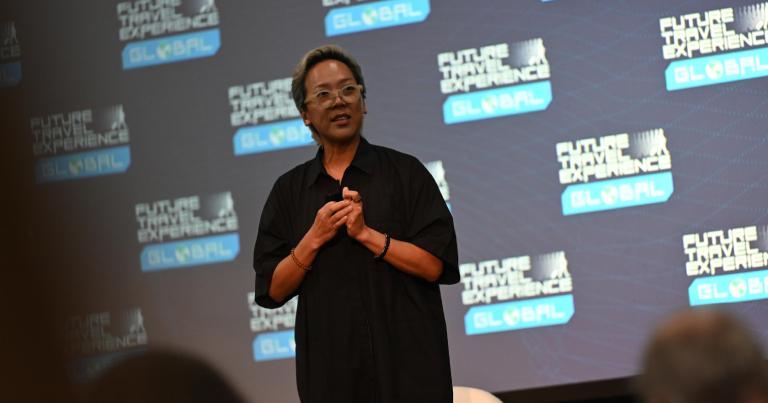
At FTE Global 2026, which took place in Dallas, Texas, on 8 to 10 September, Virgin Voyages SVP Fleet Experience Nicole Huang challenged airline and airport leaders to judge artificial intelligence (AI) by a different standard: not how much it automated, but how well it helped people listen, understand, and act. Her argument came alive through three small gestures: a rose, two glasses of Pinot Noir, and two carafes of sparkling water.
“AI only provides context,” Huang reflected. “Human beings interpret the nuance and act on it.”
The future of AI in travel arrived on stage at the Gaylord Texan Resort & Convention Center on Wednesday 9 September 2026, without a robot, dashboard, or generative AI demonstration. Instead, one of FTE Global 2026’s clearest examinations of AI started with an intensely human act of hospitality. It arrived as a rose.
APEX Future Travel Experience Managing Director Max Gosney had opened the Wednesday morning programme as FTE Global marked its 20th anniversary under the theme ‘Transforming Travel Together’. The Opening Keynote Session moved from DFW International Airport CEO Chris McLaughlin discussing resilience and innovation at DFW into Huang’s outside-of-industry examination of hospitality, personalisation, and AI.
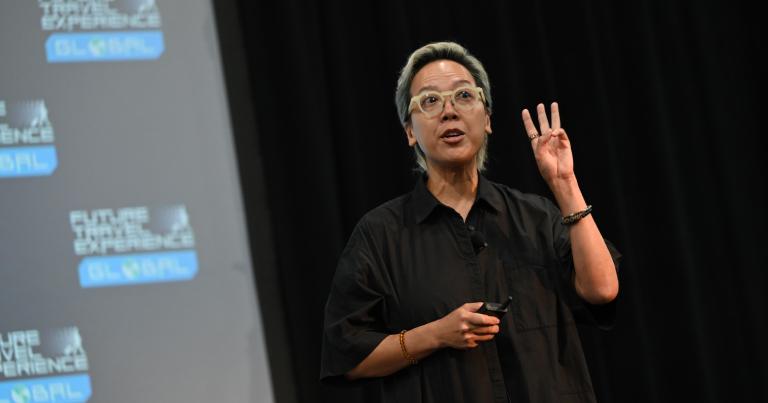
Virgin Voyages SVP Fleet Experience Nicole Huang then took the stage for her session ‘More Human, Powered by AI: The Future of Hospitality’.
AI could not decide what a particular moment meant to the person standing in front of an employee, which led to the three words that anchored her keynote: “Listen. Think. Act.”
Mark your diary for FTE Global 2027 – 7 to 9 September, Las Vegas >>One rose exposed the limits of a transaction
Huang began with the mother of a former JetBlue colleague, who routinely travelled with a photograph of her late husband and fresh flowers. The ritual helped the woman feel as though her husband remained with her during the journey.
During one Virgin Voyages sailing, she forgot the flowers and approached Sailor Services for help. “Can I get some fresh flowers?” Huang recalled her asking.
Virgin Voyages did not sell them, which created a perfectly reasonable transactional response. “Well, we don’t sell flowers onboard, so the answer is no, right?” Huang said. “Transaction closed. Move on.”
The transaction could have ended there, but the crew member had understood that the woman had asked for more than a product. “The next day, the mother went back to her cabin and found a rose waiting for her,” Huang said. “The crew member had gone out of her way to talk to the horticulturist onboard the ship to see if she could get a flower for this particular Sailor.”
The employee had listened closely enough to understand the need behind the request, thought beyond the normal process, and acted.
Two glasses carried an entire memory
Huang’s second story involved a repeat Sailor she called Rich, who had previously sailed with Virgin Voyages alongside his wife. By the time of the voyage Huang described at FTE Global, his wife had died.
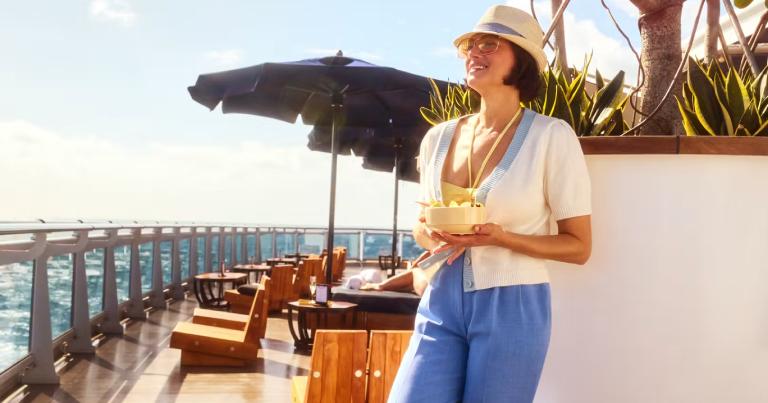
During the seven-day journey, a crew member learned that one of Rich’s favourite memories with his wife involved sitting at The Dock, watching the sunset, and drinking Pinot Noir. On the final day, she approached him carrying two glasses.
“This is for you and your wife, on the house,” Huang recalled the employee saying. Huang then underlined what made the moment important: “Completely initiated by the crew member.”
Two carafes showed the power of remembering
“I go onboard quite often just to check on the experience, to make sure that it’s implemented correctly, and really observe how our Sailors react to it,” Huang said. “Are there any adjustments that we need to make?”
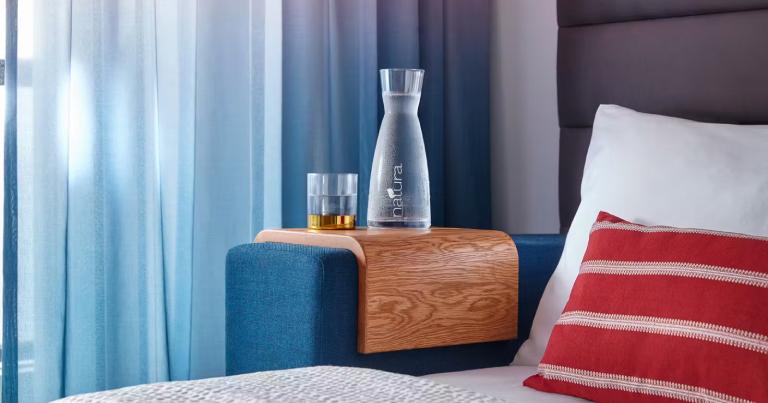
Over time, crew members learned that Huang liked sparkling water, and that simple preference began following her from voyage to voyage. “Our crew know I like sparkling water, so whenever I go into my cabin, there are always two carafes of sparkling water waiting for me,” she said.
One example involved grief, another memory, and another an everyday preference, yet each depended on an employee recognising that a small piece of information mattered.
Huang asked attendees what linked the stories, and audience members called out hospitality and service. She narrowed the answer further: “Listen. Think. Act. Listen actively.”
“Instead of simply following a procedure, our crew members think, and then proactively act upon what they’ve heard,” Huang continued.
A hot dog demonstrated the same principle
Huang reinforced the point through the well-known Eleven Madison Park story in which diners told a server they had missed one quintessential New York experience: eating a hot dog. Because they planned to leave the following morning, the server could have treated the comment as harmless conversation.
Instead, the employee left the three-Michelin-star restaurant, bought a hot dog, and brought it back for them. “Same thing,” Huang said. “Something very small.”
The importance again came from what happened between hearing and acting. “The server actively listened,” Huang said. “They thought. They didn’t simply follow a procedure and treat what they heard as just another story. They acted upon it.”
The customer never agreed to experience the org chart
Huang framed the problem with one of the keynote’s sharpest lines. “I’m actually a very nice person, but even I don’t say this: ‘I totally understand why you screwed up because your organisation is very complex,’” she told attendees. “Said no customer ever.”
Her next sentence stripped away the organisational excuse. “It is not our customer’s job to experience our organisation,” Huang said.
For airlines, that observation carried particular weight. A passenger can move through reservations, an app, check-in, an airport, a lounge, a gate, a cabin, baggage, and customer care during a single journey, often encountering different employees and systems at every step.
“They shouldn’t need to deal with all of the friction that happens because of our organisation,” Huang said. Then came the transition that brought the keynote squarely into the AI conversation: “This is where AI truly can help.”
Every interaction left another trace
Huang asked attendees to consider how much information a traveller generated before, during, and after a journey. Every purchase, conversation, preference, and service problem created another signal, even when those signals remained scattered across systems.
“I like matcha lattes,” Huang said. “I like the spa. I like my Shore Things. I like dining in our restaurants.”
Virgin Voyages’ relationship with a Sailor extends from booking through pre-voyage, onboard, disembarkation, and post-voyage. Airlines face an analogous challenge across shopping, booking, airport processing, flight, disruption recovery, and post-travel service, often at far greater transaction frequency.
The opportunity came from connecting those fragments, not simply gathering more of them. “What AI can do is collect all of that information from the different parts of the organisation and turn it into a smooth journey for the customer,” Huang said. “The goal is really to make sure all of those systems can talk to each other.”
Future Travel Experience’s advance interview with Huang had outlined how Virgin Voyages pursued that strategy through a Gemini Enterprise AI architecture. Its AI agents span marketing, revenue, sales, crew training, commercial operations, and Sailor Services, reducing friction and giving crew more space for human connection.
What if the next employee already remembered?
“For an airline, almost every single flight might have a different crew member, right?” Huang asked.
One employee might learn a passenger’s preference, another might understand a previous service issue, and somebody else might know what mattered during an earlier journey. Without organisational memory, much of that understanding disappeared when the employee changed.
“Imagine that AI can help us remember all of that,” Huang said.
The next employee could begin with context instead of starting from zero. “Now every crew member, without ever having interacted with me before, can have that information available so they can better serve me and I can have the best holiday possible,” Huang said.
For an airline, the same principle could connect what happened in a contact centre with what happened at the airport, what happened at the gate with what happened onboard, or what happened during a disruption with the employee who encountered that passenger next.
Huang called the model “AI-enhanced human delivery,” deliberately keeping the human being at the point of service. “At the end of the day, it’s still a crew member delivering the service to you,” she said.
Virgin Voyages treated AI as an enhancement layer rather than the hospitality itself. “For us, we use AI as an enhancement tool for our crew members, so they can provide great service.”
Passing the baton without losing the customer
Huang asked attendees to imagine a customer who had called a contact centre the previous evening, struggled to resolve a problem, and arrived already frustrated or anxious.
A frontline employee who knew none of that history would start the next encounter cold. Huang saw AI creating continuity between those moments: “For the first time, I think we can truly pass the baton, with a complete set of information, from one department to another department.”
For airlines, that baton might pass among reservations, airport teams, lounge staff, gate agents, flight attendants, and customer care. The passenger should not have to reconstruct the same problem every time the organisational handoff changed.
“Maybe they had a difficult experience when they called the contact centre the night before,” Huang said. “Maybe they had trouble getting something resolved before they came onboard. They might arrive a little anxious. So we should know that. We should understand their expectations. And now, by using AI, we can have a much more complete picture of that customer.”
The profile never became the person
Huang then exposed the danger in trusting even a highly detailed customer profile too much. A system might correctly know that she preferred sparkling water, yet that preference still could not predict what she wanted in every moment.
“Nicole tells you she prefers sparkling water. But in fact, sometimes she likes her wine, rosé, and she likes her Negroni,” Huang said.
The contradiction exposed the limit of predictive service because, as Huang put it, “People change.” For airlines, a passenger travelling for business on Monday may have entirely different needs when travelling with family on Friday. Historical behaviour could provide context without becoming a command.
“Data is not the full picture,” Huang said. “You really need your crew member to be in front of that person to interpret what is happening at that particular moment.”
“Is AI going to impact my job?” Huang said employees sometimes asked, before giving her answer: “No.”
“Human beings are very complex beings,” Huang said. “We change every single second. You need another human being who is properly trained, who can really listen actively, who can think with common sense, and who can act.”
AI could help that person reach understanding faster. “All of that data will help them get there faster,” Huang said. “But you still need the human being there to deliver that service. AI provides context. Human beings interpret the nuance and act on it. For me, that’s the best hospitality.”
An 11-year pursuit of humanity
In 2015, while serving as JetBlue Manager of Onboard Experience, Huang appeared in an Airline Passenger Experience Association (APEX) profile covering her work across customer and crew member feedback, product development, catering, and the Mint meal experience.
Her mission then centred on “bringing humanity back to air travel.”
Eleven years later, she stood before airline and airport executives with a keynote called “More Human, Powered by AI.”
Long before the generative AI boom, Huang had already worked where passenger behaviour, transaction data, employee feedback, product design, and operational realities met. Yet the fundamental question remained whether somebody could recognise what mattered to one traveller and act before the moment disappeared.
“More information does not necessarily mean better hospitality,” Huang said. “It’s not about more. It’s about what matters.”
Nia described what no dashboard could measure
“Virgin Voyages has changed my life,” Sailor Nia said in a pre-recorded testimonial Huang shared with attendees. She described friendships with fellow Sailors, crew, cast, and members of the executive team that continued from one voyage to another. “We sail together often,” she said, explaining how groups reconnected on later journeys.
Nia also described another Sailor named Ray, who celebrated his 80th birthday aboard Scarlet Lady and sometimes boarded dressed in drag despite not dressing that way elsewhere. “He feels comfortable when he gets onboard the ship to just express himself,” she said.
That environment had changed Nia as well by giving her greater freedom to show parts of herself she had previously held back. “It allowed me to be my true self,” she said.
“There were things that I didn’t realise I was ashamed to share with the world,” Nia continued. She described an impact that reached well beyond a holiday: “So I dress differently. I act differently. I am a completely different person because of Virgin magic.”
Nia connected that sense of freedom directly to crew members’ willingness to express their own individuality. “The fact that the crew can share their uniqueness makes a big difference as well,” she said. “That makes us feel comfortable doing the same and being our true selves.”
AI could not manufacture the belonging Nia described because that outcome still emerged through relationships among people.
The baton stayed human
Huang closed by returning to the three actions that had carried the presentation from its opening stories through its AI argument. “Listen. Think. Act,” she told the audience.
“If there’s anything I want you to leave this presentation with, it’s that,” Huang said. She then named the larger proposition one final time: “That’s my presentation: ‘More Human, Powered by AI.’ I really think that’s the future of hospitality.”
The rose mattered because someone listened, while the Pinot Noir mattered because someone understood the memory attached to it. The sparkling water mattered because somebody remembered a preference and acted before Huang needed to ask.
Technology could help travel organisations perform each of those actions more consistently across employees, departments, and journeys. The final act, however, still belonged to a human being.
Mark your diary for FTE Global 2027 – 7 to 9 September, Las Vegas >>You may also be interested in
12 technology and CX trends that can enhance airline and airport operations in 2026
Making travel more human: Virgin Voyages on AI, hospitality and reimagining the passenger experience
FTE World Innovation Summit relocates to Tokyo for 2027 edition hosted by Haneda Airport – 1-3 March