




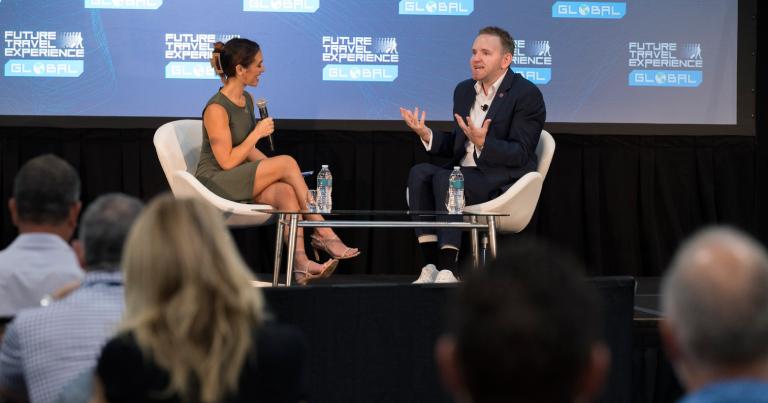
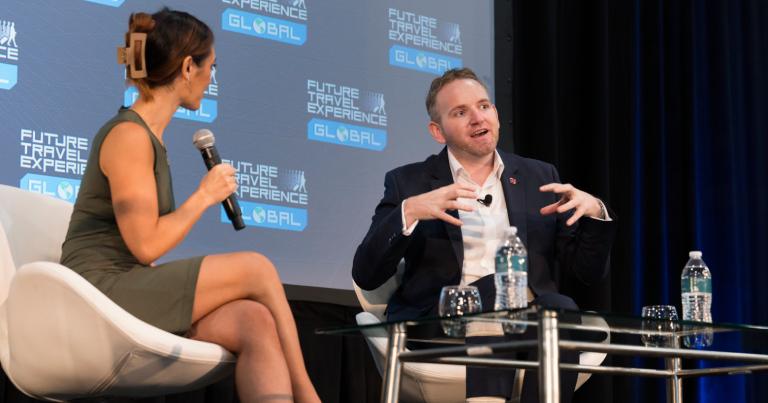
At the 20th anniversary edition of FTE Global, which took place in Dallas, Texas, on 8 to 10 September 2026, Air Canada Vice President of Customer Experience and Service Operations Tom Stevens participated in an insightful Keynote Fireside Chat, focusing on how the airline uses artificial intelligence (AI), better information, and new technology to make the passenger journey more proactive and personal. In conversation with Atlanta News First On Air Personality Savannah Louie, Stevens discussed disruption recovery, frontline empowerment, baggage, accessibility, and Air Canada’s Airbus A321XLR, which he said already delivers an NPS score about 11 points higher than the airline’s standard aircraft. Stevens said Air Canada wants to better understand what customers need before they have to ask while giving employees more information and time to take care of them.
Mark your diary for FTE Global 2027 – 7 to 9 September, Las Vegas >>A321XLR delivers an early NPS lift
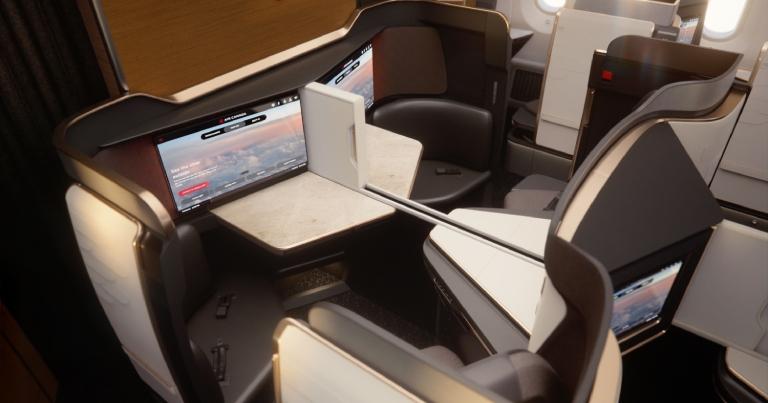
Air Canada has already seen one of the clearest results from its recent passenger experience investments onboard the A321XLR. Stevens said the aircraft delivers an NPS score about 11 points higher than Air Canada’s standard aircraft. The airline currently operates three A321XLRs and plans to add more as part of a 30-aircraft commitment, including 15 leased jets and 15 acquired directly from Airbus.
“We know customers love the product,” Stevens said.
Air Canada has made few major changes since introducing the aircraft, although the airline continues to adjust the onboard service flow for longer international flights. Longer flights can keep service carts in the aisle for more time than on a typical domestic flight, creating new operational considerations as Air Canada gains more experience with the A321XLR.
Accessibility remains another focus. Stevens said Air Canada works with other airlines, equipment manufacturers, and service providers to improve the experience for passengers with specialised accessibility needs.
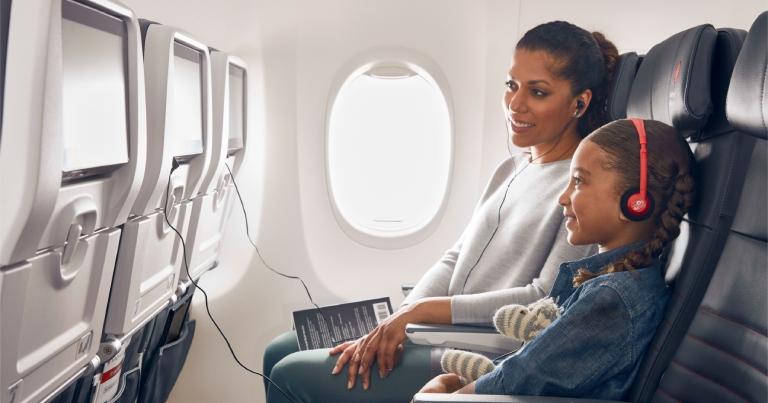
Air Canada also wants to create a more consistent experience across its fleet. The airline continues to update its Rouge operation and mainline aircraft, with a focus on inflight entertainment (IFE) and fast, free WiFi.
Stevens said growing competition across North America continues to push airlines to improve the onboard experience. “Competition is actually really great,” he said. “It’s really great for customers because everybody is elevating the game here.”
Moving from reactive to proactive recovery
Beyond the cabin, Stevens pointed to disruption recovery as one of the biggest opportunities for AI to improve the passenger journey. Air Canada already automatically rebooks some disrupted passengers and provides digital hotel, meal, and transportation vouchers. Stevens said the next step is using more customer information to offer recovery options that better match what each passenger actually needs.
“Our strategy is proactivity,” he said.
A business traveller taking a same-day trip may no longer need to travel if a major delay pushes the outbound flight several hours later. Automatically moving that traveller onto another flight may solve the disruption from an operational perspective, but it may no longer solve the customer’s problem. Air Canada wants to combine information about the passenger’s journey, travel history, and reason for travelling to offer a better option.
Stevens gave the example of a passenger traveling from Vancouver to Sydney for three weeks who may prefer to leave a day later in Business Class rather than take an earlier flight in Economy.
“You’re going for three weeks, we see you’re a leisure customer, we see you’re a top customer, you always buy business,” Stevens said.
AI could help Air Canada better understand those differences and offer an option that fits what the passenger actually needs. The airline also plans to let customers explain what they need in natural language through the mobile app, allowing Air Canada to combine that request with information about the passenger, the trip, and its policies.
Stevens called that approach “a million miles away from the chatbot of old.” It could also reduce lines at airport service desks and calls to contact centres, giving employees more time to focus on customers who need more help.
Giving passengers better information earlier
Proactive recovery also depends on giving passengers accurate information as quickly as possible. Travellers increasingly use third-party apps that can predict delays before an airline officially changes a flight’s status, which can create frustration when one source shows a flight on time while another already expects it to leave late.
Air Canada wants its own channels to provide the most current information, even if that means sharing some uncertainty earlier. “I’d much rather have our source of the truth versus maybe what they’re working out for themselves,” Stevens said.
The airline has spent years updating the systems behind that information, including its passenger service, baggage, and operations platforms. Air Canada is also giving employees iPhones so gate agents, baggage handlers, pilots, service directors, and the operations centre can share information in real time. That can help the airline better understand what is happening around an aircraft and give passengers more consistent updates.
Stevens acknowledged that disruptions will always remain part of air travel, especially in Canada, where severe weather can quickly affect schedules. While Air Canada cannot prevent every delay, he said it can improve how quickly and clearly it communicates with passengers.
“The actual number one thing that we would see in our customer satisfaction survey is customer information,” Stevens said.
“If we give you as a customer real information as to what is happening, that puts you in control of your own destiny,” he added.
Better information can help passengers decide whether to continue a trip, change plans, or choose another option before a disruption becomes harder to manage.
Using AI to give employees better answers
Air Canada is taking a similar approach with its frontline employees. Stevens said large airlines can have thousands of pages of customer policies and procedures, making it difficult for employees to quickly find the right answer while helping a passenger.
To make that process easier, Air Canada created an internal AI tool called Ask AC. Frontline employees can access it through an iPhone app and enter a specific customer situation in their own words. The tool then brings together the relevant information and policies, so the employee can spend less time searching and more time deciding how to help.
Stevens gave the example of a passenger travelling on a basic fare who later needs wheelchair assistance or needs to change the trip. Rather than searching through different policies, an employee can use Ask AC to find the relevant information and then decide whether to waive a fee, arrange assistance, or take another action.
The technology also supports Air Canada’s broader effort to give frontline employees more freedom to use their judgment. “Do what you feel is right. We trust you,” Stevens said of the airline’s message to employees.
He stressed that Air Canada does not see AI as a way to remove people from the passenger experience. “AI is not there to remove jobs. It’s there to change the way that we work,” he said.
“What we’re looking to do is to have AI power our people delivering better service and hospitality,” Stevens added.
That approach ties into Air Canada’s “Glowing Hearted” service philosophy, which Stevens said reflects Canadian warmth and hospitality. The airline has already brought that idea into new cabins and products and now wants employees to bring it more directly into the customer experience.
Preventing baggage problems before they happen
Air Canada is also using data to move beyond telling passengers where a missing bag went. Stevens said the airline combines baggage tracking information with AI models built in-house to predict which bags have the highest risk of missing a connection.
“The first thing is to prevent it altogether,” he said.
That information can help Air Canada adjust gate planning, connection times, and how employees respond during the operation. The airline also combines multiple baggage scans with information from airport systems to identify bags that need immediate attention.
Instead of sending employees to search for luggage across a wide area, Air Canada can direct someone to a specific bag and move it between flights. Stevens said better data can tell employees “where it actually ends up” instead of having them drive around looking for different bags.
The goal is to prevent the problem before a passenger ever receives a missing-bag notification. That becomes especially important at Air Canada’s hubs, where domestic and international bags can move through different systems during a connection.
Reducing anxiety around mobility devices
Air Canada now wants to use some of the same tracking technology for mobility devices. Stevens said the airline should not depart without a passenger’s mobility device onboard. “We should not depart a flight without customer mobility. Period,” he said.
Air Canada does not reach that goal every time today, but the airline is adapting its baggage technology to track mobility devices throughout the journey. Stevens said additional software and system updates should help Air Canada create a more complete end-to-end process.
Tracking alone, however, may not give passengers enough reassurance. Stevens said conversations with Air Canada’s accessibility advisory committees have shown that anxiety can become one of the biggest barriers to travel, particularly when passengers worry about whether a wheelchair will arrive, whether it could become damaged, or what losing access to it could mean for their independence.
“The biggest barrier is the anxiety of travel itself,” Stevens said.
For some travellers, that uncertainty can stop them from flying altogether. Air Canada now wants to provide more reassurance through its mobile app, which Stevens said could eventually include a photo showing that a passenger’s power wheelchair safely made it onto the aircraft.
That would give passengers more than tracking information and help them feel more confident throughout the journey.
Making technology work behind the journey
Across disruption recovery, baggage, accessibility, and the onboard experience, Air Canada’s strategy points to a broader shift in how airlines can use technology.
The opportunity comes from connecting information across the passenger journey, so the airline can act earlier and make better decisions when something changes. When the right information reaches the right person at the right time, it can help employees respond faster while giving passengers more control over what happens next.
Stevens’ message centred on using technology in a way that supports both the customer and the employee. The next step for airlines will be turning the information they already have into faster decisions, more personal service, and a smoother journey.
Mark your diary for FTE Global 2027 – 7 to 9 September, Las Vegas >>You may also be interested in
12 technology and CX trends that can enhance airline and airport operations in 2026
Making travel more human: Virgin Voyages on AI, hospitality and reimagining the passenger experience