





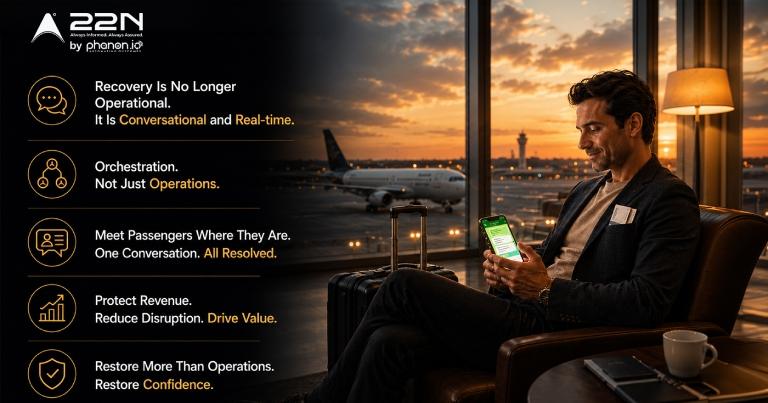
Recovery Is No Longer Operational. It Is Conversational and Real-time.
Delayed aircrafts. Airport availability. Displaced crew. Thousands of impacted passengers receive fragmented updates across channels. For most airlines, irregular operations (IRROPS) still trigger operational and CX friction.
The challenge is no longer simply operational recovery. It is orchestration.
The liability of getting it wrong is significant. According to IATA, nearly 78% of passengers expect a unified digital experience throughout their journey. Yet irregular operations cost airlines up to 8% of annual revenue and a staggering $60bn to the industry annually.
Picture this.
It is 06:40 on a Tuesday morning. A narrow-body inbound is holding due to ATC congestion. The delay is confirmed at 52 minutes. Within moments, three downstream flights are at risk – a connecting regional service, a turnaround slot and a crew rotation feeding an evening long-haul departure. What started as a single delay is quietly becoming a network event.
On board, thirty-eight passengers have onward connections. Ten are in the premium cabin. Twenty-four are frequent flyers. Four have previously filed service complaints.
Before your OCC team finishes their first assessment, the orchestration engine has already modelled every recovery scenario and surfaced the three most viable options. Keeping in mind your varied fleet and compliances such as FDTL and EDTO. What would have taken 25 minutes of cross-functional coordination is now a single decision screen.
Your OCC selects a recovery path. All impacted passenger itineraries are automatically updated. The three cascading flights are stabilised within the same recovery sequence, ensuring your crew and aircraft are where they are supposed to be on recovery.
But more importantly, passengers are already hearing from you.
The premium traveller in seat 4A receives a WhatsApp message that knows his name, connection, and loyalty status. It offers two rebooking options, a lounge voucher and a priority seat, all within a single conversation. He taps twice and his journey is back on track. The twenty-four frequent flyers receive personalised recovery offers timed to their situation. The four passengers with prior complaints are reached proactively before they escalate.
Ancillary revenue, rebooking fees waived, upgrades accepted, and meal vouchers redeemed partially offset the disruption cost. Also, the premium traveller in 4A? He lands, opens LinkedIn and posts about how his airline handled a delay better than any he’d experienced.
This is not a future state. This is what coordinated orchestration looks like today.
At APEX FTE Ancillary & Retailing 2026, 22North will showcase a new-generation disruption recovery and passenger servicing platform that connects operations, passenger engagement, and ancillary commerce.
22North’s platform meets passengers where they already are — on WhatsApp, voice, RCS, SMS, or Telegram — within a single continuous conversation. Rebooking, upgrades, compensation and support all resolved without channel-switching or repeated verification. And for your airline, we optimise messaging costs by upto 40%.
Because modern passenger recovery is no longer just about restoring operations.
It is about restoring confidence in real time.
Register for the co-located APEX FTE EMEA and APEX FTE Ancillary & Retailing events – free for airlines, low-cost for airports >>You may also be interested in
12 technology and CX trends that can enhance airline and airport operations in 2026
FTE launches new podcast to explore the realities of successful innovation
ADR, MUC, AMS, IST, LHR, DOH & more among FTE Airport Digital Transformation Power List EMEA 2026