




Summary:
- Pittsburgh International Airport is expanding its xBridge innovation programme with trials of autonomous robots, AI and computer vision to support airport operations and passenger service.
- Skild AI’s quadruped robots will be tested for applications including indoor air-quality monitoring, spill and waste detection, passenger congestion monitoring and potential autonomous delivery.
- A separate trial with Arrow Analytics and Southwest Airlines is exploring computer vision technology to provide real-time insight into carry-on baggage and overhead bin capacity during boarding.
Pittsburgh International Airport (PIT) – a Corporate Partner of the FTE Digital, Innovation & Startup Hub – is expanding its use of emerging technology through the xBridge innovation programme, with new trials exploring how robotics, artificial intelligence (AI) and computer vision can enhance airport efficiency, operations and customer service.
The latest initiatives involve partnerships with Skild AI and Arrow Analytics, giving the technology companies a real-world airport environment in which to test their solutions and assess potential applications across the aviation industry.
“Pittsburgh is a global leader in robotics and AI. Through xBridge, we’re creating a place where that innovation can move from the lab into the airport environment and ultimately help shape the future of the industry,” said Deepak Nayyar, Executive Vice President and Chief Technology Officer at PIT.
Autonomous robots trialled across terminal operations
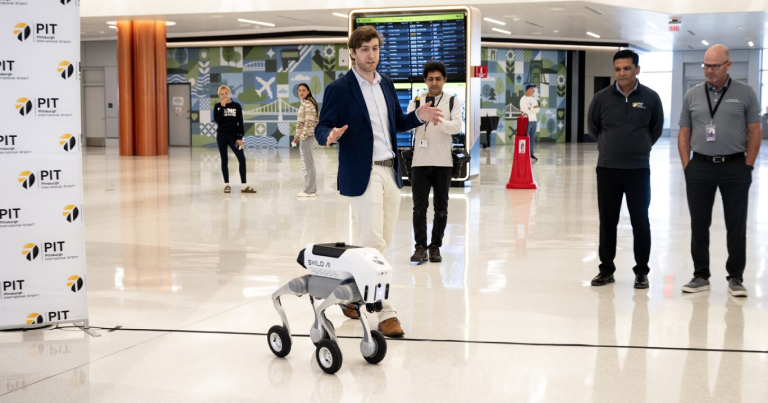
PIT is working with Pittsburgh-based Skild AI to evaluate four-legged autonomous robots, or quadrupeds, in the Airside Terminal. Up to four robots and two charging stations will be deployed, with each robot assigned a defined operating area and keep-out zones. Skild AI will manage installation, mapping, supervision and monitoring, as well as provide training for PIT employees.
Powered by Skild AI’s adaptive autonomy software, the robots use sensors, cameras and AI-driven perception to navigate complex environments, identify anomalies and provide real-time information to airport operations teams.
The initial phase will focus on mobile indoor air-quality monitoring. Equipped with environmental sensors, a robot will autonomously collect location-specific data, monitor defined thresholds and alert airport personnel when readings fall outside established parameters.
Further phases will investigate applications supporting custodial and terminal operations teams. Potential use cases include identifying full or nearly full waste also be explored, including a potential collaboration with BioFlyte, a former xBridge participant, to combine Skild AI’s quadr bins, detecting spills and monitoring passenger congestion to provide operations teams with additional visibility.
More advanced applications will also be explored, including a potential collaboration with BioFlyte, a former xBridge participant, to combine Skild AI’s quadruped platform with airborne biological threat detection technology.
The project will also assess the potential for autonomous delivery of food and beverages to selected locations within the airside terminal. The technology could also support airport employees by transporting items between locations, allowing staff to focus on passengers and core operational responsibilities.
Computer vision targets boarding efficiency
Separately, PIT is working with Arrow Analytics and Southwest Airlines – a Corporate Partner of the FTE Digital, Innovation & Startup Hub – to test the company’s EZ-Board technology at Gate A7. The system uses off-the-shelf depth cameras and real-time analytics to track how carry-on bags move through the boarding process. The technology provides gate agents and airport operations teams with a real-time view of baggage volume and helps predict the amount of overhead bin capacity that will be required.
When overhead storage becomes constrained, airlines may ask passengers to gate-check carry-on bags. By providing more detailed information on actual baggage volumes and projected bin usage, the trial is exploring whether technology can support faster boarding and more informed operational decisions.
“We are excited to work with the innovative team at PIT as we continue to develop our EZ-Board product and computer vision offerings for airports and airlines,” said Valerie McNeill, Chief Operating Officer of Arrow Analytics.
For airline partners, the xBridge programme provides an opportunity to evaluate how autonomous systems and data-driven technology can complement the employees responsible for keeping airport operations running efficiently.
“Pittsburgh is known globally for its growing tech economy, and our new industry-leading terminal continues to reflect that innovation right at the airport,” said Allegheny County Executive Sara Innamorato. “The airport is an economic driver for the region and xBridge is another example of that success.”
The latest projects reinforce PIT’s approach to using its airport environment as a testbed for emerging technologies, with trials designed to move innovations from development into practical aviation applications.
You may also be interested in
12 technology and CX trends that can enhance airline and airport operations in 2026
How Nice Airport is blending personalisation, experiential retail and omnichannel innovation
Air Canada targets more proactive, personalised passenger experience with AI and better data