





Summary:
- Avinor has launched a modular biogas energy plant at Svalbard Airport, delivering a fossil-free solution for both electricity and heating under challenging Arctic conditions.
- Powered by liquefied biogas (LBG), the facility is expected to significantly reduce Avinor’s operational emissions, addressing around 20% of the company’s total emissions based on 2022 figures.
- The project demonstrates how airports can drive energy transition through self-sufficient, relocatable infrastructure while supporting long-term renewable integration.
Avinor has opened a new biogas plant at Norway’s Svalbard Airport. Using liquefied biogas (LBG) as its energy carrier, the airport will have a fossil-free solution for both electricity and heating, representing an important step towards significantly lower emissions from Avinor’s own operations.
“This is a very important climate measure for Avinor,” said Anders Kirsebom, Chair of the Board of Svalbard Airport Ltd. “Based on figures from 2022, emissions from electricity and heating at Svalbard Airport accounted for around 20% of Avinor’s total emissions. With this solution, we are taking a clear step in the right direction.”
Karianne Helland Strand, Executive Vice President for Sustainability and Infrastructure, Avinor, commented: “The energy plant is a key measure to reduce Avinor’s own climate emissions and demonstrates how the company takes an active role as a driver and facilitator of emission reductions – even under demanding Arctic conditions.”
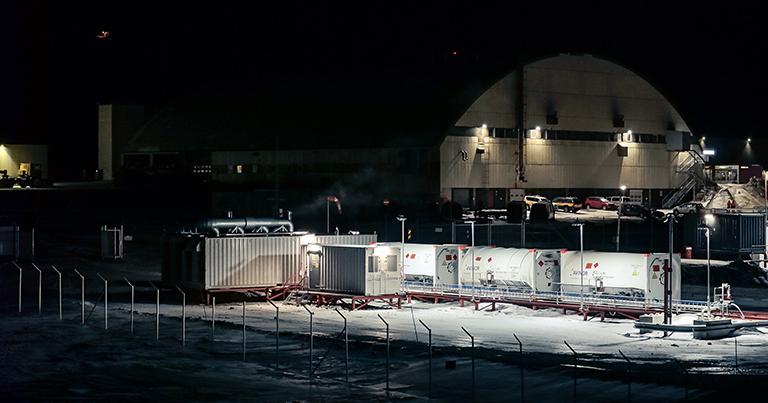
The modular energy plant is designed to cover Svalbard Airport’s entire demand for both electricity and heating. The facility includes three micro gas turbines for power generation, combined with heat recovery and a biogas boiler for efficient production of thermal energy for heating.
“This effectively makes us self-sufficient with fossil-free energy,” said Ragnhild Kommisrud, Airport Manager, Svalbard Airport. “At the same time, we are building on many years of targeted work on energy efficiency, solar power and wind energy here at the airport.”
Since 2016, the airport has implemented several energy efficiency measures and established production of both solar and wind energy, including for off-grid air navigation facilities.
The biogas plant is modular and can easily be relocated. Avinor views the solution as partially temporary and at the same time aims to share experience and knowledge from the project as part of the continued energy transition.
“When the main energy supply in Longyearbyen in the future has a sufficient share of renewable energy, it will be natural for us to connect to this and phase out the biogas plant,” said Kommisrud. “Until then, we take responsibility for reducing our own emissions as much as possible.”