




Summary:
- Changi Airport deploys fully driverless autonomous tractors in live airside operations, enhancing baggage handling efficiency, safety and reliability as part of its smart airport transformation strategy.
- Autonomous airside vehicles support workforce productivity and job redesign, freeing ground staff from driving tasks while enabling seamless human-machine collaboration across terminals.
- Scalable autonomous technology underpins future-ready airport operations, with plans to expand the fleet to 24 vehicles by 2027 to support baggage, cargo and equipment movements ahead of Terminal 5.
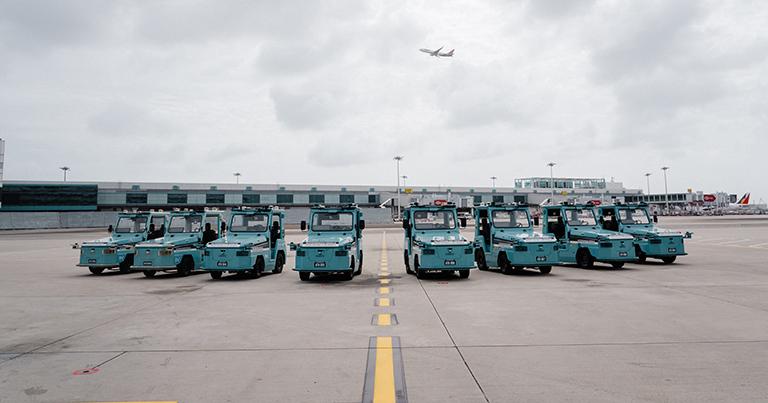
Changi Airport has deployed its first fleet of fully driverless autonomous tractors for airside operations, following nearly a year of rigorous trials covering more than 5,000 test trips. The launch, officiated by Ms. Sun Xueling, Senior Minister of State for Transport, signals Singapore’s commitment to pioneering smart airport technologies that set new benchmarks for operations.
The milestone marks a significant leap in Changi Airport’s push for innovation and operational efficiency, raising productivity while enhancing safety and reliability.
Two autonomous tractors are now deployed in live operations in Changi’s airside to transfer passenger bags between Terminal 1 and Terminal 4’s baggage handling areas.
More than ten sensors and cameras on each of these tractors work together to enable the vehicles to safely navigate the complex airside environment in all conditions – day, night and rain. The autonomous tractors are also monitored in a control centre during operations, where a remote operator can step in immediately, should human intervention be required.
Another six autonomous tractors will be deployed to a different route between Terminal 2’s baggage handling area and aircraft stands later this year, to support baggage operations under a CAG-SATS collaboration. The autonomous tractor fleet will be expanded to 24 by the year 2027. Going forward, more autonomous tractors will be deployed to tow cargo and equipment, in addition to baggage.
This project, co-funded by the Civil Aviation Authority of Singapore (CAAS), aligns with Changi Airport’s broader innovation strategy, which includes the integration of autonomous technology into airside operations, the use of artificial intelligence (AI) in initiatives such as ‘Aircraft 360’, as well as automation and robotics to increase productivity.
“The operationalisation of our autonomous tractors today represents a huge step forward for Changi Airport, as we move towards our vision of the airside of the future,” said CAG’s Senior Vice President, Airport Operations Strategy & Transformation Ms. Liu Yanling. “Through collaborating with our airport partners to redesign work processes and infrastructural policies, we are shaping a future-proofed working environment where autonomous vehicles can function safely and seamlessly with other human-driven vehicles, with workers focusing on last mile operations.”
Autonomous tractors free up airside workers from driving tasks, enabling them to focus on last mile operations, which are more difficult to automate. To ensure that the autonomous tractors operate safely alongside workers, clear autonomous vehicles (AV) zone markings have been painted in the airside. Clear labels have also been attached to all AVs.
As the airport scales up to meet the operational requirements of Terminal 5 by the mid-2030s, such innovations will enable Changi Airport Group (CAG) and its partners to redesign and upgrade the job scopes of airside workers, to improve their productivity. Such productivity improvements and upgrading of airside roles are critical to grow the Singapore air hub to meet the future demands of air travel.
CAAS Director of Aviation Industry Ms. Angela Ng commented: “In July 2025, CAAS published the Aviation Jobs Transformation Report which indicates that the Singapore aviation sector will continue to create good jobs and up to 30% of the existing workforce could experience job redesign and transformation over the next five years, majority of them in the ground handling sector. The scaled deployment of autonomous tractors allows CAAS, CAG, SATS and our unions to work together to implement the technology, develop new systems and protocols and set up job redesign programmes to help our workers adopt technology and transition to higher-value work. Lessons learnt here will be useful for the sector’s wider technology adoption and job transformation efforts.”
SATS Apron Services Senior Vice President Mr Kuah Boon Kiam added: “We are pleased to work with Changi Airport Group and CAAS in trialling autonomous tractors as part of our efforts to redesign jobs and ensure our employees remain future-ready while providing a safe working environment for our people. This initiative supports SATS’ Hub Handler of the Future programme, where the integration of automation into our airside operations is a core focus to enhance safety, boost turnaround efficiency, and uplift service quality. For travellers, this translates into more reliable baggage handling and smoother aircraft turnarounds, supporting on-time departures and a seamless airport experience.”
Groundbreaking FTE Smart Ramp program, accelerating automation and collaborative innovation
Smart Ramp is the latest initiative as part of the groundbreaking FTE Accelerating Collaboration & Engagement (ACE) platform launched in partnership with innovation consultancy nlmtd. ACE is dedicated to driving real collaborative action among stakeholders, facilitating fast progress and dynamic change in key areas of the aviation industry which are ripe for transformation. International Airlines Group, Miami International Airport, All Nippon Airways, Royal Schiphol Group, KLM Royal Dutch Airlines, and Metropolitan Washington Airports Authority are all members of what is a truly global collaborative innovation initiative.
The focus on Smart Ramp operations has the ultimate goal that aircraft turnaround can be achieved autonomously and more efficiently. A phased approach will assess which solutions truly work by each member testing new technologies, while incorporating requirements from the other participants. The program will support startups and introduce new suppliers not yet active in aviation, forging paths together on how to overcome hurdles while also exploring the potential for shared investments in the future. Results of the innovations will be shared with respective experts, industry bodies and regulators, meaning the outcomes can be used to create recommended practices and standards in the industry.
Rapid progress has been made since the launch of Smart Ramp and the innovation challenges undertaken by members included some 20 projects across eight airports in 2025.
Learn more about Smart Ramp and the FTE Accelerating Collaboration & Engagement (ACE) platform and how to participate >>You may also be interested in
12 technology and CX trends that can enhance airline and airport operations in 2026