




Summary:
- Hong Kong International Airport has opened its first Sensory Corner, providing a free dedicated space for passengers with invisible disabilities.
- Developed with input from professional organisations, people with invisible disabilities and caregivers, the facility is designed to create a calmer, more accessible airport experience.
- The Sensory Corner features interactive sensory equipment, adjustable lighting and a cabin-inspired space to help travellers regulate their emotions and prepare for their journey.
Airport Authority Hong Kong (AAHK) has opened the first Sensory Corner at Hong Kong International Airport (HKIA), providing passengers with special needs a dedicated space. The Sensory Corner at the airport is the first of its kind in Hong Kong made available free of charge for passengers with invisible disabilities. AAHK has invited professional organisations, people with invisible disabilities and their caretakers to provide comments on the design of Sensory Corner.
“We understand that travellers with invisible disabilities may find it challenging to wait for their flight in the busy environment of an airport,” said Chris Au Young, General Manager, Terminal and Passenger Experience, AAHK. “We hope that the Sensory Corner can provide them with a quiet, safe space, away from the crowds, where they can wait comfortably for boarding. This is in line with our commitment to ensuring that every passenger enjoys a high-quality airport experience.”
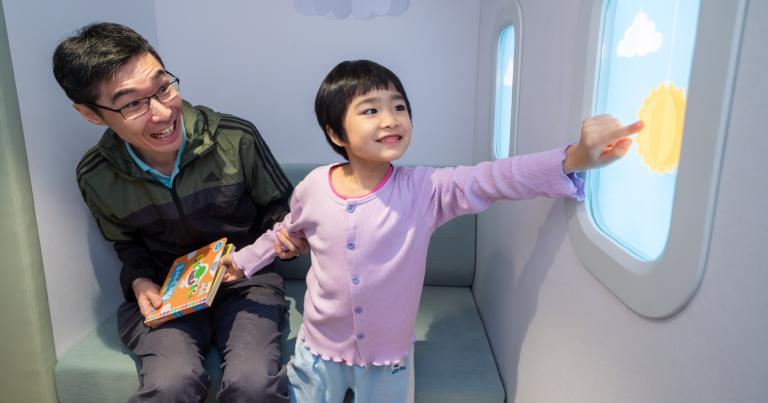
Located on the Departures Level in the airport’s restricted area of Terminal 1, the 30sqm Sensory Corner adopts an array of special features to help users regulate their emotions. The walls and floor are fitted with soft padding to ensure users’ safety, while the lighting is adjustable depending on the users’ preference and needs. The Sky Explorium is equipped with interactive multi-sensory features, including the Bubble Tube, Colour Command Centre, Hip Hop Activity Box, Serene Scene Panel, Musical Abstract Tactile Panel and a bean bag, offering visual, auditory and tactile stimulation to physically active users. The Sky Cocoon simulates an aircraft’s cabin environment, providing a calm and separated space while helping users familiarise themselves with the cabin environment in advance to be prepared emotionally for their journey.
“It is estimated that one in every 39 children has autism in Hong Kong, according to The Chinese University of Hong Kong,” said Damien Green, Founder of the Hong Kong Autism Institute. “People with autism may generally experience hypersensitivity or very low sensitivity to their surroundings. What we worry about most is hypersensitivity in an environment like the airport, a fast moving and busy transport hub, with things like sound, movement and light. It is therefore important that we cater to those sensitivities and needs when it comes to autistic travellers.”
Using the Sensory Corner is free of charge, and neither advance booking nor proof of eligibility are required.
You may also be interested in
12 technology and CX trends that can enhance airline and airport operations in 2026
FTE World Innovation Summit relocates to Tokyo for 2027 edition hosted by Haneda Airport – 1-3 March
Vote now: What will be aviation’s most game-changing technology over the next 20 years?