





Summary:
- Hawaiian Airlines electrifies GSE at Honolulu, replacing 116 diesel and propane units with lithium battery powered equipment to cut emissions and improve ramp operations.
- New electric fleet reduces noise, maintenance and fossil fuel use while enhancing safety and working conditions for ramp teams handling 8,500+ bags daily.
- Sustainability partnership with Hawai‘i DOT includes new charging infrastructure supporting long term clean energy goals and future expansion across Hawai‘i airports.
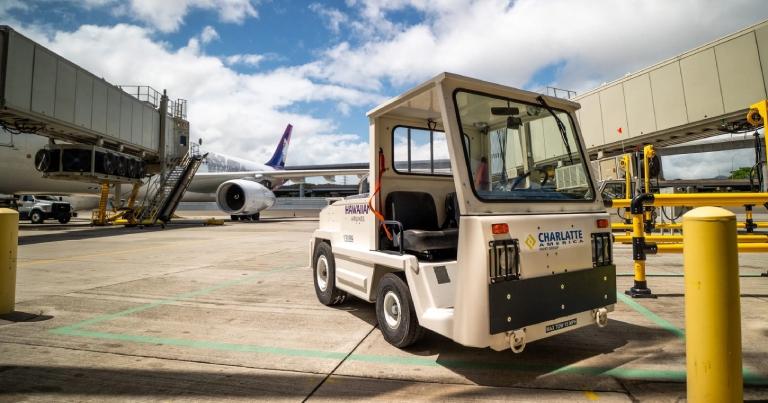
Hawaiian Airlines has unveiled a new fleet of electric baggage tractors, belt loaders and aircraft pushback tractors that will replace 116 diesel and propane ground support equipment (GSE) at its Honolulu (HNL) hub.
Hawaiian’s investment in lithium battery-powered GSE, which will now represent 73% of its HNL fleet, will eliminate fossil fuel consumption, fumes and spills, and reduce greenhouse gas emissions. It will also lower maintenance costs and engine noise while increasing efficiency and creating a better working environment for hundreds of ramp workers who each day move more than 8,500 checked bags and support some 180 daily flight arrivals and departures at HNL.
“Electrifying our ground support fleet in Honolulu, our second-largest hub, represents an important step in our long-term sustainability strategy,” said Ryan Spies, Managing Director of Sustainability, Alaska Airlines and Hawaiian Airlines. “By investing in cleaner, quieter and more efficient equipment, we’re reducing our environmental impact, enabling safe and reliable operations, and improving the workplace for our teams and the travel experience for our guests. We extend a big mahalo to the state of Hawaiʻi Department of Transportation for their partnership and investment in the GSE charging infrastructure at Honolulu’s airport.”
HDOT installed 30 GSE charging stations (60 ports) at multiple locations across HNL to support electric ground operations. An additional four charging stations (eight ports) are under construction and expected to be available in the fourth quarter of 2026.
“Hawaiian Airlines’ new fleet of electric ground support equipment represents an important contribution to our efforts to build long-term energy security for Hawai’i,” said Ed Sniffen, Director, Hawaiʻi Department of Transportation (HDOT). “As part of this collaborative effort, HDOT is providing Hawaiian Airlines and other airline partners that have electric GSE with access to the charging stations at no cost for two years. As the state continues its ambitious $7 billion plans to modernise our airports, investments in our electric infrastructure coupled with Governor Green’s efforts to secure cleaner energy options for thermal generation, will help improve overall airport efficiency, reduce the cost of power and achieve Hawai‘i’s clean energy goals.”
After extensive testing and team feedback, Hawaiian selected the Charlatte T137 bag tractor and CBL2000 belt loader, and the Kalmar TBL100 towbarless pushback tractors. Charlatte engineers also modified the belt loader to enhance its versatility, allowing the units to support Hawaiian’s narrow-body and wide-body fleet, as well as other aircraft types.
The new equipment also includes enhanced safety features, such as a cab configuration designed to protect bag tractor operators from the sun, wind and rain. Belt loaders have an advanced, sensor-guided aircraft approach system.
Hawaiian intends to expand its fleet of electric GSE as infrastructure becomes available at other Hawai‘i airports. Today, nearly half, or 42% of Alaska Air Group’s GSE fleet – including Hawaiian Airlines, Alaska Airlines and Horizon Air – is electric.
You may also be interested in
12 technology and CX trends that can enhance airline and airport operations in 2026
FTE launches new podcast to explore the realities of successful innovation
ADR, MUC, AMS, IST, LHR, DOH & more among FTE Airport Digital Transformation Power List EMEA 2026