




Summary:
- Changi Airport Group has completed construction of its first satellite gate, extending the comfort and convenience of aerobridge boarding to flights operating from remote aircraft parking stands.
- The new facility provides an all-weather boarding and disembarkation experience, with two aerobridges, improved accessibility and enhanced comfort for passengers and airport staff.
- Designed as a zero-energy smart facility, the satellite gate uses rooftop solar power, automated systems and digital maintenance features to improve operational efficiency and sustainability.
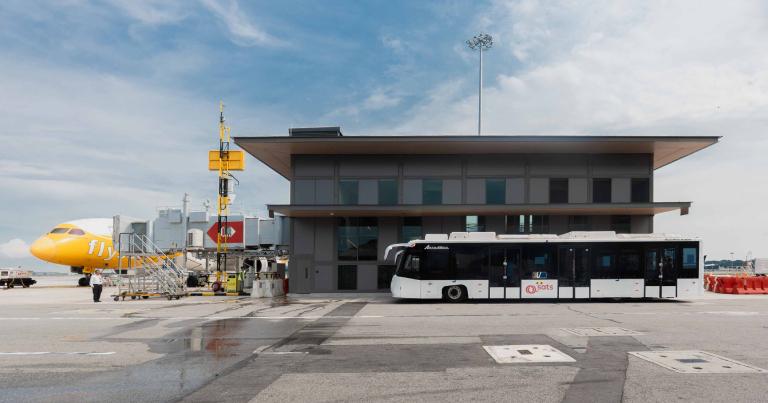
Changi Airport Group – a Headline Partner of APEX FTE EXPO Asia, Singapore, 18-19 November 2026 – has completed construction of its first satellite gate, a standalone remote boarding and disembarkation facility designed to enhance the passenger experience for flights assigned to remote aircraft parking stands. Preparations to ensure operational readiness are currently underway, with use of the gate for selected flights set to commence by August 2026.
Located in the airfield, the satellite gate is equipped with two aerobridges. It provides a fully sheltered, all-weather walkway for boarding and disembarkation, offering a more seamless and comfortable journey for travellers.
Today, around 98% of passenger flights at Changi use contact gates with aerobridges at the terminals. For the remaining flights, remote stands are assigned, requiring the bussing of passengers between the terminal and the aircraft. Remote stands are an integral part of Changi’s operating model, enabling the airport to maximise the use of available apron space during peak periods of the day to support the growing needs of airlines. The satellite gate extends the benefits and comfort of aerobridges to flights operating at a remote stand.
With a floor area of 200sqm, the satellite gate is designed to support both narrow and wide-body aircraft operations. The air-conditioned building features an entrance canopy for passengers to board and disembark from buses sheltered from the elements. Access to the aircraft is via a ramp leading to two aerobridges on the upper level which provide passengers with full-shelter comfort throughout the aircraft boarding and disembarkation journey. A key feature of the satellite gate is its gently sloping 60m ramp, which improves accessibility for wheelchair users and makes it user-friendly for minors, seniors, families with strollers and those travelling with wheeled carry-on luggage. Buses will convey departing passengers from the terminal to the satellite gate when it is time for boarding. Arriving passengers will disembark into the facility before transferring to waiting buses for their journey to the terminal.
“Every element of the satellite gate has been designed with passenger experience, universal accessibility, staff-friendliness and operational practicality in mind,” said Koh Ming Sue, Executive Vice President, Engineering & Development, Changi Airport Group. “As we continue to enhance Changi’s infrastructure, we are also integrating environmental sustainability features and smart technology into new developments to reduce carbon emissions, strengthen operational resilience and improve service efficiency. We would like to thank our partners who have supported us in reinventing airport handling processes, which in this case, would make remote flight operations more seamless and pleasant.”
Beyond improving passenger experience, the facility also provides a more comfortable and sheltered working environment for airport staff deployed for remote flight operations, including aircraft ground handling personnel, passenger service officers, auxiliary police officers and aircraft cabin cleaning teams.
In line with Changi’s sustainability efforts, the satellite gate is designed as a zero-energy facility powered entirely by its rooftop solar panels. Electricity generated by the panels is stored in an off-grid battery system nearby, reducing reliance on the airport’s power supply and supporting more energy-efficient ground operations.
The satellite gate is also equipped with smart building features. Air-conditioning is automatically activated based on real-time flight information to ensure that the facility is ready to serve ahead of flight crew and passenger use while optimising energy consumption. Additionally, electrical faults can be detected and wirelessly transmitted to maintenance teams at the main terminal, enabling quicker response and rectification.
“As passenger traffic continues to grow ahead of the opening of Terminal 5 in the mid-2030s, remote stand facilities such as the satellite gate will play an increasingly important role in supporting Changi Airport’s operations especially during peak periods,” said Yeo Kia Thye, Managing Director, Airport Operations Control, Changi Airport Group. “These support our long‑term capacity planning by providing greater operational flexibility when contact gates are fully utilised, helping to ensure a smooth and seamless passenger journey.”
You may also be interested in
12 technology and CX trends that can enhance airline and airport operations in 2026
Vote now: What will be aviation’s most game-changing technology over the next 20 years?