





Summary:
- Changi Airport and SATS have begun the first phase of autonomous wheelchair deployment following successful trials, improving mobility support for passengers with reduced mobility.
- The autonomous wheelchairs help passengers navigate terminals more independently while enabling ground staff to provide more personalised assistance where needed.
- The initiative combines automation, accessibility and operational efficiency as Changi prepares for growing demand for special assistance services.
Changi Airport Group (CAG) – a Headline Partner of APEX FTE EXPO, taking place in Singapore on 18 to 19 November 2026 – together with ground handling partner SATS Ltd, is commencing the first phase of autonomous wheelchair deployment at Changi Airport following successful trials, to enhance the travel experience for passengers with reduced mobility (PRMs).
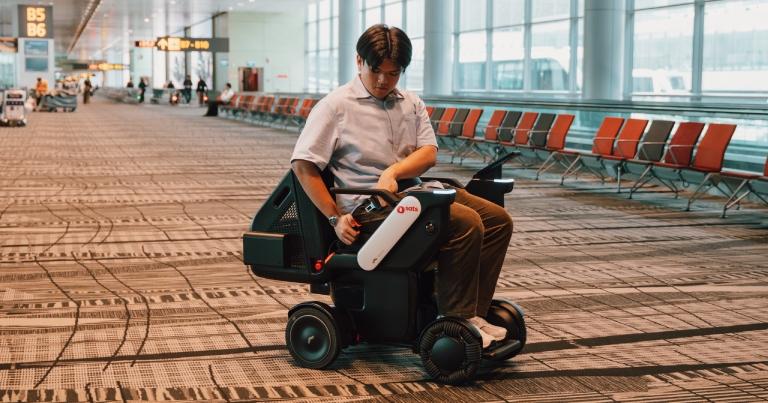
The autonomous wheelchairs, which are operationalised and managed by SATS, enable PRMs to move through the terminals more independently, reducing reliance on one-to-one staff assistance. This service complements existing support for PRMs, enabling ground staff to focus on those who require higher levels of care and assistance.
Demand for special assistance services is expected to increase with an ageing population profile and as air travel continues to grow. Changi Airport recorded a 20% increase in requests for wheelchair assistance between 2023 and 2025, reflecting the growing need for mobility support among travellers.
“At Changi Airport, we are committed to making travel more comfortable and convenient for every passenger,” said Damon Wong, Senior Vice President, Airport Operations Planning, CAG. “For those with reduced mobility, navigating a large airport can be challenging. The autonomous wheelchairs offer these passengers greater independence and convenience, while enabling frontline staff to provide more dedicated care to those who require higher levels of need. This marks another milestone chapter in our CARE@Changi journey and reflects our ongoing efforts to strengthen the mobility assistance and explore innovative solutions as demand continues to grow.”
The autonomous wheelchair service deployment is an investment under SATS’ Hub Handler of the Future operating model. Supporting about 10% of daily mobility assistance demand in Changi, it reinforces Changi’s efforts to make air travel more inclusive and seamless, by leveraging automation and technology to strengthen operational efficiency and support the growing demand for mobility assistance services.
Designed to help passengers get around the terminals safely and comfortably, the autonomous wheelchair uses advanced sensors to detect obstacles and human traffic while navigating customised routes. Its omni-directional wheels enable smooth and precise manoeuvring. Safety features include seatbelt monitoring, which allows the wheelchair to move only when the seatbelt is securely fastened, as well as an emergency stop button and an assistance call function. A rear basket accommodates cabin-sized luggage.
The autonomous wheelchairs are programmed to transport PRMs along predefined routes within departure transit areas. Each journey is monitored by a SATS ground handling supervisor at a control centre. By automating selected wheelchair journeys, the technology complements frontline staff, enables more efficient resource deployment and strengthens the sustainable delivery of mobility assistance services as demand grows.
Launched in Terminal 3 in March 2025 and later expanded to Terminal 2, the trials tested the autonomous wheelchair technology across diverse operating environments and passenger journeys. More than 13,000 passengers have used the autonomous wheelchairs since the trials began. Selected PRMs travelling on participating flights who required wheelchair assistance and could walk short distances independently were invited to participate. Trained staff were available throughout the journey to provide support where required.
Prior to the passenger trials, CAG led the initial phase of testing to ensure that the autonomous wheelchairs could operate safely within the airport environment. Together with SATS, this included assessment of speed controls, passenger safety and comfort, obstacle detection and navigation performance. CAG also organised learning visits and industry engagements to assess how autonomous wheelchairs were used at other airports and evaluate their suitability for Changi.
“This deployment marks another milestone in our ‘Hub Handler of the Future’ journey, where automation and our people work together to deliver enhanced passenger experiences,” said Edwin Tan, Vice President, APS and Terminal Services, SATS. “In the first phase of the roll-out of autonomous wheelchairs at Changi Airport, we are adding a new mobility solution that complements our existing fleet of manual wheelchairs, buggies and e-Caddies, giving transfer passengers with reduced mobility more choice while equipping our workforce with new skills to work alongside advanced technologies. Through a centralised operations model, we can intelligently deploy autonomous wheelchairs and other mobility assets across Terminals 2 and 3 based on real-time demand, improving resource utilisation, operational efficiency and service responsiveness. SATS is setting a new benchmark for accessible, seamless and future-ready ground services.”
You may also be interested in
12 technology and CX trends that can enhance airline and airport operations in 2026
FTE World Innovation Summit relocates to Tokyo for 2027 edition hosted by Haneda Airport – 1-3 March
Vote now: What will be aviation’s most game-changing technology over the next 20 years?