




Summary:
- NetForecast’s QMap Airport identifies cellular network congestion affecting baggage scan uploads and aircraft turn times at a US mid-Atlantic airport.
- Comparative airport network data found Verizon was 60% slower than FirstNet during peak hours, with DNS lookup times twice as long.
- Multi-provider wireless performance monitoring can help airports resolve connectivity issues, optimise ground operations and keep flights on schedule.
Baggage handlers at a US mid-Atlantic airport recently experienced trouble uploading baggage scans at several gates during peak hours. The problem was slowing aircraft turn times and frustrating ground ops personnel between 10:00 and 18:00. Although cellular signal strength was strong, uploads were failing.
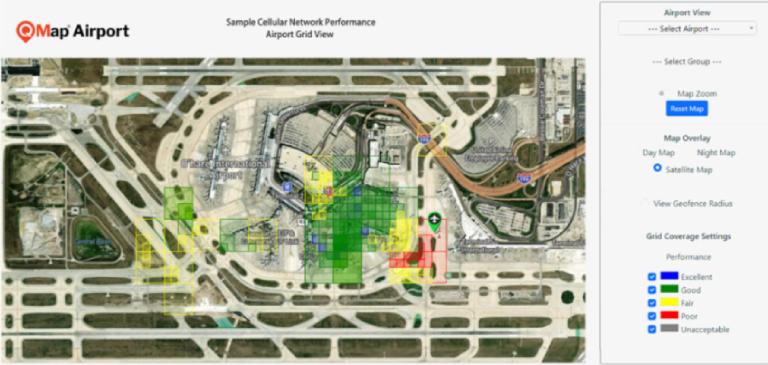
NetForecast’s QMap Airport wireless network quality mapping and alerting service pinpointed the problem and showed it to be due to network congestion during peak times. A side-by-side comparison using the QMap Airport portal showed that Verizon, the primary provider, was 60% slower, and DNS lookup times were 2X longer than FirstNet during peak hours. Additionally, network bandwidth was insufficient to support the number of connected devices. QMap Airport data showed that switching to FirstNet and addressing the network bandwidth shortfall would help alleviate the problem and keep flights on schedule in the problematic area.
NetForecast’s vast collection of data shows that no single cellular provider performs best at all airports. Even stations with excellent coverage have areas with inadequate wireless network performance, and concurrent evaluation of multiple cellular providers enables quick corrective action to optimise aircraft turn times. The data also shows that provider-based field surveys are often inadequate to diagnose performance issues.
You may also be interested in
12 technology and CX trends that can enhance airline and airport operations in 2026
FTE World Innovation Summit relocates to Tokyo for 2027 edition hosted by Haneda Airport – 1-3 March