





Summary:
- Vienna Airport has installed new CT scanners across all terminals, enabling passengers to keep laptops, mobile phones and liquids in their hand luggage during security screening.
- The €25 million investment includes 35 CT units and introduces an expanded liquids allowance of up to two litres for departing passengers.
- The upgrade enhances security efficiency and passenger convenience while supporting Vienna Airport’s strategy to become one of Europe’s most modern hubs.
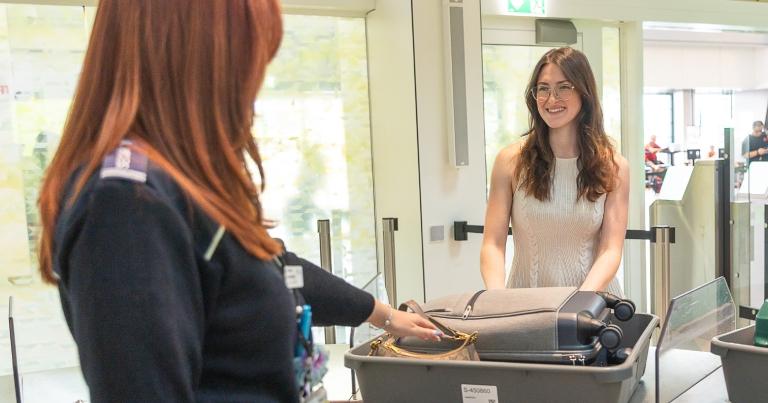
Vienna Airport – a Corporate Partner of the FTE Digital, Innovation & Startup Hub – has enhanced the security experience for travellers with the installation of new CT scanners at the central security checkpoints in all terminals. This means all departing passengers are able to leave electronic devices such as laptops and mobile phones, as well as liquids, in their hand luggage during security screening. In addition, an extended liquids regulation now applies at Vienna Airport: liquids with a volume of up to two litres may be carried in hand luggage. In total, Vienna Airport is investing around €25 million in the transition to the new CT technology, with 35 units purchased for this purpose. The new CT scanners will also be used in the new Terminal 3 southern expansion, which is scheduled to open in the second quarter of 2027.
“Our passengers already benefit from an average waiting time of only around five minutes at the security checkpoints – a top performance by European standards,” said Julian Jäger, Joint CEO and COO, Vienna Airport. “With the full commissioning of the new CT scanners, we are making security checks significantly easier and more efficient just in time for the start of the holiday season. This modern technology simplifies the process for our passengers and enhances the quality of security screening. In doing so, we are taking another important step towards positioning Vienna Airport as one of the most modern and convenient hubs in Europe. Nevertheless, due to the high volume of travel expected on the first holiday weekend, we recommend that passengers allow a little more time for check-in, security screening and any necessary border controls, and arrive at the airport slightly earlier.”
The new devices use computed tomography to generate detailed 3D images of hand luggage. This provides security staff with all relevant information about a piece of baggage in a single display. In addition, intelligent algorithms support the detection of solid and liquid explosives, while alarms are displayed directly on the monitors in relation to the specific object concerned.
You may also be interested in
12 technology and CX trends that can enhance airline and airport operations in 2026