





Summary:
- Schiphol has begun operating the world’s first electric TaxiBot, enabling Airbus A320 aircraft to taxi to the runway without using their engines.
- The initiative, launched with easyJet, Airbus and Menzies Aviation, can reduce fuel consumption by up to 65% on longer taxi routes while lowering CO₂, NOx and particulate emissions.
- The electric TaxiBot supports Schiphol’s sustainability goals by improving air quality, reducing apron noise and creating a healthier working environment for ground staff.
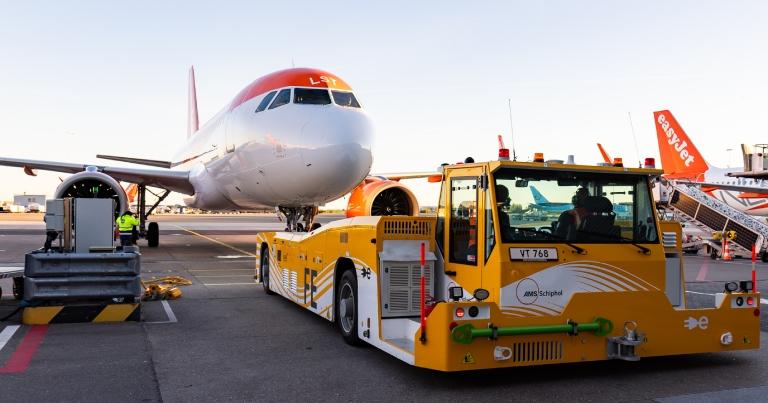
Schiphol – a Corporate Partner of the FTE Digital, Innovation & Startup Hub and a member of the FTE Smart Ramp programme – is taking the next step towards more sustainable and cleaner taxiing. The airport – together with easyJet, Airbus, and Menzies – has started using the world’s first electric TaxiBot. When the Polderbaan Runway is in use, it transports Airbus A320 aircraft from the gate to the runway. The electric TaxiBot is an addition to the two hybrid TaxiBots that have been transporting KLM Boeing 737s to the Polderbaan since 2022.
Schiphol deploys the TaxiBot on the Polderbaan Runway because this is the runway with the longest taxi time. As a result, potential fuel savings can reach up to 65%. Lower kerosene consumption means reduced emissions of CO₂, nitrogen oxides (NOx) and (ultra) fine particles. This reduction is important for the environment and, above all, better for employees on the ground. Lower emissions result in cleaner air and less noise on the apron, which directly contributes to a safer, healthier and more pleasant workplace.
The TaxiBot, powered by supplier Smart Airport Systems, is a special tug that can move aircraft from the gate to the runway at speeds of up to 23 knots (42 km/h). The pilot controls the TaxiBot from the cockpit and only starts the aircraft engines just before departure on the runway. An employee sits in the TaxiBot and drives the vehicle back to the gate for the next flight after uncoupling.
“By deploying the TaxiBot, we’re taking another practical step towards reduced emissions and noise on the apron,” said Esmé Valk, Chief People & Transformation Officer, Royal Schiphol Group. “This is how we’re creating a healthier and cleaner workplace, and an ever more sustainable and modern airport that is ready for the future.”
Schiphol currently has the world’s only electric TaxiBot and is using it to gain practical experience. Another three electric TaxiBots are expected to arrive later this year. This will allow deployment to be expanded to more aircraft types. Schiphol is working on the certification for Embraer aircraft with KLM Cityhopper and other parties. Transavia will soon participate with its Boeing 737 fleet.
“With TaxiBot, we are taking a tangible step towards making our operations at Schiphol more efficient,” said William Vet, Local Director accountable for Netherlands and Scandinavia, easyJet. “We are currently rolling out the technology on four of our Airbus A320neo aircraft, allowing planes to taxi to the runway without using their engines. This immediately leads to lower fuel consumption, emissions, and ground noise. This is only possible thanks to the commitment of our partners, and in particular the Menzies Aviation team, who play a crucial role in our ground operations.”
Groundbreaking FTE Smart Ramp program, accelerating automation and collaborative innovation
Smart Ramp is the latest initiative as part of the groundbreaking FTE Accelerating Collaboration & Engagement (ACE) platform launched in partnership with innovation consultancy nlmtd. ACE is dedicated to driving real collaborative action among stakeholders, facilitating fast progress and dynamic change in key areas of the aviation industry which are ripe for transformation. International Airlines Group, Miami International Airport, All Nippon Airways, Royal Schiphol Group, KLM Royal Dutch Airlines, and Metropolitan Washington Airports Authority are all members of what is a truly global collaborative innovation initiative.
The focus on Smart Ramp operations has the ultimate goal that aircraft turnaround can be achieved autonomously and more efficiently. A phased approach will assess which solutions truly work by each member testing new technologies, while incorporating requirements from the other participants. The program will support startups and introduce new suppliers not yet active in aviation, forging paths together on how to overcome hurdles while also exploring the potential for shared investments in the future. Results of the innovations will be shared with respective experts, industry bodies and regulators, meaning the outcomes can be used to create recommended practices and standards in the industry.
Rapid progress has been made since the launch of Smart Ramp. The innovation challenges include Schiphol Group and KLM collaborating on autonomous FOD detection and removal for a seamless inbound aircraft flow, reducing wait times, lowering apron emissions, and improving worker health; and autonomously connecting aircraft to 400Hz power to reduce apron emissions and create a healthier work environment for staff.
Learn more about Smart Ramp and the FTE Accelerating Collaboration & Engagement (ACE) platform and how to participate >>You may also be interested in
12 technology and CX trends that can enhance airline and airport operations in 2026
FTE launches new podcast to explore the realities of successful innovation
ADR, MUC, AMS, IST, LHR, DOH & more among FTE Airport Digital Transformation Power List EMEA 2026