





Summary:
- iGA Istanbul Airport has become the world’s first mega-airport to meet 100% of its electricity needs through solar energy, powered by its 240 MW Eskişehir Solar Power Plant.
- The €220 million renewable energy project is among the largest in the global aviation sector and supports iGA’s ambition to achieve Net Zero emissions by 2050.
- The solar power plant is expected to prevent approximately 212,800 tonnes of CO₂ emissions annually, helping position iGA 30-40% ahead of its Net Zero roadmap.
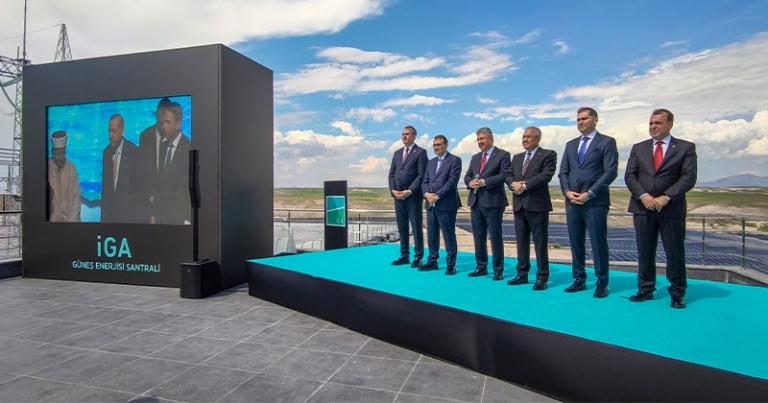
iGA Istanbul Airport’s Eskişehir Solar Power Plant (SPP), which strengthens the airport’s sustainability vision through energy transition investments, stands as one of the largest renewable energy projects in the global aviation sector, with a total investment of €220 million, an installed capacity of 240 MW, and a site covering approximately 3 million square metres. The official inauguration of the Eskişehir SPP took place during the ‘2025 Renewable Energy Investments Collective Opening Ceremony’, held with the participation of President Recep Tayyip Erdoğan.
Having set globally exemplary standards in sustainability since its founding, iGA Istanbul Airport has become the world’s first mega-airport to meet 100% of its electricity needs from solar energy, thanks to its Eskişehir Solar Power Plant with a total installed capacity of 240 MW.
Through this project, iGA Istanbul Airport now sources all electricity used in its operations from renewable energy, marking a landmark achievement and a critical milestone on its path toward the 2050 Net Zero emissions target.
As of 2026, iGA Istanbul Airport runs its operations entirely on green energy and is 30-40% ahead of its 2050 Net Zero emissions roadmap, redefining global sustainability standards through the Eskişehir SPP – one of the most strategic steps in its energy transition and decarbonisation journey.
“Our Eskişehir Solar Power Plant, which came online in 2025, is the strongest reflection of our sustainability-centred approach,” said iGA Istanbul Airport CEO Selahattin Bilgen. “Within just five months, the SPP generated energy equivalent to 54% of our total annual electricity consumption. By 2026, we are now able to meet 100% of our electricity needs within our scope of responsibility from solar energy. This means one of the world’s largest airports is powered entirely by 100% renewable electricity – a first in the history of aviation.”
Emphasising that this achievement carries meaning beyond the numbers, Bilgen noted that the SPP investment prevents 212,800 tonnes of CO₂ emissions annually. He added that Scope 1 and 2 emissions have been reduced by 27.8% compared to the 2019 baseline, and that the airport is 30-40% ahead of its 2050 Net Zero emissions roadmap. “We are well ahead of the transformation pace envisioned by European airports. This is a source of pride for us and a powerful motivation to take even greater strides. The Eskişehir SPP has become a reference point – not just for iGA, but for all energy-intensive industries. As the first institution to achieve this transformation at airport scale, we firmly believe that we do not have to choose between growth and protecting our planet. With the right vision, the right technology and a determined will, both are possible together. A cleaner future is not an unattainable ideal – it is a reality we are putting into practice today.”
iGA Istanbul Airport supports its growth with investments that reduce environmental impact and contribute to the preservation of natural resources. Under its ‘Protecting the World’ strategy, the Eskişehir SPP is projected to prevent approximately 212,800 tonnes of CO₂ emissions annually. As it progresses toward its 2050 Net Zero emissions commitment, iGA Istanbul Airport has also raised its 2030 renewable energy target from 50% to 90%.
To preserve the unique architectural design and aesthetic integrity of the terminal building, solar panels were installed at the Eskişehir plant site rather than on the terminal roof.
You may also be interested in
12 technology and CX trends that can enhance airline and airport operations in 2026
FTE launches new podcast to explore the realities of successful innovation